

Archive position — measured, not model output
2 likes on Devpost
221 of the 7,850 archived projects have more likes, and 284 share exactly 2 — so this project's #496 place in the like-ranked listing is a tie-break inside that group, not a ranking.
Projects (log scale)
Likes on Devpost. ▲ marks this project's group.
Show the figures
| Likes | Projects | Share of archive |
|---|---|---|
| 0 | 5,587 | 71.2% |
| 1 | 1,758 | 22.4% |
| 2 | 284 | 3.6% |
| 3–4 | 132 | 1.7% |
| 5–9 | 75 | 1.0% |
| 10+ | 14 | 0.2% |
 User Stories BotA demo video on every pull request
Get a demo video on every new feature
GitHub App that watches your pull requests and records a narrated, captioned demo.
Save time on demo prep and make informed decisions faster with a video walkthrough of every new feature.
Executive Summary
What the company appears to be
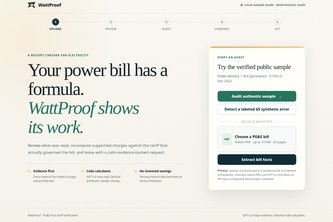
WattProof is a self-reported Python-based tool that allows users to upload an electricity bill and receive automated error detection via GPT-5.6 and deterministic code checks against tariff data. It claims to flag billing errors, draft review requests, and operate with a focus on transparency and reproducibility.
What changed
The project description is a self-reported submission for the OpenAI 2026 hackathon. No prior version or evolution is described; it appears to be a new build.
Single most important open question
Is there any evidence of traction, revenue, or customer adoption beyond the author's own account?
Analysis basis
The entire analysis is based on the self-reported project description provided by the caller. All claims are unverified and must be treated as stated by the author only. No third-party data, financials, customers or historical context are available.
What The Product Actually Is
The description states that WattProof is a small Python application built with:
- Flask (for a framework-free responsive interface)
- Pydantic (to define versioned contracts for extraction, evidence, tariff, audit, comparison, and review-request)
- Python Decimal code (for money arithmetic with explicit rounding)
- GPT-5.6 (via OpenAI API) to map unknown native-PDF text into typed evidence
- Codex (used in primary build session)
It runs entirely locally for the bundled public sample without an API key.
Inference The product is described as a proof-of-concept or prototype, not a production-ready SaaS offering. It is not evidenced to be used by customers or deployed beyond the author’s own environment.
Positioning & Claim Evolution
The description states that WattProof:
- Uses GPT-5.6 to extract evidence from PDFs
- Does not calculate charges or invent missing data
- Flags errors using deterministic code checks against tariffs
- Drafts review requests citing exact lines and sources
- Operates with a focus on truth, reproducibility, and transparency
Key claims include:
- “Effective-period truth” — newer tariffs are not applied if they didn’t govern the bill
- “Evidence before automation” — users can correct facts before conclusions
- “Deterministic money” — GPT reads evidence; code owns arithmetic
- “Visible uncertainty” — unsupported riders and insufficient data remain explicit
- “Action without overclaiming” — final request asks for review, not resolution
Claim vs. Fact
These are self-stated positioning elements, not verified claims of traction or customer validation.
Target Customer & ICP
The description does not state who the intended users are beyond the general context of electricity bill auditing.
Not evidenced No specific customer profile, persona, or ICP is described.
Business Model & Pricing Evidence
There is no evidence in the description of:
- A pricing model
- Revenue streams
- Monetization strategy
- Customer acquisition costs
- Any commercial arrangement
Not evidenced The business model and pricing are not described.
Technical & Delivery Signals
The project is built with:
- Flask (web framework)
- Python (core logic)
- Pydantic (schema validation)
- GPT-5.6 via OpenAI API
- Codex (used in development)
- JavaScript (for UI, implied)
It includes:
- Versioned contracts for data types
- SHA-256 hashes for source snapshots
- Local execution for sample documents
- Regression testing with golden and synthetic fixtures
Inference The tool is described as a minimal prototype built for demonstration or hackathon use. It is not evidenced to be in production, scalable, or integrated into any larger platform.
Traction & Maturity Signals
The description states:
- Team size: 2
- Built for the OpenAI 2026 hackathon
- No revenue, customers, or adoption data are mentioned
- The sample is bundled and runs locally without API key
Not evidenced There is no evidence of traction, usage, or product maturity beyond the author’s own account.
Competitive Context
The description does not mention:
- Competitors
- Market size
- Existing solutions in the electricity bill auditing space
- Product differentiation from other tools
Not evidenced No competitive landscape or positioning relative to existing players is described.
Open Questions & Risks
- The project is a self-reported hackathon submission with no evidence of commercial traction.
- GPT-5.6 is used for extraction but not for decision-making or calculation.
- No customer data, revenue, or usage metrics are provided.
- The tool is described as a prototype with local execution and no API integration.
- The team size is small (2 people), which may imply limited scalability or resources.
Inference The lack of any commercial evidence raises questions about viability, market fit, and potential for growth.
Questions the description leaves open
- What is the intended customer segment and how did you identify them?
- Are there any real-world users or test cases beyond the sample bill provided?
- How do you plan to monetize this tool if it remains a prototype?
- Is there any intention to scale beyond the current local execution model?
- What are your plans for integrating with utility providers or billing systems?
Overall Assessment
There is no evidence of revenue, customer adoption, or commercial traction. The project is described as a hackathon submission and prototype built by two individuals.
Assessment Not evidenced to be a viable investment or partnership opportunity at this stage. The product lacks any demonstrated market demand or business model.
User Stories BotA demo video on every pull request
Get a demo video on every new feature
GitHub App that watches your pull requests and records a narrated, captioned demo.
Save time on demo prep and make informed decisions faster with a video walkthrough of every new feature.
Source
Submitted to the OpenAI 2026 hackathon on Devpost. Project home on Devpost. Back to the full gallery on Devpost.
This competitive analysis was produced by top-founders.com (opens in a new tab)
Generated by a language model from this project's public Devpost page — its tagline, the author's own write-up and any built-with tags listed there — as captured in August 2026. Short quotations are the author's words. It is an opinion on the idea as a business, not on the people behind it, and it reflects the description as published then. If the project has moved on, request a correction below. The analysis is not independent research and contains no verified traction, revenue or customer data.
An independent guide by KFG International LLC — not affiliated with, endorsed by, or connected to Devpost or OpenAI.