

Archive position — measured, not model output
0 likes on Devpost
2,263 of the 7,850 archived projects have more likes, and 5,587 share exactly 0 — so this project's #7,613 place in the like-ranked listing is a tie-break inside that group, not a ranking.
Projects (log scale)
Likes on Devpost. ▲ marks this project's group.
Show the figures
| Likes | Projects | Share of archive |
|---|---|---|
| 0 | 5,587 | 71.2% |
| 1 | 1,758 | 22.4% |
| 2 | 284 | 3.6% |
| 3–4 | 132 | 1.7% |
| 5–9 | 75 | 1.0% |
| 10+ | 14 | 0.2% |
 User Stories BotA demo video on every pull request
Get a demo video on every new feature
GitHub App that watches your pull requests and records a narrated, captioned demo.
Save time on demo prep and make informed decisions faster with a video walkthrough of every new feature.
Executive Summary
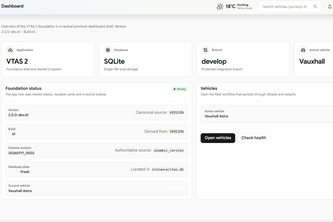
VTAS – Vehicle Telemetry Analytics System is a self-reported project submitted by Joshua Levy to the OpenAI 2026 hackathon. The description states that VTAS transforms OBD-II vehicle data into actionable insights, helping drivers analyse journeys, fuel economy, vehicle health and maintenance while keeping data private.
The author describes it as a system built with Python, Flask, SQLite, and OpenAI tools like ChatGPT and Codex, using technologies such as HTML5, CSS3, JavaScript, and Jinja. It is presented as an application that processes vehicle telemetry data from OBD-II ports, which are standard diagnostic connectors found in most vehicles manufactured after 1996.
The project appears to be a proof-of-concept or prototype built during a hackathon, with no evidence of commercial traction, revenue, customers, or product-market fit. The author is the sole team member, and there is no indication of funding, partnerships, or market validation.
The single most important open question
What is the actual functionality and value proposition of VTAS beyond its self-reported description? Is it a working prototype that can be scaled into a commercial product, or merely an idea with limited technical execution?
What The Product Actually Is
The description states: “VTAS transforms OBD-II vehicle data into actionable insights.” It is described as a system helping drivers analyse journeys, fuel economy, vehicle health and maintenance while keeping data private.
- Claimed functionality: VTAS processes OBD-II data to provide insights on driving behavior, fuel efficiency, and vehicle diagnostics.
- Technology stack: Built with Flask (Python web framework), SQLite (database), HTML5/CSS3/JavaScript (frontend), Jinja (templating), Alembic (database migrations), pytest (testing), Git/GitHub (version control), OpenAI tools like ChatGPT and Codex for code generation, and CSV handling.
- Not evidenced The actual data pipeline, how the OBD-II interface is connected or read, whether it supports real-time telemetry, or if it integrates with mobile apps or dashboards.
Inference Based on the technology stack and the mention of OBD-II, VTAS likely involves reading vehicle diagnostic data through a physical or virtual connection, processing that data using Python-based tools, and presenting insights via a web interface. However, this is not confirmed by the description.
Positioning & Claim Evolution
The author states: “VTAS transforms OBD-II vehicle data into actionable insights, helping drivers analyse journeys, fuel economy, vehicle health and maintenance while keeping data private.”
- Positioning claim: VTAS is positioned as a tool for individual drivers to gain visibility into their vehicle usage and performance.
- Value proposition: It emphasizes privacy of data and actionable insights derived from OBD-II telemetry.
- Not evidenced No information on how VTAS differentiates from existing solutions (e.g., apps like Fuelly, CarFax, or DashCommand), nor whether it offers unique features beyond basic data logging.
Inference The positioning is generic — a driver analytics tool with privacy focus. It may be attempting to appeal to environmentally conscious or cost-conscious drivers, but the description does not clarify how VTAS stands out in the crowded space of vehicle diagnostics and fuel tracking tools.
Target Customer & ICP
The author states: “VTAS helps drivers analyse journeys, fuel economy, vehicle health and maintenance.”
- Target customer: Individual drivers.
- ICP claim: Drivers who want to monitor their vehicle’s performance, fuel usage, and maintenance needs.
- Not evidenced No segmentation of the target market (e.g., commercial fleet owners, car enthusiasts, eco-conscious users), no evidence of user personas or buyer motivations.
Inference The ICP appears to be a general consumer audience interested in vehicle analytics. However, without further detail, it's unclear whether VTAS targets niche segments like fuel efficiency-focused users or broader driver populations.
Business Model & Pricing Evidence
The description does not state anything about pricing, monetization, or business model.
- Not evidenced No mention of subscription tiers, freemium models, B2B vs. B2C offerings, or revenue streams.
- Claim: The product is described as a hackathon submission, implying no commercial model has been implemented.
Inference If VTAS is intended to be monetized, it likely would follow a consumer-facing model (e.g., freemium or one-time purchase), but there is no evidence of this in the description.
Technical & Delivery Signals
The author states: “Built with (author-declared): alembic, chatgpt, codex, css3, csv, flask, git, github, html5, javascript, jinja, material, openai, pytest, python, sqlalchemy, sqlite, symbols.”
- Technology stack: Python-based web app using Flask and SQLite, with frontend components in HTML/CSS/JS.
- Tools used: OpenAI tools (ChatGPT, Codex) for code generation; Git/GitHub for version control.
- Not evidenced No information on scalability, data security, API design, or integration capabilities beyond OBD-II.
Inference VTAS appears to be a small-scale prototype built quickly using modern development tools and frameworks. It likely lacks enterprise-grade features or robust infrastructure, consistent with a hackathon project.
Traction & Maturity Signals
The description states: “This project was submitted to the OpenAI 2026 hackathon on Devpost.”
- Traction: None evidenced.
- Maturity: The product is described as a hackathon submission — implying early-stage development.
- Not evidenced No user feedback, customer interviews, or usage metrics; no evidence of product-market fit or adoption.
Inference VTAS is at a very early stage. It has not progressed beyond the prototype phase and shows no signs of traction or commercial viability.
Competitive Context
The description does not mention any competitors.
- Not evidenced No comparison to existing vehicle telemetry or analytics platforms (e.g., Fuelly, CarFax, DashCommand, etc.).
- Inference: VTAS likely competes in a space with many established players, but the author provides no evidence of awareness or differentiation from them.
Open Questions & Risks
- Risk 1: The project is described as a hackathon submission — not a commercial product.
- Risk 2: No evidence of data privacy implementation beyond stating it “keeps data private.”
- Risk 3: No evidence of OBD-II hardware integration or real-time telemetry capabilities.
- Risk 4: No mention of scalability, security, or long-term roadmap.
- Open Question: The sole team member (Joshua Levy) may not have the bandwidth to develop a full product.
Inference VTAS is likely an experimental idea with limited execution. It does not appear to be a viable commercial product as described.
Questions the description leaves open
- What specific OBD-II protocols or data points does VTAS read and interpret?
- How does VTAS connect to the vehicle — via physical OBD-II port, Bluetooth, or virtual simulation?
- Is there a plan for monetization or commercial deployment?
- What is the expected user journey from connecting a vehicle to viewing insights?
- How does VTAS ensure data privacy and security in its architecture?
- Are there any existing users or pilot programs?
- What are the technical limitations of the current prototype?
Overall Assessment
The description states that VTAS is a hackathon submission, built by one person using OpenAI tools and standard web development frameworks.
- Not evidenced No commercial traction, revenue, or customer base.
- Assessment: At this stage, VTAS appears to be an idea or prototype with no clear path to product-market fit or scalability. It is not a viable investment or partnership opportunity based on the information provided.
Inference VTAS may evolve into something valuable if further developed, but as described, it is not ready for commercialization or investment consideration.
User Stories BotA demo video on every pull request
Get a demo video on every new feature
GitHub App that watches your pull requests and records a narrated, captioned demo.
Save time on demo prep and make informed decisions faster with a video walkthrough of every new feature.
Source
Submitted to the OpenAI 2026 hackathon on Devpost. Project home on Devpost. Back to the full gallery on Devpost.
This competitive analysis was produced by top-founders.com (opens in a new tab)
Generated by a language model from this project's public Devpost page — its tagline and any built-with tags listed there, since the author published no write-up — as captured in August 2026. Short quotations are the author's words. It is an opinion on the idea as a business, not on the people behind it, and it reflects the description as published then. If the project has moved on, request a correction below. The analysis is not independent research and contains no verified traction, revenue or customer data.
An independent guide by KFG International LLC — not affiliated with, endorsed by, or connected to Devpost or OpenAI.