

Archive position — measured, not model output
0 likes on Devpost
2,263 of the 7,850 archived projects have more likes, and 5,587 share exactly 0 — so this project's #3,689 place in the like-ranked listing is a tie-break inside that group, not a ranking.
Projects (log scale)
Likes on Devpost. ▲ marks this project's group.
Show the figures
| Likes | Projects | Share of archive |
|---|---|---|
| 0 | 5,587 | 71.2% |
| 1 | 1,758 | 22.4% |
| 2 | 284 | 3.6% |
| 3–4 | 132 | 1.7% |
| 5–9 | 75 | 1.0% |
| 10+ | 14 | 0.2% |
 User Stories BotA demo video on every pull request
Get a demo video on every new feature
GitHub App that watches your pull requests and records a narrated, captioned demo.
Save time on demo prep and make informed decisions faster with a video walkthrough of every new feature.
Executive Summary
What the company appears to be
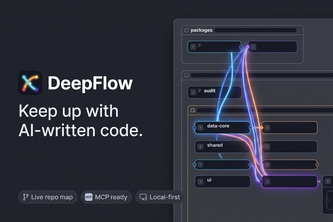
DeepFlow is a self-reported local Node.js application that provides a live visual map of code repositories, showing file structures, module calls, imports, and data flow traces. It uses Tree-sitter for parsing and Server-Sent Events (SSE) for real-time updates. The tool supports JavaScript, TypeScript, TSX, and Python, and includes an MCP server to enable interaction with AI agents.
What changed
The project was built during the OpenAI 2026 hackathon as a prototype addressing the challenge of keeping up with AI-generated code changes in complex systems. It aims to bridge the gap between human understanding and agent-driven development by offering both a visual architectural map and an MCP interface for agents.
Single most important open question
Is there any evidence of usage beyond the hackathon, or traction from developers using DeepFlow in real-world workflows?
What The Product Actually Is
The description states that DeepFlow is a local Node.js application with a browser-based architecture canvas, designed to visualize code repositories. It parses JavaScript, TypeScript, TSX, and Python using Tree-sitter and streams changes via Server-Sent Events (SSE). It includes features such as:
- Mapping folders, files, modules, calls, imports, events, and diagnostics.
- Tracing upstream and downstream relationships from a file or module.
- Watching local edits and highlighting changed files and updated relationships.
- Providing an MCP server to allow agents to interact with the workspace (e.g., open workspace, explain flows, surface impact, jump to exact file/module).
- Supporting source inspection, pins, search, minimap navigation, Git diffs, themes, and animated trace signals.
Inference The product is described as a local tool that does not upload code to any service. It is built for developers working in environments where AI agents are rapidly modifying code and where understanding the impact of those changes is difficult.
Positioning & Claim Evolution
The author claims DeepFlow addresses a bottleneck in AI-assisted development: while AI agents can write code faster than humans, understanding what changed and how it affects the system becomes the new challenge. The tool is positioned as:
- A live architectural map that updates in real time with agent edits.
- A dual-purpose solution for both human developers and AI agents.
- An MCP-compatible interface that allows agents to query, navigate, and update the visual architecture.
The positioning evolved from a problem statement (AI writes faster than humans can follow) to a solution (a live map with MCP integration). The author references Peter Steinberger’s tweet about “graph engineering” as context for this shift in workflow.
Inference The product is framed as a response to the growing complexity of AI-assisted workflows and the need for tools that support both human comprehension and agent interaction.
Target Customer & ICP
The description states that DeepFlow targets developers working with AI agents, particularly those who are:
- Working in complex codebases where understanding changes is difficult.
- Using AI agents to generate or modify code rapidly.
- Looking for a way to maintain a mental model of the system as it evolves.
It also implies a focus on developers using local repositories and tools like Codex and GPT-5.6, suggesting a developer-first audience with technical depth.
Inference The ICP is likely early-stage developers or teams working in AI-assisted development environments, especially those using agent-based workflows.
Business Model & Pricing Evidence
The description does not state anything about pricing, revenue, monetization, or business model. It only describes the tool’s functionality and how it was built.
Not evidenced.
Technical & Delivery Signals
DeepFlow is described as:
- A local Node.js application.
- Built with Tree-sitter, JavaScript, CSS, HTML, MCP, Node.js, Server-Sent Events.
- Uses semantic parsing instead of regex-based matching.
- Has a browser-based architecture canvas.
- Supports live updates via SSE.
- Includes an MCP server for agent interaction.
- Designed with hierarchy-first, graph-second principles.
The tool is said to be built using Codex and GPT-5.6, which were used as design and engineering collaborators during the hackathon.
Inference The technical stack suggests a developer-focused, local, and lightweight solution with real-time capabilities. It is not cloud-based or SaaS.
Traction & Maturity Signals
There is no evidence of traction, customers, revenue, or adoption beyond the hackathon submission. The project is described as a prototype built during a single hackathon event.
Not evidenced.
Competitive Context
The author states that most existing tools solve only one half of the problem: either visualizing architecture for humans or feeding context to agents. DeepFlow is positioned as a tool that does both at once.
No specific competitors are named, but the context implies a space involving:
- Code visualization tools.
- AI agent interfaces (e.g., MCP-compatible tools).
- Developer workflow tools in AI-assisted environments.
Inference The product is positioned to address a gap in tools that support both human understanding and agent-driven development — though no direct competitors are identified.
Open Questions & Risks
- No traction or usage beyond the hackathon.
- Unverified claims: All descriptions are self-reported, with no independent verification.
- Single-person team: The project is built by one individual (VANSH KUMAR SINGH).
- Limited scope: Only supports JavaScript, TypeScript, TSX, and Python.
- No monetization or business model described.
- MCP integration is a feature, but no evidence of adoption or compatibility with other tools.
Inference The lack of real-world usage, funding, or customer data raises concerns about viability beyond the prototype stage.
Questions the description leaves open
- Has DeepFlow been used in any real-world development workflows beyond the hackathon?
- What is the current status of the MCP server? Is it compatible with other agents or tools?
- Are there plans to support more languages beyond JavaScript, TypeScript, TSX, and Python?
- How does DeepFlow handle large-scale repositories or complex dependency graphs?
- What are the long-term goals for monetization or product development?
- Has the tool been tested with teams or in production environments?
Overall Assessment
The description is self-reported and unverified, and there is no evidence of traction, revenue, customers, or business model beyond a hackathon prototype.
Confidence: Low
This project appears to be an early-stage idea or prototype with strong technical execution in a niche area. However, without evidence of usage, adoption, or commercial viability, it is not ready for investment or partnership consideration at this stage.
Inference The tool may have potential as a developer utility in AI-assisted workflows, but its current status is that of an experimental prototype.
User Stories BotA demo video on every pull request
Get a demo video on every new feature
GitHub App that watches your pull requests and records a narrated, captioned demo.
Save time on demo prep and make informed decisions faster with a video walkthrough of every new feature.
Source
Submitted to the OpenAI 2026 hackathon on Devpost. Project home on Devpost. Back to the full gallery on Devpost.
This competitive analysis was produced by top-founders.com (opens in a new tab)
Generated by a language model from this project's public Devpost page — its tagline, the author's own write-up and any built-with tags listed there — as captured in August 2026. Short quotations are the author's words. It is an opinion on the idea as a business, not on the people behind it, and it reflects the description as published then. If the project has moved on, request a correction below. The analysis is not independent research and contains no verified traction, revenue or customer data.
An independent guide by KFG International LLC — not affiliated with, endorsed by, or connected to Devpost or OpenAI.