

Archive position — measured, not model output
0 likes on Devpost
2,263 of the 7,850 archived projects have more likes, and 5,587 share exactly 0 — so this project's #3,691 place in the like-ranked listing is a tie-break inside that group, not a ranking.
Projects (log scale)
Likes on Devpost. ▲ marks this project's group.
Show the figures
| Likes | Projects | Share of archive |
|---|---|---|
| 0 | 5,587 | 71.2% |
| 1 | 1,758 | 22.4% |
| 2 | 284 | 3.6% |
| 3–4 | 132 | 1.7% |
| 5–9 | 75 | 1.0% |
| 10+ | 14 | 0.2% |
 User Stories BotA demo video on every pull request
Get a demo video on every new feature
GitHub App that watches your pull requests and records a narrated, captioned demo.
Save time on demo prep and make informed decisions faster with a video walkthrough of every new feature.
Executive Summary
The company appears to be a solo-engineered project built by one individual (houssem elheni) for an OpenAI 2026 hackathon. The author states that it is a local-first, degraded-mode check-in system for airports, designed to operate under emergency conditions when normal infrastructure fails. It uses React/TypeScript frontend, Node.js backend, PostgreSQL, and Windows services, with Codex assisting in debugging and development.
The project is described as having no revenue, customers or traction beyond the author's own demo and submission to a hackathon. The system is built for local operation on a laptop with LAN access, supporting check-in desks, printing of boarding passes and baggage tags, and PNL import.
The single most important open question is: what is the actual commercial viability or adoption potential of this system? The description does not indicate any real-world deployment, customer feedback, or market traction. It is unclear whether this represents a prototype for a larger product, an experimental tool, or something intended for future commercialization.
This analysis is based entirely on self-reported information from the project description and author's own write-up. No independent verification or external data is available.
What The Product Actually Is
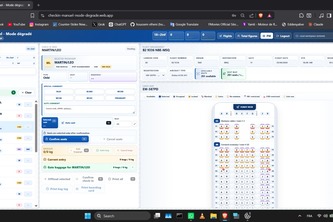
The description states that Degraded Mode Airport Check-in is a local-first check-in system designed to operate in emergency situations where normal infrastructure fails. It runs on a Windows laptop with local networking capabilities and supports multiple check-in desks over an isolated LAN.
Key technical components include:
- React/TypeScript frontend
- Node.js backend
- PostgreSQL database
- Windows service scripts
- PDF417 barcode printing support
- Local LAN access for multiple check-in counters
The system imports passenger PNL data, manages check-in processes, generates boarding passes and baggage tags, and produces operational reports. It is described as being able to run in "degraded mode" — meaning it can continue operations even when central servers or internet connectivity are unavailable.
Inferred: The product appears to be a software solution for airline operations during infrastructure failures, built with a focus on reliability and local operation rather than cloud-based or centralized systems.
Positioning & Claim Evolution
The author positions the system as an emergency check-in server that restores real airport operations using only a laptop. It is described as not being a toy demo but a practical solution for maintaining operational continuity under pressure.
Key claims:
- Built to handle real-world airport operations during infrastructure failures
- Operates locally without internet or central servers
- Supports multiple check-in desks over LAN
- Handles PNL imports, seat management, printing of boarding passes and baggage tags
- Can publish sanitized snapshots for remote support
Inferred: The positioning evolved from a hackathon submission to a practical engineering tool that addresses real operational needs in aviation. However, the description does not indicate any shift toward commercialization or broader market adoption.
Target Customer & ICP
The author states that the system is designed for airline operations during infrastructure failures, specifically targeting scenarios where normal check-in systems are unavailable.
Inferred: The primary customer segment appears to be:
- Airlines or airport operators
- Operations teams managing emergency situations
- IT departments seeking resilient local solutions
However, there is no evidence of specific customer interviews, market research, or actual users beyond the author’s own use case. The description does not mention any formal ICP (Ideal Customer Profile) or segmentation strategy.
Business Model & Pricing Evidence
There is no evidence in the description of a business model or pricing structure. The project is described as a hackathon submission with no indication of monetization, licensing, or customer acquisition plans.
The system is presented as a local-first solution that could potentially be sold to airlines for emergency preparedness, but no commercial details are provided.
Technical & Delivery Signals
The author reports:
- Built using React/TypeScript frontend and Node.js backend
- Uses PostgreSQL database
- Implements Windows service scripts for local operation
- Supports PDF417 barcode printing
- Handles LAN networking for multiple check-in desks
- Includes PNL data import functionality
- Features print-focused rendering logic
Codex was used heavily during development for:
- Debugging production issues
- Migrating the server to a replacement laptop
- Fixing barcode encoding problems
- Improving PNL parsing
- Adding baggage reporting
- Keeping the system stable under pressure
Inferred: The technical stack suggests a focus on reliability and local operation, with engineering support from AI tools like Codex. However, there is no evidence of scalability, performance testing, or integration with existing airline systems.
Traction & Maturity Signals
There is no evidence of traction or maturity beyond the author's own demo and hackathon submission. The system:
- Is described as a demo-only version
- Has no real passenger data or operational secrets included
- Was submitted to a single hackathon (OpenAI 2026)
- Has no customer base, revenue, or user feedback
The project is presented as a prototype with potential for future development but lacks any signs of market adoption or product-market fit.
Competitive Context
There is no evidence in the description of existing competitors or competitive landscape. The author does not reference similar systems or platforms in the aviation industry that might offer comparable functionality.
The system appears to be unique in its approach to local-first, degraded-mode check-in for emergency operations, but no indication exists whether such a niche exists or how it would compete with established airline IT solutions.
Open Questions & Risks
- No commercial traction or market validation: The project is described only as a hackathon submission with no real-world deployment.
- Single-person development: With only one team member, there may be limited capacity for scaling or long-term maintenance.
- Limited scope of functionality: The system appears to be designed specifically for emergency operations and may not address broader airline check-in needs.
- Unclear path to monetization: No evidence of a business model or pricing strategy.
- Dependency on niche use case: Emergency operations are rare, which could limit market size.
Questions the description leaves open
- What specific operational challenges in airport environments led you to build this system?
- Have you tested the system with actual airline partners or in real emergency scenarios?
- Is there a plan to transition from a demo version to a production-ready product?
- How does this solution integrate with or differ from existing airline IT systems?
- What are your plans for scaling, support, and ongoing maintenance of the system?
- Are you seeking partnerships or investment to commercialize this tool?
Overall Assessment
Not evidenced — There is no evidence of revenue, customers, traction, or financial performance beyond the author’s own description.
The project appears to be a solo-engineered hackathon submission with no indication of commercial viability or market demand. It is presented as a solution for emergency operations in aviation but lacks any signs of adoption, product development, or strategic positioning.
Given the lack of external validation and absence of commercial signals, there is insufficient basis to recommend investment or partnership at this time. Any potential value would depend on further development, testing, and market validation beyond the current self-reported scope.
User Stories BotA demo video on every pull request
Get a demo video on every new feature
GitHub App that watches your pull requests and records a narrated, captioned demo.
Save time on demo prep and make informed decisions faster with a video walkthrough of every new feature.
Source
Submitted to the OpenAI 2026 hackathon on Devpost. Project home on Devpost. Back to the full gallery on Devpost.
This competitive analysis was produced by top-founders.com (opens in a new tab)
Generated by a language model from this project's public Devpost page — its tagline, the author's own write-up and any built-with tags listed there — as captured in August 2026. Short quotations are the author's words. It is an opinion on the idea as a business, not on the people behind it, and it reflects the description as published then. If the project has moved on, request a correction below. The analysis is not independent research and contains no verified traction, revenue or customer data.
An independent guide by KFG International LLC — not affiliated with, endorsed by, or connected to Devpost or OpenAI.