

Archive position — measured, not model output
0 likes on Devpost
2,263 of the 7,850 archived projects have more likes, and 5,587 share exactly 0 — so this project's #5,654 place in the like-ranked listing is a tie-break inside that group, not a ranking.
Projects (log scale)
Likes on Devpost. ▲ marks this project's group.
Show the figures
| Likes | Projects | Share of archive |
|---|---|---|
| 0 | 5,587 | 71.2% |
| 1 | 1,758 | 22.4% |
| 2 | 284 | 3.6% |
| 3–4 | 132 | 1.7% |
| 5–9 | 75 | 1.0% |
| 10+ | 14 | 0.2% |
 User Stories BotA demo video on every pull request
Get a demo video on every new feature
GitHub App that watches your pull requests and records a narrated, captioned demo.
Save time on demo prep and make informed decisions faster with a video walkthrough of every new feature.
Executive Summary
The description states that Olympia Enterprise Supply Chain Suite is a self-reported suite of connected operations applications aimed at enterprise supply chain teams. The author describes it as a unified platform integrating ERP, warehouse execution, samples management, knowledge, feedback, and business intelligence — all accessed through a central launcher.
The project is presented as a single-person effort built with technologies like Docker, Next.js, Node.js, Python, and GCP. It was submitted to the OpenAI 2026 hackathon on Devpost.
What changed: The author claims to have developed a suite of interconnected modules designed to reduce time spent switching between disconnected tools in supply chain operations.
Single most important open question: Is there any evidence of real-world usage, customer feedback, or product-market fit beyond the self-reported description?
What The Product Actually Is
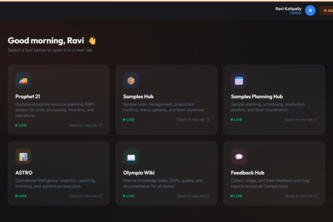
The description states that Olympia Enterprise Supply Chain Suite is a portfolio of connected operations applications, including:
- Prophet 21 — ERP workflows for orders, inventory, and operations.
- Samples Hub — sample-order management, production tracking, status updates, and workload visibility.
- Samples Planning Hub — planning, scheduling, production-pipeline coordination, approvals, and SLA tracking.
- ASTRO and Pick Strategy — warehouse intelligence for inventory insight, route focus, pick-ticket prioritization, and fulfillment decisions.
- Product Intelligence — sales-ready product knowledge with grounded, source-aware answers.
- Olympia Wiki — searchable SOPs, guides, and institutional knowledge.
- Feedback Hub — feedback and issue capture, triage, ownership, and resolution tracking.
- Project Nexus — management reporting for branch performance, logistics analytics, and planning allocations.
- Predictive Analysis and WBR Metrics — forecasting, performance review, and operational decision support.
- Central authentication and app launcher — one entry point that connects authorized employees to the tools relevant to their role.
Inference: These modules appear to be purpose-built for specific functions within an enterprise supply chain, connected through a shared interface or launcher. The suite is described as organized around real operational handoffs.
Not evidenced: No information on how these modules interconnect technically, whether they are integrated systems or separate tools with shared data layers, or if any of them have been tested in live environments.
Positioning & Claim Evolution
The description states that the product aims to help teams move from request to planning, fulfillment, insight, and improvement with clearer handoffs. It positions itself as a solution for supply-chain teams who lose time moving between disconnected tools.
It also claims to offer:
- A unified enterprise suite covering ERP, supply chain, sales, warehouse operations, samples, knowledge, feedback, and business intelligence.
- One entry point that connects employees to relevant tools based on their role.
Inference: The positioning is centered on reducing friction in cross-functional workflows by integrating multiple tools into a single operating layer. It emphasizes clarity of handoffs and shared visibility across departments.
Not evidenced: There is no evidence of prior market testing, user feedback, or competitive differentiation beyond the self-description. No claims about unique value proposition or competitive advantages are substantiated.
Target Customer & ICP
The description states that the suite targets enterprise supply chain teams, particularly those who “lose time moving between disconnected tools for ERP, samples, warehouse execution, sales knowledge, reporting, and feedback.”
Inference: The target is likely mid-to-large enterprises with complex supply chains involving multiple departments (sales, procurement, logistics, operations) that require coordination across functions.
Not evidenced: No specific customer segments, personas, or use cases beyond general enterprise teams are provided. No indication of whether the product is aimed at manufacturers, retailers, distributors, or service providers.
Business Model & Pricing Evidence
The description does not include any information about business model, pricing, or monetization strategy.
Not evidenced: There is no mention of how the product will be sold, licensed, or consumed. No details on subscription tiers, per-user pricing, or enterprise contracts are included.
Technical & Delivery Signals
The author states that the project was built using:
- Technologies: Docker, Express.js, Flask, GCP, Next.js, Node.js, PostgreSQL, Python, React.
- Source: https://devpost.com/software/olympia-enterprise-supply-chain-suite
- Team size: 1 person (Raviteja Reddy)
Inference: The tech stack suggests a modern web-based platform built with microservices and cloud infrastructure. The single-person team implies either rapid prototyping or limited development capacity.
Not evidenced: No information on scalability, deployment architecture, data handling, security practices, or integration capabilities beyond what is implied by the tools listed.
Traction & Maturity Signals
The description states that this project was submitted to the OpenAI 2026 hackathon, and that the next focus is a polished, public-safe demonstration workflow and documentation.
Inference: This is an early-stage prototype or proof-of-concept, likely built during a hackathon. The author mentions no live users, customers, or production deployments.
Not evidenced: No evidence of revenue, customer adoption, user engagement, or product maturity beyond the initial submission.
Competitive Context
The description does not provide any information about competitors, market landscape, or competitive positioning.
Not evidenced: No mention of existing players in the ERP, supply chain, or knowledge management space. No comparison to tools like SAP, Oracle, or other enterprise platforms is made.
Open Questions & Risks
- The product is described as a single-person effort, which raises concerns about scalability and long-term maintenance.
- It is presented as a hackathon submission, suggesting it may be an early prototype without real-world validation.
- There is no evidence of traction, revenue, or customer feedback beyond the self-reported description.
- The suite spans a wide range of functions (ERP, warehouse, knowledge, feedback), which could indicate scope creep or lack of focus.
- No mention of security, data privacy, or enterprise-grade features.
Questions the description leaves open
- What specific enterprise supply chain pain points does this suite address, and how do you know?
- How is data shared between modules? Is there a central database or API layer?
- Have you tested the platform with any real users or in actual workflows?
- What are your plans for scaling beyond a single developer?
- Are there any existing partnerships or pilot programs with enterprises?
- What is the timeline for moving from prototype to production-ready product?
Overall Assessment
The description states that this is a self-reported hackathon project by one individual, built using modern web technologies but lacking evidence of traction, revenue, or customer validation.
Inference: At this stage, it appears to be an early-stage idea or prototype with potential for development. However, without any real-world usage or market feedback, there is no basis for investment or partnership decisions.
Not evidenced: No financials, user data, or product-market fit indicators are provided. The project does not demonstrate a clear path to monetization or enterprise adoption.
User Stories BotA demo video on every pull request
Get a demo video on every new feature
GitHub App that watches your pull requests and records a narrated, captioned demo.
Save time on demo prep and make informed decisions faster with a video walkthrough of every new feature.
Source
Submitted to the OpenAI 2026 hackathon on Devpost. Project home on Devpost. Back to the full gallery on Devpost.
This competitive analysis was produced by top-founders.com (opens in a new tab)
Generated by a language model from this project's public Devpost page — its tagline, the author's own write-up and any built-with tags listed there — as captured in August 2026. Short quotations are the author's words. It is an opinion on the idea as a business, not on the people behind it, and it reflects the description as published then. If the project has moved on, request a correction below. The analysis is not independent research and contains no verified traction, revenue or customer data.
An independent guide by KFG International LLC — not affiliated with, endorsed by, or connected to Devpost or OpenAI.