

Archive position — measured, not model output
0 likes on Devpost
2,263 of the 7,850 archived projects have more likes, and 5,587 share exactly 0 — so this project's #7,574 place in the like-ranked listing is a tie-break inside that group, not a ranking.
Projects (log scale)
Likes on Devpost. ▲ marks this project's group.
Show the figures
| Likes | Projects | Share of archive |
|---|---|---|
| 0 | 5,587 | 71.2% |
| 1 | 1,758 | 22.4% |
| 2 | 284 | 3.6% |
| 3–4 | 132 | 1.7% |
| 5–9 | 75 | 1.0% |
| 10+ | 14 | 0.2% |
 User Stories BotA demo video on every pull request
Get a demo video on every new feature
GitHub App that watches your pull requests and records a narrated, captioned demo.
Save time on demo prep and make informed decisions faster with a video walkthrough of every new feature.
Executive Summary
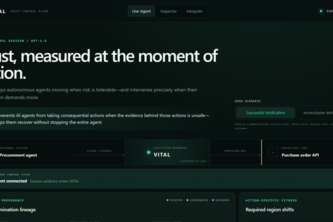
What the company appears to be: Vital is a self-reported trust-control and authorization layer for AI agents that evaluates whether an agent should be allowed to act based on the reliability of its evidence and the consequences of the action it wants to perform. The system tracks uncertainty propagation, accumulates "trust debt", and makes dynamic authorization decisions.
What changed: The author states they shifted from building a system that simply interprets evidence to one that questions whether anything should be trusted, using GPT-5.6 for interpretation but Codex as an adversarial tester to strengthen the architecture.
Single most important open question: Does the described trust-control mechanism actually work in practice, or is it an untested theoretical framework?
Commercial due-diligence read: The description is entirely self-reported and unverified. No evidence of revenue, customers, traction or operational data exists. The author's own account describes a conceptual system built around one person using AI tools to create a prototype, but provides no proof of functionality or real-world deployment.
What The Product Actually Is
The description states that Vital is:
- A "trust-control and authorization layer for AI agents operating with consequential tools"
- Designed to evaluate whether an agent should be allowed to act based on evidence reliability
- A system that tracks when information behind decisions becomes unreliable
- An architecture that treats trust as dynamic and action-dependent rather than permanent
- A mechanism that tracks uncertainty provenance, propagation, and accumulated trust debt
- A system that prevents agents from carrying unresolved uncertainty into more consequential actions
The description also states that:
- GPT-5.6 handles interpretation of messy evidence
- The authorization layer is deterministic
- Evidence submitted by agents cannot declare itself trustworthy
- Trusted recovery requires server-controlled verification
- The system uses Codex as an adversarial tester to strengthen architecture
Confidence: Low - this is entirely self-reported and unverified.
Positioning & Claim Evolution
The description states that:
- The author was inspired by biological systems' approach to uncertainty management
- The core idea is that agents can be "healthy enough to research, but not healthy enough to act"
- The system asks "Does the agent's current evidence actually justify giving it the authority to perform this specific action?"
- It focuses on "consequence-aware authority" rather than just capability
- The author states they wanted to build something that asks "whether they should" rather than "what else can agents do"
The positioning evolved from:
- A general interest in AI agent reliability and consequences
- Inspiration from biological systems
- Development of a trust-control architecture
- Realization that tools like Codex could be used as adversarial testers
Confidence: Low - this is entirely self-reported.
Target Customer & ICP
The description states:
- The target is "AI agents operating with consequential tools"
- It's designed for "companies using autonomous agents to make purchases, execute workflows, manage infrastructure, or make decisions based on information that later turns out to be wrong"
- The system can be placed between existing agents and protected tools
- Developers can configure server-registered policies and trusted verifier adapters
The description does not specify:
- Specific industry verticals
- Size of target organizations
- Specific use cases beyond procurement workflows
- Whether it targets enterprise or individual developers
Confidence: Low - no clear customer segmentation or targeting data.
Business Model & Pricing Evidence
The description states:
- The system is built as an infrastructure layer that can be integrated with existing agents
- It uses server-registered policies and trusted verifier adapters
- Final authorization remains governed by deterministic VITAL logic
- There's a demonstration of procurement workflow integration
However, the description does not contain:
- Any pricing information
- Revenue model details
- Customer acquisition strategy
- Commercialization approach
- Licensing or subscription model
Confidence: Very low - no business model evidence.
Technical & Delivery Signals
The description states:
- Built with: codex, gpt-5.6, next.js, node.js, openai, react, typescript
- Uses GPT-5.6 for interpreting messy evidence
- Authorization layer is deterministic
- Codex was used as adversarial tester to strengthen architecture
- System has 43 regression tests
- Includes UI tests, production builds, and live validation
- The system tracks contaminated evidence, uncertainty propagation, and trust debt
The description also states:
- The author built it alone with one team member (kju sjukk)
- It was built for the OpenAI 2026 hackathon
- The system uses a "rule" that AI models can help interpret but never give themselves permission to act
- Codex was used both as engineering partner and adversarial tester
Confidence: Low - this is self-reported technical architecture without verification.
Traction & Maturity Signals
The description states:
- The project was submitted to the OpenAI 2026 hackathon
- It was built by one person with one team member (kju sjukk)
- It has 43 regression tests
- Includes rendered UI tests, production builds, and live validation
- The system was tested in both local and Production environments
- The author mentions "many of those tests exist because something genuinely failed first"
However, the description does not contain:
- Any revenue data
- Customer adoption or usage metrics
- Product-market fit evidence
- Real-world deployment information
- User feedback or testimonials
- Market traction indicators
Confidence: Very low - no traction or maturity evidence.
Competitive Context
The description states:
- The author was inspired by biological systems' approach to uncertainty management
- It's positioned against "AI agents that focus on capability rather than consequences"
- It's designed for "companies using autonomous agents to make purchases, execute workflows, manage infrastructure, or make decisions based on information that later turns out to be wrong"
The description does not contain:
- Any mention of direct competitors
- Market analysis or competitive positioning
- Industry landscape information
- Differentiation from existing trust-control systems
- Competitive advantages or disadvantages
Confidence: Very low - no competitive context evidence.
Open Questions & Risks
Key risks and open questions based on the description:
- Unverified claims: All information is self-reported and unverified
- Single-person development: Only one person built it, with one team member
- No traction evidence: No revenue, customers or adoption data
- Hackathon project: Built for a hackathon, not necessarily production-ready
- Unproven architecture: The system's effectiveness is untested in practice
- Dependency on AI models: Relies heavily on GPT-5.6 and Codex which may not be reliable or consistent
- Limited testing scope: Only mentions 43 regression tests, no broader validation
- Conceptual vs. operational: Describes a conceptual system but provides no evidence of real-world functionality
Confidence: High - these are clear risks from the self-reported information.
Questions the description leaves open
- What specific problems have you identified in existing AI agent trust-control systems?
- How do you plan to validate that your trust debt calculation actually works in practice?
- What is your roadmap for moving from a hackathon prototype to a production-ready system?
- How will you handle the scalability of your deterministic authorization layer?
- What specific industries or use cases are you targeting, and how did you arrive at those?
- How do you plan to address the challenge of trusted verification in practice?
- What metrics do you have for measuring the effectiveness of your trust-control mechanism?
- How will you ensure consistent behavior across different AI model versions?
- What is your approach to regulatory compliance and auditability?
- How do you plan to monetize this system, and what pricing models are you considering?
Overall Assessment
Assessment: Not evidenced - the description provides no evidence of commercial viability, traction or operational success.
The description states that:
- This is a hackathon project built by one person with one team member
- It has no revenue, customers or adoption data
- The system's effectiveness is unproven
- All information is self-reported and unverified
Confidence: Very low - this appears to be an early-stage concept rather than a developed business.
The author states they built it for the OpenAI 2026 hackathon, which suggests this is an experimental prototype rather than a commercial product. There is no evidence of:
- Revenue generation
- Customer adoption
- Market traction
- Operational capability
- Commercial viability
This appears to be a conceptual system that has not yet been proven in practice. The description provides no basis for investment or partnership consideration at this stage.
User Stories BotA demo video on every pull request
Get a demo video on every new feature
GitHub App that watches your pull requests and records a narrated, captioned demo.
Save time on demo prep and make informed decisions faster with a video walkthrough of every new feature.
Source
Submitted to the OpenAI 2026 hackathon on Devpost. Project home on Devpost. Back to the full gallery on Devpost.
This competitive analysis was produced by top-founders.com (opens in a new tab)
Generated by a language model from this project's public Devpost page — its tagline, the author's own write-up and any built-with tags listed there — as captured in August 2026. Short quotations are the author's words. It is an opinion on the idea as a business, not on the people behind it, and it reflects the description as published then. If the project has moved on, request a correction below. The analysis is not independent research and contains no verified traction, revenue or customer data.
An independent guide by KFG International LLC — not affiliated with, endorsed by, or connected to Devpost or OpenAI.