

Archive position — measured, not model output
0 likes on Devpost
2,263 of the 7,850 archived projects have more likes, and 5,587 share exactly 0 — so this project's #3,650 place in the like-ranked listing is a tie-break inside that group, not a ranking.
Projects (log scale)
Likes on Devpost. ▲ marks this project's group.
Show the figures
| Likes | Projects | Share of archive |
|---|---|---|
| 0 | 5,587 | 71.2% |
| 1 | 1,758 | 22.4% |
| 2 | 284 | 3.6% |
| 3–4 | 132 | 1.7% |
| 5–9 | 75 | 1.0% |
| 10+ | 14 | 0.2% |
 User Stories BotA demo video on every pull request
Get a demo video on every new feature
GitHub App that watches your pull requests and records a narrated, captioned demo.
Save time on demo prep and make informed decisions faster with a video walkthrough of every new feature.
Executive Summary
Daykeeper, as described by its author, is a personal journaling and social platform built by a 15-year-old developer in Brazil. The project began in February 2024 and has evolved over more than two and a half years into a full-stack application with features including photo/video posts, AI moderation, calendar-based organization, privacy controls, and social networking elements.
The author states that Daykeeper is not intended to be a scrolling feed but rather a tool for users to "pay attention to their own lives" and preserve meaningful memories. It combines familiar social media features with journaling tools and personal organization capabilities.
Key technical aspects include:
- Built on Node.js, Express, MongoDB, AWS services
- Uses custom authentication, AI moderation via AWS Rekognition, asynchronous processing queues
- Supports time zone-aware calendar functionality
- Open-source with public API and web/mobile applications
The author reports no revenue or customers, and the platform is described as being in beta. The project has been presented at an official IB event and has led to opportunities outside of development.
Most important open question: What is the actual user demand for this type of product? The description contains no evidence of users beyond the creator's own use, nor any indication of whether others find value in the platform or its features.
What The Product Actually Is
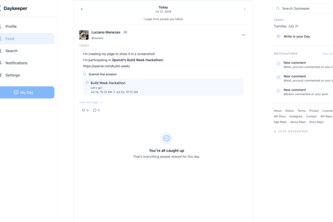
The description states that Daykeeper is a social journal that helps people capture each day through photos, notes, tasks, and memories, then organize everything in a personal calendar.
It includes:
- Posts with text, photos, videos
- Automatic AI moderation for uploaded media
- Social features: likes, comments, replies, follow requests
- Privacy controls (public, private, Close Friends visibility)
- Personal calendars with posts, tasks, and events
- Recurring task templates
- Streaks and activity history
- Notifications and session management
The author describes it as a platform that combines "familiar social features with tools inspired by journaling and personal organization."
Positioning & Claim Evolution
The description states that Daykeeper began with the author's fear that days pass without being noticed or remembered. The core positioning is to help people "pay attention to their own lives, preserve meaningful memories, and understand how their time is being spent."
The platform is positioned as:
- A social journal rather than a scrolling feed
- A tool for personal organization and memory preservation
- An alternative to traditional social media consumption patterns
The author emphasizes that the goal is not to encourage hours of scrolling but to help users "pay attention" to their own lives.
Target Customer & ICP
The description states that Daykeeper is designed for people who want to:
- Maintain a meaningful record of their lives
- Capture daily experiences through photos, notes, tasks, and memories
- Organize their time and activities in a personal calendar
- Preserve meaningful moments that might otherwise be forgotten
The author describes the platform as being built for "people" generally, without specifying particular demographics or user segments beyond those who would value journaling and memory preservation.
Business Model & Pricing Evidence
The description states that Daykeeper is completely free. The author mentions investing more than R$5,000 into its design, branding, servers, testing, and development, but does not indicate any monetization strategy or pricing model.
There is no evidence of revenue streams, subscription models, advertising, or paid features in the description.
Technical & Delivery Signals
The author built Daykeeper as a full-stack project using:
- Backend: Node.js, Express, MongoDB, Mongoose
- Authentication: Custom access and refresh tokens, Passport, Google authentication
- Media storage: Amazon S3
- AI moderation: AWS Rekognition
- Asynchronous processing: BullMQ, Redis
- Notifications: Firebase Admin, Nodemailer
- Date/time handling: date-fns, date-fns-tz
The platform includes features like:
- Session management
- Email verification and password recovery
- Responsive design across screen sizes
- Public and private user accounts
- Reporting and administrative systems
The author notes that the project is open source with API, web application, mobile application, and API documentation publicly available.
Traction & Maturity Signals
The description states:
- The platform has been in development for more than two and a half years
- It was presented as the author's IB Personal Project
- The author built a landing page and demonstrated the functioning API through Postman at that stage
- The application is now functional and in beta
- The author personally invested over R$5,000 into development
However, there is no evidence of users, customers, or revenue. The description explicitly states that no traction data beyond the creator's own use is available.
Competitive Context
The description does not mention any direct competitors. It positions Daykeeper as a platform that combines "familiar social features with tools inspired by journaling and personal organization," but provides no information about existing products in this space or how Daykeeper differentiates from them.
Open Questions & Risks
- No evidence of users or customers - The description contains no data on actual user adoption, engagement, or demand
- Single-person development - The platform was built by one person (the author) with no indication of team size beyond that
- Lack of commercial traction - No revenue, monetization strategy, or customer base is evidenced
- Unproven market demand - The description does not establish whether others find value in the product or its features
- Limited scalability concerns - While technical architecture is described, there's no evidence of performance testing or scaling challenges faced by users
Questions the description leaves open
- What specific user problems are you solving that existing solutions don't address?
- How many actual users do you have, and what is their engagement level?
- What is your plan for monetization if you want to scale beyond personal investment?
- How do you plan to handle content moderation at scale?
- What are the key technical challenges you've faced that you haven't yet solved?
- How do you plan to acquire users organically or through marketing?
- What metrics do you use to measure product success and user satisfaction?
Overall Assessment
Not evidenced
The description provides no information about:
- Revenue or financial performance
- Customer base or user adoption
- Market size or competitive positioning
- Commercial traction or business metrics
- Scalability of the technical architecture beyond one developer
- Monetization strategy or path to profitability
This is a self-reported, unverified project that has not demonstrated any commercial traction. The author describes building a functional platform over two and a half years but provides no evidence of users, customers, or revenue. The project appears to be an experimental development effort by one individual rather than a commercial venture with proven market demand.
The description contains no evidence that Daykeeper has achieved any meaningful user adoption or business success beyond the creator's own use. Without data on users, customers, or revenue, it is not possible to assess whether this represents a viable investment opportunity or partnership target.
User Stories BotA demo video on every pull request
Get a demo video on every new feature
GitHub App that watches your pull requests and records a narrated, captioned demo.
Save time on demo prep and make informed decisions faster with a video walkthrough of every new feature.
Source
Submitted to the OpenAI 2026 hackathon on Devpost. Project home on Devpost. Back to the full gallery on Devpost.
This competitive analysis was produced by top-founders.com (opens in a new tab)
Generated by a language model from this project's public Devpost page — its tagline, the author's own write-up and any built-with tags listed there — as captured in August 2026. Short quotations are the author's words. It is an opinion on the idea as a business, not on the people behind it, and it reflects the description as published then. If the project has moved on, request a correction below. The analysis is not independent research and contains no verified traction, revenue or customer data.
An independent guide by KFG International LLC — not affiliated with, endorsed by, or connected to Devpost or OpenAI.