

Archive position — measured, not model output
4 likes on Devpost
89 of the 7,850 archived projects have more likes, and 39 share exactly 4 — so this project's #128 place in the like-ranked listing is a tie-break inside that group, not a ranking.
Projects (log scale)
Likes on Devpost. ▲ marks this project's group.
Show the figures
| Likes | Projects | Share of archive |
|---|---|---|
| 0 | 5,587 | 71.2% |
| 1 | 1,758 | 22.4% |
| 2 | 284 | 3.6% |
| 3–4 | 132 | 1.7% |
| 5–9 | 75 | 1.0% |
| 10+ | 14 | 0.2% |
 User Stories BotA demo video on every pull request
Get a demo video on every new feature
GitHub App that watches your pull requests and records a narrated, captioned demo.
Save time on demo prep and make informed decisions faster with a video walkthrough of every new feature.
Executive Summary
What the company appears to be
A self-reported tool that converts books into playable visual novels using AI-generated scenes, audio, and branching storylines. The author describes a prototype built for a hackathon with no verified revenue, customers or traction.
What changed
This is a single-person hackathon project submitted to the OpenAI 2026 hackathon. There is no evidence of prior development, funding, or commercial activity beyond this submission.
The single most important open question
Is there any evidence of actual product-market fit, user adoption, or monetization capability beyond the author's self-reported prototype?
What The Product Actually Is
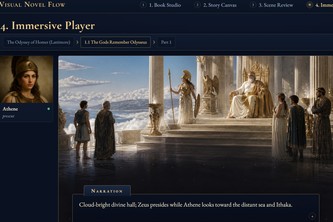
The description states that the project "turns any book into a playable visual novel" by using an "agentic workflow" to divide books into scenes. Each scene is animated with GPT image 2 and includes audio like music and speaking persons. Users can create branches for alternative storylines.
Evidence The author describes uploading a book, having it divided into scenes, and each scene being animated with GPT image 2 and audio elements including music and character voices.
Inference The system appears to use AI models for content generation (image, audio) and workflow automation. However, the description does not clarify whether this is an end-to-end tool or requires manual intervention.
Positioning & Claim Evolution
The author states that they were inspired by wanting to explore how books could continue in different ways, combining their love of reading with visual novel gameplay. The core idea is to allow users to experiment with alternative storylines — for example, what if Harry Potter never met Ron Weasley?
Evidence The inspiration section explicitly mentions the desire to visualize books differently and play with alternate storylines.
Inference This suggests a positioning around creative storytelling tools or interactive reading experiences. However, there is no evidence of market research, competitive analysis, or user feedback that would validate this positioning.
Target Customer & ICP
The description does not specify target customers or ideal customer profiles (ICP). The author mentions personal inspiration from reading and playing visual novels but does not identify a clear segment or persona.
Evidence None provided.
Inference Based on the self-reported nature of the project, it appears to be aimed at individuals interested in creative writing or interactive storytelling. However, no explicit customer segmentation is evident.
Business Model & Pricing Evidence
There is no evidence of any business model or pricing structure described by the author. The description mentions potential future enhancements such as adding Stripe and user management, but does not indicate current monetization plans.
Evidence The author notes that they would like to add "stripe and user management" and "marketing for it," suggesting an intent to monetize, but no actual model or pricing is detailed.
Inference If this evolves into a product, it may follow a freemium or subscription model, but there is no evidence of such planning in the current description.
Technical & Delivery Signals
The project was built using AWS/Cloudflare, OpenAI models (including GPT image 2), and music generation from GCP. It uses Codex and Terraform for development. The author mentions challenges with hosting cheaply and UI design.
Evidence The author lists the technologies used: Amazon Web Services, Cloudflare, Codex, Python, Terraform, OpenAI models, and GCP for music generation.
Inference The technical stack suggests a cloud-based AI application with some automation capabilities. However, no details are provided about scalability, performance, or delivery mechanisms beyond the hackathon prototype.
Traction & Maturity Signals
There is no evidence of traction, revenue, customers, or adoption beyond the author's own submission to a hackathon. The project is described as a single-person effort with limited time and resources.
Evidence The description indicates this was built for a hackathon with a tight deadline ("1 h to deadline"), and mentions only one team member (rafal bog).
Inference This is a prototype, not a mature product or service. No metrics, users, or business development are evident.
Competitive Context
The description does not mention any competitors or market context. The author focuses on personal inspiration rather than existing solutions in the visual novel or interactive storytelling space.
Evidence None provided.
Inference Without competitive analysis or awareness of similar tools, it's unclear whether this addresses a gap or overlaps with existing offerings.
Open Questions & Risks
- Unproven commercial viability: The project is described as a hackathon prototype with no evidence of traction or monetization.
- Technical limitations: The author notes hardware constraints ("my PC not having enough RAM") and uncertainty about tool integration ("I have 1 h to deadline dunno if the codex will manage to do it").
- Lack of clarity on product-market fit: No indication of user testing, feedback, or validation beyond personal interest.
- Single-person operation: With only one team member, scalability and long-term development are questionable.
Questions the description leaves open
- What specific market need does this tool address, and how did you validate that need?
- Have you conducted any user testing or gathered feedback from potential users?
- How do you plan to monetize the product beyond the initial prototype?
- What are your long-term technical and operational plans for scaling the platform?
- Are there any existing competitors in this space, and how does your solution differ?
Overall Assessment
Not evidenced.
The description provides no information on revenue, customers, traction, or business development beyond a hackathon submission. The project is described as a prototype with no commercial activity or validated market demand.
This is a self-reported idea with no evidence of product-market fit, monetization strategy, or operational maturity. Any investment or partnership decision would require further due diligence into actual usage, user feedback, and business model validation — none of which are present in the current description.
User Stories BotA demo video on every pull request
Get a demo video on every new feature
GitHub App that watches your pull requests and records a narrated, captioned demo.
Save time on demo prep and make informed decisions faster with a video walkthrough of every new feature.
Source
Submitted to the OpenAI 2026 hackathon on Devpost. Project home on Devpost. Back to the full gallery on Devpost.
This competitive analysis was produced by top-founders.com (opens in a new tab)
Generated by a language model from this project's public Devpost page — its tagline, the author's own write-up and any built-with tags listed there — as captured in August 2026. Short quotations are the author's words. It is an opinion on the idea as a business, not on the people behind it, and it reflects the description as published then. If the project has moved on, request a correction below. The analysis is not independent research and contains no verified traction, revenue or customer data.
An independent guide by KFG International LLC — not affiliated with, endorsed by, or connected to Devpost or OpenAI.