

Archive position — measured, not model output
1 like on Devpost
505 of the 7,850 archived projects have more likes, and 1,758 share exactly 1 — so this project's #2,091 place in the like-ranked listing is a tie-break inside that group, not a ranking.
Projects (log scale)
Likes on Devpost. ▲ marks this project's group.
Show the figures
| Likes | Projects | Share of archive |
|---|---|---|
| 0 | 5,587 | 71.2% |
| 1 | 1,758 | 22.4% |
| 2 | 284 | 3.6% |
| 3–4 | 132 | 1.7% |
| 5–9 | 75 | 1.0% |
| 10+ | 14 | 0.2% |
 User Stories BotA demo video on every pull request
Get a demo video on every new feature
GitHub App that watches your pull requests and records a narrated, captioned demo.
Save time on demo prep and make informed decisions faster with a video walkthrough of every new feature.
Executive Summary
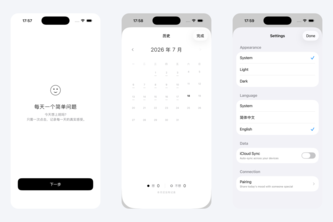
**The company appears to be a solo developer project named today.work, a SwiftUI iOS app for recording daily work moods.** The author states the app tracks workdays, holidays, and makeup days in China, supports history, pairing, widgets, iCloud sync, bilingual UI, and dark mode. It was built as part of the OpenAI 2026 hackathon.
The product is described as a lightweight daily ritual for users to acknowledge their mood without judgment, with optional pairing features and widget support. The app uses SwiftUI, Combine, WidgetKit, Supabase, and FoundationDB.
What changed
This is a self-reported project submitted to a hackathon; there is no evidence of prior development or commercial activity beyond the author's own description.
The single most important open question
Is today.work intended as a personal tool, a prototype for future productization, or a minimal viable product for user feedback?
Analysis basis
The entire analysis is based on the self-reported project description provided by the caller. No external verification, revenue data, customer base, or traction evidence is available.
What The Product Actually Is
- The description states today.work is a SwiftUI iOS app.
- It records whether users want to go to work each day.
- It recognizes workdays, weekends, public holidays, and compensatory workdays in China.
- Features include:
- Historical calendar views
- Streak statistics
- Optional iCloud synchronization
- One-to-one mood pairing
- Home Screen and Lock Screen widgets
- Onboarding and bilingual (Chinese/English) UI support
- Light and dark mode
Inference The app is a personal productivity tool focused on emotional awareness in the workplace, with a minimalistic interface.
Evidence Author's own write-up. No independent verification or data about actual usage or adoption.
Positioning & Claim Evolution
- The description states that today.work turns the emotional question “Do I want to go to work today?” into a daily ritual.
- It aims to help users acknowledge their mood without judgment.
- The pairing feature is described as inspired by sharing that moment with someone close.
- The app is positioned as a calm interface for noticing rather than judging work-related emotions.
Inference The positioning is centered on emotional reflection and personal mindfulness, not productivity optimization or performance tracking.
Evidence Author's own write-up. No claims about market positioning beyond self-description.
Target Customer & ICP
- The description does not name specific customer segments.
- It implies a user base that includes individuals in China (due to support for Chinese holidays and compensatory workdays).
- The app supports bilingual UI (Chinese/English), suggesting a global or multilingual audience.
- Pairing functionality suggests users may be in relationships, friendships, or professional partnerships.
Inference Likely targets individuals who value emotional awareness in their work lives, possibly in China or among Chinese-speaking professionals.
Evidence Author's own write-up. No data on actual user demographics or segmentation.
Business Model & Pricing Evidence
- The description does not state any pricing model.
- There is no mention of monetization, subscriptions, or paid features.
- The app is described as a personal tool with no indication of commercial intent beyond the hackathon submission.
Inference No evidence of a business model or pricing structure. The project appears to be a prototype or personal endeavor.
Evidence Author's own write-up. No claims about revenue, monetization, or pricing.
Technical & Delivery Signals
- Built with SwiftUI.
- Uses Combine for reactive state management.
- WidgetKit powers Home Screen and Lock Screen widgets.
- Supabase is used for backend services (pairing users, synchronizing partner mood updates).
- FoundationDB is mentioned as a technology used.
- App Groups are used to share data between the main app and widgets.
- iCloud sync is supported.
- Localization support for Chinese and English.
- JSON and REST API are referenced in tech stack.
Inference The app uses modern iOS development practices and integrates with Apple ecosystem features like widgets and iCloud.
Evidence Author's own write-up. No evidence of scalability, performance, or production deployment.
Traction & Maturity Signals
- The project was submitted to a hackathon (OpenAI 2026).
- Team size is listed as one person.
- No mention of user adoption, downloads, or usage metrics.
- No evidence of revenue, customers, or product-market fit beyond the author’s own description.
Inference This is a prototype or personal project with no demonstrated traction or commercial maturity.
Evidence Author's own write-up. No data on users, adoption, or business metrics.
Competitive Context
- The description does not mention competitors.
- No evidence of existing apps in the same space (work mood tracking, emotional reflection tools).
- The app’s focus on Chinese holidays and compensatory workdays suggests a niche or localized market.
Inference There is no known competitive landscape for this specific tool. It may be unique to its niche or lack visibility in the broader market.
Evidence Author's own write-up. No mention of competitors or market analysis.
Open Questions & Risks
- The project is a solo effort with no team or external support.
- No evidence of monetization, user base, or product-market fit.
- The app is described as a hackathon submission — not a commercial product.
- No indication of long-term viability or scalability.
- The app’s niche focus (Chinese holidays, mood pairing) may limit its broader appeal.
Inference High risk of being a non-commercial prototype with limited potential for growth or monetization.
Evidence Author's own write-up. No evidence of traction, funding, or commercial strategy.
Questions the description leaves open
- What is the intended long-term vision for today.work?
- Is this a one-off personal project or a prototype for future development?
- Are there plans to expand beyond China or add more features?
- How do you plan to monetize or scale the product if at all?
- What are your expectations around user adoption and feedback?
Inference These questions aim to uncover whether today.work is a prototype, personal tool, or potential commercial product.
Overall Assessment
- The project is described as a hackathon submission by one developer.
- No evidence of revenue, customers, or traction.
- It is not evident that the app has moved beyond the prototype stage.
- There is no indication of a business model or monetization strategy.
Inference This is likely a personal or experimental project with no demonstrated commercial potential at this time.
Evidence Author's own write-up. No evidence of investment readiness, partnership interest, or commercial viability.
User Stories BotA demo video on every pull request
Get a demo video on every new feature
GitHub App that watches your pull requests and records a narrated, captioned demo.
Save time on demo prep and make informed decisions faster with a video walkthrough of every new feature.
Source
Submitted to the OpenAI 2026 hackathon on Devpost. Project home on Devpost. Back to the full gallery on Devpost.
This competitive analysis was produced by top-founders.com (opens in a new tab)
Generated by a language model from this project's public Devpost page — its tagline, the author's own write-up and any built-with tags listed there — as captured in August 2026. Short quotations are the author's words. It is an opinion on the idea as a business, not on the people behind it, and it reflects the description as published then. If the project has moved on, request a correction below. The analysis is not independent research and contains no verified traction, revenue or customer data.
An independent guide by KFG International LLC — not affiliated with, endorsed by, or connected to Devpost or OpenAI.