

Archive position — measured, not model output
0 likes on Devpost
2,263 of the 7,850 archived projects have more likes, and 5,587 share exactly 0 — so this project's #7,549 place in the like-ranked listing is a tie-break inside that group, not a ranking.
Projects (log scale)
Likes on Devpost. ▲ marks this project's group.
Show the figures
| Likes | Projects | Share of archive |
|---|---|---|
| 0 | 5,587 | 71.2% |
| 1 | 1,758 | 22.4% |
| 2 | 284 | 3.6% |
| 3–4 | 132 | 1.7% |
| 5–9 | 75 | 1.0% |
| 10+ | 14 | 0.2% |
 User Stories BotA demo video on every pull request
Get a demo video on every new feature
GitHub App that watches your pull requests and records a narrated, captioned demo.
Save time on demo prep and make informed decisions faster with a video walkthrough of every new feature.
Executive Summary
Company: Vibraxis
Self-reported basis: The description is entirely self-reported and unverified, as per ground rules. No third-party corroboration exists for any claim made in the write-up.
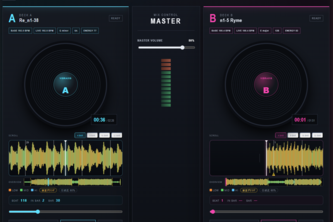
What it appears to be: A software agent that interprets natural-language requests to generate continuous DJ sets using audio analysis and AI. It uses a two-deck audio engine with deterministic logic and bounded LLM interaction, designed to autonomously select, beat-match, and crossfade tracks.
What changed: The project is a hackathon submission, not a commercial product or business. It was built as part of the OpenAI 2026 hackathon.
Most important open question: Is there any evidence that this concept has traction beyond the author’s personal use case, or that it could be monetized in a scalable way?
What The Product Actually Is
The description states that Vibraxis is a Club DJ Agent that interprets natural-language requests to generate continuous DJ sets. It uses:
- A two-deck audio engine, controlled by a protocol called VDAP.
- An AI pipeline involving GPT-5.6, deterministic scoring, and Codex for decision-making.
- The system is designed to automatically select, beat-match, and crossfade tracks without manual approval.
The audio engine runs in the browser and uses a MessagePort contract (VDAP) to validate commands and schedule transitions on bar boundaries. It includes features like EQ, crossfader curves, playback-rate limits, and a limiter.
The AI pipeline is bounded, meaning:
- GPT-5.6 parses natural language into a bounded intent.
- A deterministic engine scores candidates by BPM, key, and energy.
- Codex selects from a shortlist in a read-only sandbox.
- All outputs are validated before reaching the audio engine.
Not evidenced: No mention of actual user interaction, customer data, or product deployment beyond the hackathon project.
Positioning & Claim Evolution
The author states that Vibraxis is a DJ agent that understands natural-language requests, aiming to replicate the experience of a human DJ who reads the room and blends tracks seamlessly. The system is described as:
- Designed for autonomous operation with instant manual override.
- Built with a protocol-first approach, where VDAP was written before features.
The author claims it works better to:
- Let GPT handle ambiguous language.
- Keep audio-critical decisions in deterministic code.
- Allow autonomous behavior by default, rather than asking for approval on every mix.
Inference: The positioning is that of a personalized, AI-driven DJ assistant, but this is not validated with any market data or user feedback. It is a self-described vision, not a demonstrated product.
Target Customer & ICP
The description does not state:
- Who the target customer is.
- What the ideal customer profile (ICP) looks like.
- Whether it targets DJs, music enthusiasts, or commercial venues.
Not evidenced: No evidence of customer segmentation, personas, or use cases beyond the author’s personal experience.
Business Model & Pricing Evidence
The description does not include:
- Any information about pricing.
- A business model.
- Revenue streams.
- Monetization strategy.
Not evidenced: No indication of how this would be sold or whether it is intended for commercial use.
Technical & Delivery Signals
The project was built using:
- Node.js + TypeScript
- Python (with uv)
- React
- Librosa
- OpenAI models (GPT-5.6, Codex)
Key technical features include:
- A two-deck audio engine with beat-matching and crossfading.
- A protocol-first design using VDAP.
- A bounded AI pipeline that validates all outputs before reaching the audio engine.
- 389 backend/frontend/contract tests and 33 analyzer tests.
The author states:
- The spec and its checker were written before any feature.
- It runs an endless set autonomously.
- Manual override is possible.
Inference: The technical architecture suggests a strong focus on reliability, validation, and deterministic control over audio decisions. However, this is a hackathon project with no evidence of production deployment or scalability beyond the author’s own use case.
Traction & Maturity Signals
The description states:
- This is a hackathon submission.
- The team size is 0.
- No customers, revenue, or adoption data are provided.
- It was built in a short timeframe (presumably a hackathon).
Not evidenced: No evidence of traction, usage, or product-market fit beyond the author’s personal interest.
Competitive Context
The description does not mention:
- Competitors.
- Market landscape.
- Existing solutions in the DJ or music automation space.
Not evidenced: No competitive analysis or positioning against other tools.
Open Questions & Risks
- No commercial traction: The project is a hackathon submission with no evidence of real-world use or revenue.
- Unproven market demand: The author’s personal interest does not indicate market need.
- Limited team size: No team is mentioned, suggesting no development beyond the individual contributor.
- Unverified AI model: GPT-5.6 is referenced but not validated as a real product or service.
- No monetization strategy: No indication of how this would be sold or scaled.
Inference: The project lacks commercial viability without further evidence of market demand, team, or product development beyond the hackathon stage.
Questions the description leaves open
- What is the intended use case for Vibraxis beyond personal DJing?
- How does the bounded AI pipeline scale to real-world music libraries and user inputs?
- Is there any plan to monetize this, or is it purely a personal project?
- Are there any existing users or early adopters who have tested the system?
- What are the technical limitations of the current implementation that would prevent commercial deployment?
Overall Assessment
Not evidenced: No evidence of commercial readiness, traction, or scalability.
Assessment: This is a self-reported hackathon project, not a product or business. It shows technical capability but lacks any indication of market demand, revenue, or commercial viability. The author states no team, no customers, and no monetization strategy.
Confidence level: Low — based entirely on self-reporting with no external validation.
User Stories BotA demo video on every pull request
Get a demo video on every new feature
GitHub App that watches your pull requests and records a narrated, captioned demo.
Save time on demo prep and make informed decisions faster with a video walkthrough of every new feature.
Source
Submitted to the OpenAI 2026 hackathon on Devpost. Project home on Devpost. Back to the full gallery on Devpost.
This competitive analysis was produced by top-founders.com (opens in a new tab)
Generated by a language model from this project's public Devpost page — its tagline, the author's own write-up and any built-with tags listed there — as captured in August 2026. Short quotations are the author's words. It is an opinion on the idea as a business, not on the people behind it, and it reflects the description as published then. If the project has moved on, request a correction below. The analysis is not independent research and contains no verified traction, revenue or customer data.
An independent guide by KFG International LLC — not affiliated with, endorsed by, or connected to Devpost or OpenAI.