

Archive position — measured, not model output
0 likes on Devpost
2,263 of the 7,850 archived projects have more likes, and 5,587 share exactly 0 — so this project's #7,545 place in the like-ranked listing is a tie-break inside that group, not a ranking.
Projects (log scale)
Likes on Devpost. ▲ marks this project's group.
Show the figures
| Likes | Projects | Share of archive |
|---|---|---|
| 0 | 5,587 | 71.2% |
| 1 | 1,758 | 22.4% |
| 2 | 284 | 3.6% |
| 3–4 | 132 | 1.7% |
| 5–9 | 75 | 1.0% |
| 10+ | 14 | 0.2% |
 User Stories BotA demo video on every pull request
Get a demo video on every new feature
GitHub App that watches your pull requests and records a narrated, captioned demo.
Save time on demo prep and make informed decisions faster with a video walkthrough of every new feature.
Executive Summary
What the company appears to be
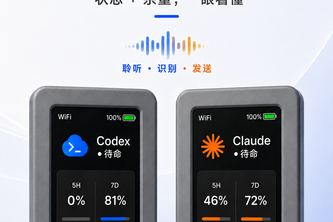
VibeStick is a self-reported physical console built for AI coding agents, specifically designed to monitor Codex workflows. The author states it uses an M5Stack StickS3 hardware device and integrates with macOS to display agent status, provide alerts, and support voice input.
What changed
The project description indicates the author built this as a personal solution to reduce the need for switching back to a computer to check AI agent progress. It is presented as a prototype or proof-of-concept submitted to an OpenAI hackathon.
Single most important open question
Is there any evidence of actual usage, adoption, or traction beyond the author’s own development and submission? The description does not indicate any commercial activity, user base, or revenue.
What The Product Actually Is
The description states that VibeStick is a physical console for AI coding agents, built using an M5Stack StickS3 device. It is designed to work with Codex workflows and includes:
- A display showing agent status (running, completed, waiting, error)
- Usage limit tracking (5-hour and 7-day limits)
- Device information (Wi-Fi, battery, time)
- Audio alerts for task completion or errors
- Voice input functionality that transcribes speech into actionable coding instructions
The system is composed of:
- Embedded firmware on the hardware device
- A local desktop service that reads Codex status and handles voice processing
- A macOS companion application with HUD (Heads-Up Display) for interaction
The author notes that the project was built using Codex to help implement features, troubleshoot communication, and improve documentation.
Claim: VibeStick is a hardware-software system integrating Codex monitoring with a physical console.
Evidence: Yes — from the author’s own write-up.
Positioning & Claim Evolution
The description states that the author built VibeStick to address a personal pain point: the need to constantly check a computer terminal for AI agent progress. It is positioned as a way to "stay aware of my AI agent’s progress without constantly watching the terminal."
It also claims that:
- The device brings agent status, usage limits, and alerts out of the computer window
- It supports voice input to convert speech into coding instructions
- It reduces the need for repeated terminal checks
Claim: VibeStick is a physical interface for AI agents, designed to reduce reliance on computer terminals.
Evidence: Yes — from the author’s own write-up.
Target Customer & ICP
The description does not explicitly state a target customer or ideal customer profile (ICP). It only notes that the device is built around Codex workflows and works with macOS. The author is the sole team member, suggesting this is a personal project or prototype.
Claim: The target customer is likely developers using Codex.
Inference: Based on the context of Codex and macOS integration.
Evidence: Not directly stated — only implied by the use case.
Business Model & Pricing Evidence
The description does not contain any information about pricing, monetization, or business model. It is presented as a prototype or hackathon submission with no indication of commercial intent or revenue streams.
Claim: No evidence of pricing or business model.
Evidence: Not evidenced.
Technical & Delivery Signals
The author states that VibeStick is built using:
- Hardware: M5Stack StickS3
- Software stack: C, Python, Swift, macOS, ESP-IDF, Wi-Fi
- Integration with: Codex, macOS, and local desktop services
- Features include: voice transcription, status display, alerts, and synchronization
The system is described as:
- Running embedded firmware on the device
- Using a local service to communicate with Codex
- Including a macOS HUD for interaction
Claim: VibeStick is a hardware-software integration using specific technologies.
Evidence: Yes — from the author’s own write-up.
Traction & Maturity Signals
The description does not include any evidence of traction, adoption, or user engagement. It is presented as a hackathon submission and personal project with no mention of:
- Customers
- Revenue
- Usage metrics
- Product-market fit
- Iteration history
Claim: No evidence of traction or maturity.
Evidence: Not evidenced.
Competitive Context
The description does not provide any information about competitors or the broader marketplace. It is unclear whether similar products exist, how VibeStick differentiates, or what the competitive landscape looks like.
Claim: No evidence of competitive context.
Evidence: Not evidenced.
Open Questions & Risks
- The project is a single-person effort with no team or external validation
- It is presented as a hackathon submission — not a commercial product
- No evidence of user adoption, revenue, or traction
- The author built it using Codex, but there is no indication of broader compatibility or scalability
- No mention of future development plans or roadmap
Claim: Risk of lack of traction and unproven market demand.
Evidence: Not evidenced — inferred from absence of data.
Questions the description leaves open
- What is the intended user base beyond personal use?
- Are there any plans to expand compatibility beyond Codex or macOS?
- Is this a one-off prototype, or are you planning to build a product for sale?
- How do you plan to monetize this product if at all?
- Have you tested it with other developers or users outside of your own workflow?
Overall Assessment
The description presents VibeStick as a personal prototype built for a hackathon, with no evidence of commercial traction, revenue, or user adoption. It is not clear whether this is intended to evolve into a product or if it remains a proof-of-concept.
Claim: Not a commercial product yet.
Evidence: Yes — from the author’s own write-up.
Assessment: No evidence of readiness for investment or partnership. The project is in early-stage development and lacks any indication of market traction, scalability, or business model.
User Stories BotA demo video on every pull request
Get a demo video on every new feature
GitHub App that watches your pull requests and records a narrated, captioned demo.
Save time on demo prep and make informed decisions faster with a video walkthrough of every new feature.
Source
Submitted to the OpenAI 2026 hackathon on Devpost. Project home on Devpost. Back to the full gallery on Devpost.
This competitive analysis was produced by top-founders.com (opens in a new tab)
Generated by a language model from this project's public Devpost page — its tagline, the author's own write-up and any built-with tags listed there — as captured in August 2026. Short quotations are the author's words. It is an opinion on the idea as a business, not on the people behind it, and it reflects the description as published then. If the project has moved on, request a correction below. The analysis is not independent research and contains no verified traction, revenue or customer data.
An independent guide by KFG International LLC — not affiliated with, endorsed by, or connected to Devpost or OpenAI.