

Archive position — measured, not model output
0 likes on Devpost
2,263 of the 7,850 archived projects have more likes, and 5,587 share exactly 0 — so this project's #3,621 place in the like-ranked listing is a tie-break inside that group, not a ranking.
Projects (log scale)
Likes on Devpost. ▲ marks this project's group.
Show the figures
| Likes | Projects | Share of archive |
|---|---|---|
| 0 | 5,587 | 71.2% |
| 1 | 1,758 | 22.4% |
| 2 | 284 | 3.6% |
| 3–4 | 132 | 1.7% |
| 5–9 | 75 | 1.0% |
| 10+ | 14 | 0.2% |
 User Stories BotA demo video on every pull request
Get a demo video on every new feature
GitHub App that watches your pull requests and records a narrated, captioned demo.
Save time on demo prep and make informed decisions faster with a video walkthrough of every new feature.
Executive Summary
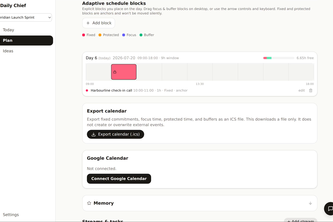
The company appears to be a solo project named Daily Chief, an AI chief of staff that ranks tasks based on capacity and context, with a focus on accountability and momentum tracking. The author states it was built over a fortnight as part of the OpenAI 2026 hackathon.
What changed: The description shows a self-reported attempt to build a personal productivity tool that combines task ranking, AI-driven personality, and commitment mechanisms. It is not clear if this has moved beyond prototype or if any commercial traction exists.
Single most important open question: Is there evidence of actual usage or revenue generation from Daily Chief, or is it purely a hackathon prototype?
What The Product Actually Is
The description states that Daily Chief is:
- An AI chief of staff
- A tool that ranks tasks based on capacity and context
- A system that asks two questions daily: "How many hours do you have?" and "How much is left in the tank?"
- A planner that uses five weighted signals to rank tasks:
- Project momentum (w)
- Deadline pressure (d)
- Energy fit (e)
- Staleness (s)
- Effort overflow (o)
The ranking algorithm is defined as:
$$\text{score} = 2w + 3d + 1.5e + s - 2o$$
It also includes:
- A persona layer with eight personas and thirteen moods
- An importance-versus-urgency board
- A wind map for tracking momentum per stream
- A chat interface that provides feedback in character
- Tools to move work around deep-work windows
- Cryptographic receipts for changes made
Not evidenced: No mention of actual customers, revenue, or adoption.
Positioning & Claim Evolution
The description states:
- The product was built to solve the problem of "pretending" not to do work that others are waiting on.
- It aims to prevent static planners from going stale by Tuesday.
- It combines elements from earlier prototypes: Tao (project momentum), a 30-day challenge tracker, and a mentor app.
- It positions itself as an AI assistant that does not let users pretend.
Inferred: The positioning evolved from solving personal productivity issues to building a tool that enforces accountability through AI.
Not evidenced: No evidence of market positioning beyond the author's own claims. No competitor comparison or target audience definition.
Target Customer & ICP
The description states:
- The primary user is likely a solo founder or individual working on multiple projects.
- It targets people who have "about fifty side projects and three customers waiting on quotes."
- It assumes users are looking for ways to manage time, momentum, and accountability.
Inferred: The ICP appears to be self-employed individuals or solo founders managing multiple streams of work.
Not evidenced: No explicit customer segmentation or persona data. No evidence of actual users beyond the author's own experience.
Business Model & Pricing Evidence
The description states:
- There is no mention of pricing.
- No business model is described.
- The project was built for a hackathon and has no commercial traction.
Not evidenced: No evidence of any revenue model, pricing structure, or monetization strategy.
Technical & Delivery Signals
The description states:
- Built with Next.js 15, React 19, TypeScript, Vercel
- Uses OpenAI's GPT-5.6-luna for chat and persona generation
- Uses Clerk for identity, Upstash Redis for state, Stripe for payments (though no payment flow is described)
- Includes cryptographic receipts using WebCrypto
- The app uses a deterministic ranking algorithm
- Persona lines fall back to hand-written versions if the model fails
Inferred: The technical stack suggests a modern web application with AI integration and some security features.
Not evidenced: No evidence of production deployment, scalability, or performance metrics.
Traction & Maturity Signals
The description states:
- This was built as a hackathon submission.
- It includes 257 tests across 31 files.
- There are no mentions of users, customers, or revenue.
- The demo video was created using synthetic inputs and recording tools.
Not evidenced: No evidence of traction, adoption, or user engagement beyond the author's own use case.
Competitive Context
The description states:
- It is positioned as a productivity tool that ranks tasks based on capacity.
- It combines elements from other apps like planners, task managers, and AI assistants.
- It references earlier prototypes but does not name competitors directly.
Inferred: The competitive landscape includes personal productivity tools, AI assistants, and task management platforms.
Not evidenced: No evidence of direct competition or market positioning against existing products.
Open Questions & Risks
The description states:
- The app was built in a short timeframe (fortnight) as a hackathon project.
- It has known bugs such as reload loops, test suite failures, and click handling issues.
- It relies heavily on AI models for personality but falls back to hand-written lines.
- There is no evidence of monetization or commercial viability.
Inferred: The risk is high due to lack of real-world testing, unproven business model, and reliance on a single developer.
Not evidenced: No evidence of market validation, user feedback, or long-term sustainability.
Questions the description leaves open
- What is the actual usage rate of Daily Chief beyond the author's own use?
- Has there been any external testing or feedback from users?
- Is there a plan to monetize this product, and how?
- How does the team intend to scale beyond a single developer?
- Are there any plans for community features or multi-user support?
- What are the technical challenges in moving from prototype to production?
Overall Assessment
The description states:
- This is a hackathon project submitted to the OpenAI 2026 hackathon.
- It has no evidence of revenue, customers, or traction.
- The author built it for personal use and as part of a competition.
Inferred: Given the lack of commercial evidence, this appears to be an early-stage prototype with no clear path to investment or partnership.
Not evidenced: No evidence of market demand, user base, or financial viability.
User Stories BotA demo video on every pull request
Get a demo video on every new feature
GitHub App that watches your pull requests and records a narrated, captioned demo.
Save time on demo prep and make informed decisions faster with a video walkthrough of every new feature.
Source
Submitted to the OpenAI 2026 hackathon on Devpost. Project home on Devpost. Back to the full gallery on Devpost.
This competitive analysis was produced by top-founders.com (opens in a new tab)
Generated by a language model from this project's public Devpost page — its tagline, the author's own write-up and any built-with tags listed there — as captured in August 2026. Short quotations are the author's words. It is an opinion on the idea as a business, not on the people behind it, and it reflects the description as published then. If the project has moved on, request a correction below. The analysis is not independent research and contains no verified traction, revenue or customer data.
An independent guide by KFG International LLC — not affiliated with, endorsed by, or connected to Devpost or OpenAI.