

Archive position — measured, not model output
0 likes on Devpost
2,263 of the 7,850 archived projects have more likes, and 5,587 share exactly 0 — so this project's #7,518 place in the like-ranked listing is a tie-break inside that group, not a ranking.
Projects (log scale)
Likes on Devpost. ▲ marks this project's group.
Show the figures
| Likes | Projects | Share of archive |
|---|---|---|
| 0 | 5,587 | 71.2% |
| 1 | 1,758 | 22.4% |
| 2 | 284 | 3.6% |
| 3–4 | 132 | 1.7% |
| 5–9 | 75 | 1.0% |
| 10+ | 14 | 0.2% |
 User Stories BotA demo video on every pull request
Get a demo video on every new feature
GitHub App that watches your pull requests and records a narrated, captioned demo.
Save time on demo prep and make informed decisions faster with a video walkthrough of every new feature.
Executive Summary
What the company appears to be
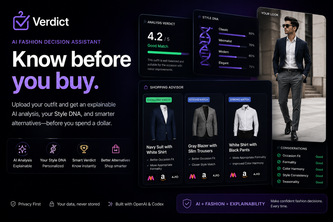
Assessment – Know Before You Buy is described as an AI-powered fashion purchase decision assistant. It claims to analyze outfits, explain recommendations, and suggest smarter alternatives before a purchase is made.
What changed
This project was submitted to the OpenAI 2026 hackathon on Devpost. No further development or commercial activity is evidenced.
Single most important open question
Is there any evidence of product-market fit, customer traction, or revenue generation? The description provides no information about these critical commercial signals.
What The Product Actually Is
The description states:
“Assessment is an AI-powered fashion purchase decision assistant that analyzes your outfit, explains every recommendation, and suggests smarter alternatives before you spend money.”
Inference Based on the author’s self-description, the product appears to be a consumer-facing tool that uses AI (likely via OpenAI APIs) and computer vision to assist users in making purchasing decisions about fashion items.
Evidence strength
- Claimed functionality: Yes
- Product architecture or features: Not detailed
- Technology stack: The author lists several technologies including GPT, Next.js, React, Node.js, Vercel, etc., but no technical specifications or product screenshots are provided.
Positioning & Claim Evolution
The description states:
“Assessment is an AI-powered fashion purchase decision assistant that analyzes your outfit, explains every recommendation, and suggests smarter alternatives before you spend money.”
Inference This is a self-positioned tool aimed at helping consumers make better shopping decisions by leveraging AI. It positions itself as a decision-support system rather than a marketplace or retailer.
Evidence strength
- Positioning: Yes (self-reported)
- Evolution of claims: Not evidenced — no prior versions, marketing history, or product evolution described
Target Customer & ICP
The description states:
“Assessment is an AI-powered fashion purchase decision assistant that analyzes your outfit, explains every recommendation, and suggests smarter alternatives before you spend money.”
Inference The target customer appears to be a consumer who shops for fashion and seeks guidance or reassurance before purchasing.
Evidence strength
- Target customer: Not explicitly defined
- Ideal Customer Profile (ICP): Not evidenced
Business Model & Pricing Evidence
The description states:
“Assessment is an AI-powered fashion purchase decision assistant that analyzes your outfit, explains every recommendation, and suggests smarter alternatives before you spend money.”
Inference No business model or pricing information is provided. The product appears to be a prototype or hackathon submission with no indication of monetization strategy.
Evidence strength
- Business model: Not evidenced
- Pricing: Not evidenced
Technical & Delivery Signals
The author lists the following technologies used:
“Built with (author-declared): api, computer-vision, github, gpt-5.6, next.js, node.js, openai, react, tailwindcss, typescript, vercel”
Inference This is a web-based application built using modern frontend and backend stacks, likely integrating OpenAI APIs for AI functionality and computer vision capabilities.
Evidence strength
- Technology stack: Yes (self-reported)
- Delivery mechanism: Not detailed
- Product delivery: Not evidenced
Traction & Maturity Signals
The description states:
“This project was submitted to the OpenAI 2026 hackathon on Devpost.”
Inference No evidence of traction, revenue, or adoption. The project is a hackathon submission, suggesting early-stage development.
Evidence strength
- Traction: Not evidenced
- Maturity: Not evidenced
Competitive Context
The description states:
“Assessment is an AI-powered fashion purchase decision assistant that analyzes your outfit, explains every recommendation, and suggests smarter alternatives before you spend money.”
Inference This product enters a space where AI-driven shopping assistants or style advisors exist. However, no competitive analysis or differentiation from existing players is provided.
Evidence strength
- Competitive landscape: Not evidenced
- Differentiation: Not evidenced
Open Questions & Risks
Inference
- The project is a hackathon submission with no evidence of further development or commercialization.
- No revenue, customers, or product-market fit are evident.
- The team size is listed as 1, suggesting limited execution capacity.
- Use of "GPT-5.6" (which does not exist) may indicate a lack of technical precision in the description.
Evidence strength
- Risks: Inferred from lack of evidence
- Open questions: Not directly stated but implied by absence of traction or product details
Questions the description leaves open
- What is the current stage of development beyond the hackathon submission?
- Have you conducted any user testing or gathered feedback on the product?
- Is there a plan to monetize this tool, and if so, what is the business model?
- How does Assessment differentiate from existing AI fashion tools in the market?
- What are your plans for scaling or expanding the product beyond its current scope?
Overall Assessment
Inference Given that this is a hackathon submission with no evidence of traction, revenue, or customer adoption, there is insufficient basis to recommend investment or partnership at this time.
Evidence strength
- Assessment: Not evidenced
- Investment potential: Not evidenced
User Stories BotA demo video on every pull request
Get a demo video on every new feature
GitHub App that watches your pull requests and records a narrated, captioned demo.
Save time on demo prep and make informed decisions faster with a video walkthrough of every new feature.
Source
Submitted to the OpenAI 2026 hackathon on Devpost. Project home on Devpost. Back to the full gallery on Devpost.
This competitive analysis was produced by top-founders.com (opens in a new tab)
Generated by a language model from this project's public Devpost page — its tagline and any built-with tags listed there, since the author published no write-up — as captured in August 2026. Short quotations are the author's words. It is an opinion on the idea as a business, not on the people behind it, and it reflects the description as published then. If the project has moved on, request a correction below. The analysis is not independent research and contains no verified traction, revenue or customer data.
An independent guide by KFG International LLC — not affiliated with, endorsed by, or connected to Devpost or OpenAI.