

Archive position — measured, not model output
2 likes on Devpost
221 of the 7,850 archived projects have more likes, and 284 share exactly 2 — so this project's #490 place in the like-ranked listing is a tie-break inside that group, not a ranking.
Projects (log scale)
Likes on Devpost. ▲ marks this project's group.
Show the figures
| Likes | Projects | Share of archive |
|---|---|---|
| 0 | 5,587 | 71.2% |
| 1 | 1,758 | 22.4% |
| 2 | 284 | 3.6% |
| 3–4 | 132 | 1.7% |
| 5–9 | 75 | 1.0% |
| 10+ | 14 | 0.2% |
 User Stories BotA demo video on every pull request
Get a demo video on every new feature
GitHub App that watches your pull requests and records a narrated, captioned demo.
Save time on demo prep and make informed decisions faster with a video walkthrough of every new feature.
Executive Summary
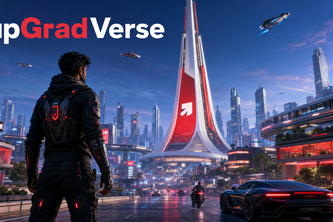
The description states that upGradVerse is a browser-native 3D learning world where AI skills become places, missions, and repeatable practice. The author, Kish Kumar, built a prototype using OpenAI Codex (GPT-5.6) as the primary engineering collaborator, with no runtime calls to OpenAI APIs. It includes three visual learning spaces, six playable characters, multiple vehicles, a phone gamepad, and a narrated 60fps demo. The project was submitted for OpenAI Build Week and is described as deployed and controller-tested.
The most important open question is whether the prototype demonstrates sufficient commercial viability or traction to warrant further due-diligence attention — which cannot be determined from this self-reported description alone.
What The Product Actually Is
The description states that upGradVerse is a browser-native 3D learning world where AI skills become places, missions, and repeatable practice. It includes:
- A cyber-city environment with traffic, flying vehicles, an elevated metro, and a fight ring
- Six playable characters
- Modular Skill Shops (three visual learning spaces: ChatGPT Skill Shop, Claude Artifact Studio, upGrad Skill Shop)
- Support for DualSense controller or keyboard input
- A same-Wi-Fi phone controller
- Visual missions inspired by Data Science, Full Stack Development, and Digital Marketing
The author claims the prototype was built using OpenAI Codex running GPT-5.6 Sol with high reasoning, which translated feedback into implementation work, coordinated fixes, integrated systems, debugged animations, and verified deployment.
Inference: The product is described as a playable 3D prototype, not a commercial offering. It uses Three.js, Vite, JavaScript, GLTFLoader, Web Audio APIs, and Gamepad API for delivery.
Positioning & Claim Evolution
The description states that the inspiration behind upGradVerse was to make AI skills feel like a world you can enter, rather than another page of videos. The author notes that AI skills change faster than traditional course catalogues and emphasizes practical decisions such as choosing the right level of intelligence, supplying useful context, checking evidence, recovering from failure, and verifying an output before shipping.
The author also states that the concept was reviewed and appreciated internally by upGrad leadership, including the CEO, and received permission to submit it individually for OpenAI Build Week.
Inference: The positioning appears to be a gamified approach to AI skill development, aiming to make learning more immersive and interactive than traditional video-based instruction. However, there is no evidence of market traction or adoption beyond this prototype.
Target Customer & ICP
The description states that the project includes Skill Shops inspired by Data Science, Full Stack Development, and Digital Marketing. It also mentions that educators may publish versioned Skill Shops in the future.
Inference: The target customer appears to be learners interested in AI skills development, particularly those studying data science, full stack development, or digital marketing. However, there is no evidence of actual customers or user segments identified beyond this prototype's scope.
Business Model & Pricing Evidence
The description does not provide any information about pricing or business model. It mentions that the author intends to connect Skill Shops to live OpenAI models, structured evaluations, and personalized feedback, but does not elaborate on monetization strategies.
Inference: No evidence of a defined business model or pricing structure is provided in the self-reported description.
Technical & Delivery Signals
The description states that the prototype was built using:
- OpenAI Codex running GPT-5.6 Sol with high reasoning
- Three.js, Vite, modern JavaScript, HTML/CSS
- Gamepad and Web Audio APIs
- GLTFLoader for 3D assets
- Local WebSocket relay logic for phone controller
- Vercel hosting
The author also notes that the current executable does not call the OpenAI API at runtime; GPT-5.6 was used as an engineering layer during development.
Inference: The technical stack suggests a browser-native, interactive 3D experience with AI-assisted development. However, there is no evidence of production deployment or scalability beyond this prototype.
Traction & Maturity Signals
The description states that the author completed the meaningful Build Week extension in roughly two focused days while balancing other live work. The result is described as a deployed, controller-tested 3D product with:
- Six playable characters
- Three Skill Shops
- Multiple vehicles
- A phone gamepad
- Licensed assets with attribution
- A narrated 60fps demo
- A complete public source repository
Inference: There is no evidence of revenue, customers, or adoption beyond the prototype. The project is described as a playable prototype, not a commercial product.
Competitive Context
The description does not provide any information about competitors or competitive positioning. It mentions that the concept was reviewed and appreciated internally by upGrad leadership but does not compare upGradVerse to existing solutions in the market.
Inference: No evidence of competitive landscape or differentiation is provided.
Open Questions & Risks
- The project is described as a prototype with no runtime calls to OpenAI APIs, suggesting limited real-world AI integration
- There is no evidence of revenue, customers, or adoption beyond the author's own development efforts
- The business model and pricing are not defined
- The team size is listed as one member (the author)
- No third-party validation or external feedback is mentioned
Inference: The lack of traction, revenue, or customer data raises questions about commercial viability. The single-person team and prototype-only status suggest a high-risk, early-stage project.
Questions the description leaves open
- What specific AI models will be integrated into the Skill Shops in the future?
- How does upGradVerse plan to monetize its platform?
- Has there been any external validation or feedback from educators or learners beyond internal review?
- What is the roadmap for scaling beyond the current prototype?
- Are there any partnerships or collaborations planned with educational institutions or AI providers?
Overall Assessment
The description states that upGradVerse is a browser-native 3D learning world where AI skills become places, missions, and repeatable practice. It includes three visual learning spaces, six playable characters, multiple vehicles, and a phone gamepad.
Inference: Based on the self-reported description alone, there is insufficient evidence to support an investment or partnership decision. The project remains at the prototype stage with no demonstrated traction, revenue, or customer base. The single-person team and lack of business model details raise significant concerns about commercial viability. Further due-diligence would require verification of claims, evidence of market demand, and demonstration of scalability beyond this initial prototype.
User Stories BotA demo video on every pull request
Get a demo video on every new feature
GitHub App that watches your pull requests and records a narrated, captioned demo.
Save time on demo prep and make informed decisions faster with a video walkthrough of every new feature.
Source
Submitted to the OpenAI 2026 hackathon on Devpost. Project home on Devpost. Back to the full gallery on Devpost.
This competitive analysis was produced by top-founders.com (opens in a new tab)
Generated by a language model from this project's public Devpost page — its tagline, the author's own write-up and any built-with tags listed there — as captured in August 2026. Short quotations are the author's words. It is an opinion on the idea as a business, not on the people behind it, and it reflects the description as published then. If the project has moved on, request a correction below. The analysis is not independent research and contains no verified traction, revenue or customer data.
An independent guide by KFG International LLC — not affiliated with, endorsed by, or connected to Devpost or OpenAI.