

Archive position — measured, not model output
0 likes on Devpost
2,263 of the 7,850 archived projects have more likes, and 5,587 share exactly 0 — so this project's #4,416 place in the like-ranked listing is a tie-break inside that group, not a ranking.
Projects (log scale)
Likes on Devpost. ▲ marks this project's group.
Show the figures
| Likes | Projects | Share of archive |
|---|---|---|
| 0 | 5,587 | 71.2% |
| 1 | 1,758 | 22.4% |
| 2 | 284 | 3.6% |
| 3–4 | 132 | 1.7% |
| 5–9 | 75 | 1.0% |
| 10+ | 14 | 0.2% |
 User Stories BotA demo video on every pull request
Get a demo video on every new feature
GitHub App that watches your pull requests and records a narrated, captioned demo.
Save time on demo prep and make informed decisions faster with a video walkthrough of every new feature.
Executive Summary
What the company appears to be
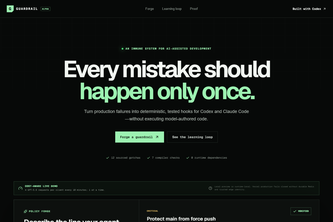
Guardrail is a self-reported tool that claims to offer a deterministic, attack-tested guardrail system for AI-assisted development environments like Codex or Claude Code. It allows users to define security or operational rules in plain English and converts them into installable protections using a combination of LLMs (specifically GPT-5.6) for policy design and deterministic compilers for execution.
What changed
The project was submitted as part of the OpenAI 2026 hackathon, indicating it is an early-stage prototype or proof-of-concept. The author states that the system avoids trusting LLMs to write executable code directly by using a strict separation between policy design and implementation.
Single most important open question
Is there any evidence of real-world usage, testing, or adoption beyond this hackathon submission? The description contains no data on customers, revenue, traction, or even whether the system has been deployed in production.
What The Product Actually Is
The description states that Guardrail is a system designed to turn plain-English rules or sanitized incidents into installable protections for AI coding agents like Codex or Claude Code. It uses GPT-5.6 via the OpenAI Responses API with Structured Outputs to generate a declarative PolicyBlueprint, which includes conditions, rationale, limitations, and proposed fixtures. A deterministic compiler—not the model—generates JavaScript hooks and platform configurations.
The system runs seven static checks and executes proposed fixtures against a deterministic policy engine before marking anything as verified. It also preserves source URL, verification date, confidence, severity, and lessons locally to prevent tribal memory from persisting.
Evidence
- The author describes how GPT-5.6 is used only for schema-validated policy data generation.
- A deterministic compiler emits JavaScript hooks without runtime dependencies.
- The system requires both blocking fixtures and safe near misses to pass verification.
- Artifacts include hook, config, install steps, evidence, limitations, and server-side control.
Inference This appears to be a prototype or hackathon project focused on secure AI agent integration, not a commercial product with real users or revenue.
Positioning & Claim Evolution
The author positions Guardrail as an “immune system” for AI-assisted development. It aims to prevent production mistakes by turning them into reusable guardrails rather than relying on trust in model-generated code.
Claims made
- Guardrail turns one production mistake into a deterministic, attack-tested guardrail.
- The system ensures that models help design policies but never own executable surfaces.
- It uses a strict trust boundary where schema-valid JSON does not equate to truth.
- A learning loop preserves lessons from failures so they become reflexive protections.
Inference The positioning reflects a concern around AI agent safety and the need for deterministic controls in development workflows. However, there is no evidence of prior market positioning or customer feedback beyond this submission.
Target Customer & ICP
The description does not explicitly name target customers or personas. It implies that developers working with AI coding agents like Codex or Claude Code are likely users.
Claims made
- Guardrail protects AI-assisted development environments.
- Users define rules in plain English.
- The system supports both Codex and Claude Code adapters.
Inference The target audience seems to be developers or DevOps engineers who use AI coding tools and want to enforce safety or operational policies. However, no specific ICP is defined beyond this general assumption.
Business Model & Pricing Evidence
There is no evidence of pricing, business model, or monetization strategy in the description.
Claims made
- Not stated.
Inference Given that this is a hackathon submission and no revenue or customer data are provided, it's unclear if any business model exists beyond its current prototype form.
Technical & Delivery Signals
The system uses:
- GPT-5.6 via OpenAI Responses API with Structured Outputs
- Codex and Claude Code adapters
- Deterministic compiler for hook generation
- Playwright for QA testing
- React, Next.js, TypeScript, Vitest, Zod, Upstash Redis
Claims made
- No runtime dependencies.
- Avoids eval, subprocess spawning, or network access.
- Uses separate adapters for Codex and Claude Code due to differing hook payloads.
- Static checks and execution gates ensure artifact integrity.
Inference The technical stack suggests a modern web-based tool with strong emphasis on security through determinism. However, no evidence of deployment, scalability, or performance metrics is available.
Traction & Maturity Signals
There is no evidence of traction, adoption, or maturity beyond the hackathon submission.
Claims made
- The system passes 40 tests across seven files.
- Typecheck, lint, and production build pass.
- Session trails are recorded in Git history.
Inference This indicates a functional prototype but does not suggest real-world usage or product-market fit. No metrics on user engagement, retention, or performance are reported.
Competitive Context
The description does not mention competitors or existing solutions in the space.
Claims made
- Not stated.
Inference Without explicit references to competitors or market positioning, it's impossible to assess how Guardrail fits into the broader landscape of AI agent security tools. The lack of competitive analysis is notable.
Open Questions & Risks
Several key risks and open questions emerge from the self-reported description:
- No real-world usage: This is a hackathon project with no evidence of actual deployment or adoption.
- Unverified claims: The system's effectiveness relies on assumptions about determinism, which are not independently validated.
- Limited scope: Only Codex and Claude Code are supported; no expansion plans described.
- No commercial viability: No pricing, business model, or monetization strategy is evident.
- Self-contained nature: The tool appears to be a private-repo test path, not a public-facing service.
Inference Guardrail lacks the foundational elements of a scalable product—traction, customers, revenue, or even basic deployment history. It remains an unproven concept at best.
Questions the description leaves open
- What specific operational or security incidents inspired this project?
- Has the system been tested in any real-world AI coding environments beyond the prototype?
- Are there plans to expand support beyond Codex and Claude Code?
- How does Guardrail integrate with existing CI/CD pipelines or DevOps practices?
- Is there a roadmap for moving from a private-repo test path to a public, hosted solution?
- What are the long-term goals for monetization or product development?
Overall Assessment
Not evidenced.
The description provides no information on financials, traction, customer base, or commercial viability. It is a self-reported hackathon submission with no evidence of real-world application or market validation.
Confidence Level Low This analysis is based entirely on the author’s own account and lacks any external corroboration or measurable outcomes. The project shows potential in concept but has not demonstrated any meaningful progress toward becoming a viable product or business.
User Stories BotA demo video on every pull request
Get a demo video on every new feature
GitHub App that watches your pull requests and records a narrated, captioned demo.
Save time on demo prep and make informed decisions faster with a video walkthrough of every new feature.
Source
Submitted to the OpenAI 2026 hackathon on Devpost. Project home on Devpost. Back to the full gallery on Devpost.
This competitive analysis was produced by top-founders.com (opens in a new tab)
Generated by a language model from this project's public Devpost page — its tagline, the author's own write-up and any built-with tags listed there — as captured in August 2026. Short quotations are the author's words. It is an opinion on the idea as a business, not on the people behind it, and it reflects the description as published then. If the project has moved on, request a correction below. The analysis is not independent research and contains no verified traction, revenue or customer data.
An independent guide by KFG International LLC — not affiliated with, endorsed by, or connected to Devpost or OpenAI.