

Archive position — measured, not model output
0 likes on Devpost
2,263 of the 7,850 archived projects have more likes, and 5,587 share exactly 0 — so this project's #4,418 place in the like-ranked listing is a tie-break inside that group, not a ranking.
Projects (log scale)
Likes on Devpost. ▲ marks this project's group.
Show the figures
| Likes | Projects | Share of archive |
|---|---|---|
| 0 | 5,587 | 71.2% |
| 1 | 1,758 | 22.4% |
| 2 | 284 | 3.6% |
| 3–4 | 132 | 1.7% |
| 5–9 | 75 | 1.0% |
| 10+ | 14 | 0.2% |
 User Stories BotA demo video on every pull request
Get a demo video on every new feature
GitHub App that watches your pull requests and records a narrated, captioned demo.
Save time on demo prep and make informed decisions faster with a video walkthrough of every new feature.
Executive Summary
What the company appears to be
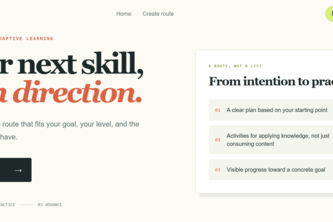
SkillSprint AI is an adaptive learning application designed for professionals seeking to reskill or upskill through structured, evidence-based sprints. It uses GPT-5.6 and Codex to generate personalized learning paths, challenges, and evaluations based on user-defined goals and current skill levels.
What changed
The project evolved from a simple roadmap generator into a complete adaptive learning workflow that includes diagnostics, sprint planning, practical challenges, evidence evaluation, and deterministic adaptation decisions.
Single most important open question
Is there sufficient evidence of real-world usage or user feedback to validate the effectiveness of its adaptive learning model?
What The Product Actually Is
The description states that SkillSprint AI is an adaptive learning application for professionals aiming to reskill or upskill. It creates personalized learning journeys using:
- GPT-5.6 for generating diagnostic assessments, learning routes, challenges, and rubrics.
- Codex for software development support.
- A backend engine that evaluates submitted evidence (code, explanations, etc.) against weighted rubrics.
- Deterministic adaptation rules to determine next steps in the learning journey.
It does not appear to be a traditional LMS or course delivery platform. Instead, it focuses on learning execution, where users build and explain what they learn rather than passively consume content.
Inference The product is built as a web application using Next.js, React, TypeScript, Node.js, and Vercel-compatible infrastructure.
Positioning & Claim Evolution
The author claims that SkillSprint AI addresses the gap between access to information and real capability. It positions itself as an evidence-based adaptive learning system, not just another course catalog or content delivery tool.
Key claims:
- Learners define their goals, current level, availability, and preferred style.
- The system generates a structured learning route with sprints, challenges, and rubrics.
- Evaluation is based on submitted evidence (code, YAML, JSON) rather than watched videos or quizzes.
- It uses AI to assess performance but applies backend logic for final decisions.
Inference This is a shift from passive consumption toward active demonstration of competence, supported by AI-generated scaffolding and structured feedback loops.
Target Customer & ICP
The description states that SkillSprint targets IT professionals who need to continuously update their knowledge due to rapid industry changes driven by AI.
It also mentions:
- A 56-year-old IT professional as the inspiration for the product.
- The goal of helping users convert learning goals into measurable and demonstrable capabilities.
Inference The primary ICP appears to be mid-to-senior-level technical professionals looking to reskill or upskill in a focused, practical way — particularly those in fast-moving fields like software development or data science.
Business Model & Pricing Evidence
There is no evidence provided about pricing models, monetization strategies, or business model assumptions. The description does not mention any revenue streams, subscriptions, or commercial partnerships.
Not evidenced
Technical & Delivery Signals
The project was built with:
- Next.js 16, React 19, TypeScript
- OpenAI API (GPT-5.6) for AI generation
- Codex for software development support
- Zod for validation
- Node.js native test runner with TSX
- Vercel-compatible infrastructure
Endpoints include:
/api/diagnostic-questions/api/learning-routes/api/evaluate-evidence/api/health
The system uses:
- Structured outputs via JSON schema
- Strict validation of inputs and model responses
- Separation between AI recommendations and backend authority
- Prompt injection safeguards
Inference The architecture shows a strong focus on trust and safety, especially around handling untrusted user input, validating AI responses, and maintaining deterministic control over learning decisions.
Traction & Maturity Signals
The project is described as a hackathon submission (submitted to the OpenAI 2026 hackathon). It includes:
- 87 automated tests
- TypeScript validation
- ESLint checks
- Production build verification
However, there is no evidence of:
- Real users or customer feedback
- Revenue or monetization
- Customer acquisition or retention metrics
- Product-market fit indicators
Not evidenced
Competitive Context
The description does not mention competitors or direct market positioning. It implies that existing platforms do not adequately support learning execution and demonstration, focusing instead on content consumption.
Inference SkillSprint may compete with:
- Traditional LMS systems (e.g., Coursera, Udemy)
- Coding bootcamps
- AI-powered learning tools like Duolingo or Khan Academy (though less directly)
But it seems to target a niche where real-world application and capability proof are emphasized over content delivery.
Open Questions & Risks
- No traction or user data: The project is described as a hackathon prototype with no evidence of real usage.
- AI dependency without clear control mechanisms: While the backend recalculates scores, the system still heavily relies on GPT-5.6 for route creation and evaluation — raising questions about consistency and reliability.
- Limited scope in current version: The tool is described as a "stabilized" hackathon version with many future features planned (e.g., GitHub integration, mentor review).
- Unproven business model: No indication of how the product will generate revenue or scale beyond its initial prototype.
Questions the description leaves open
- What is the actual user feedback or pilot data from early adopters?
- How does the system handle edge cases in evidence evaluation (e.g., ambiguous submissions)?
- Are there any plans to integrate with existing LMS platforms or enterprise systems?
- How do you plan to scale beyond a single developer team?
- What are your assumptions about user behavior and motivation for completing sprints?
- Can you describe how the adaptive logic will evolve as more data becomes available?
Overall Assessment
This is a self-reported prototype submitted to a hackathon, with no verified traction or commercial evidence.
The product concept appears well-thought-out and addresses a real need in professional upskilling — particularly for technical roles. However, the lack of user data, revenue, or market validation makes it difficult to assess its viability as an investment or partnership opportunity.
Confidence level: Low
Assessment Not ready for investment or partnership without further evidence of traction, user engagement, or business model development.
User Stories BotA demo video on every pull request
Get a demo video on every new feature
GitHub App that watches your pull requests and records a narrated, captioned demo.
Save time on demo prep and make informed decisions faster with a video walkthrough of every new feature.
Source
Submitted to the OpenAI 2026 hackathon on Devpost. Project home on Devpost. Back to the full gallery on Devpost.
This competitive analysis was produced by top-founders.com (opens in a new tab)
Generated by a language model from this project's public Devpost page — its tagline, the author's own write-up and any built-with tags listed there — as captured in August 2026. Short quotations are the author's words. It is an opinion on the idea as a business, not on the people behind it, and it reflects the description as published then. If the project has moved on, request a correction below. The analysis is not independent research and contains no verified traction, revenue or customer data.
An independent guide by KFG International LLC — not affiliated with, endorsed by, or connected to Devpost or OpenAI.