

Archive position — measured, not model output
1 like on Devpost
505 of the 7,850 archived projects have more likes, and 1,758 share exactly 1 — so this project's #2,139 place in the like-ranked listing is a tie-break inside that group, not a ranking.
Projects (log scale)
Likes on Devpost. ▲ marks this project's group.
Show the figures
| Likes | Projects | Share of archive |
|---|---|---|
| 0 | 5,587 | 71.2% |
| 1 | 1,758 | 22.4% |
| 2 | 284 | 3.6% |
| 3–4 | 132 | 1.7% |
| 5–9 | 75 | 1.0% |
| 10+ | 14 | 0.2% |
 User Stories BotA demo video on every pull request
Get a demo video on every new feature
GitHub App that watches your pull requests and records a narrated, captioned demo.
Save time on demo prep and make informed decisions faster with a video walkthrough of every new feature.
Executive Summary
What the company appears to be
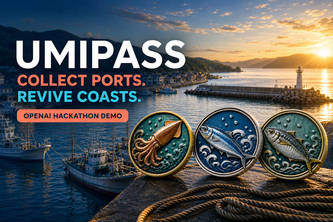
UMIPASS is a mobile-first stamp rally application for fishing ports in Japan, designed for everyday travelers. The author describes it as a "friendly" tool that allows users to discover nearby ports, collect stamps, and optionally contribute observations via AI-assisted tools. It uses a combination of browser-based geolocation, Cloudflare D1 for data persistence, and GPT-5.6 for structuring optional user-submitted photos into human-reviewable drafts.
What changed
The project is a prototype submitted to the OpenAI 2026 hackathon. It includes a demo flow for signed-out users and an authenticated path with check-in validation and AI observation features. The author emphasizes that this is a proof-of-concept, not a production system, and that no real port data or rewards are currently active.
Single most important open question
Is there a viable commercial model or user base beyond the hackathon prototype? The description does not indicate any revenue, customers, or traction beyond the author’s own development efforts.
What The Product Actually Is
The description states that UMIPASS is a mobile-first stamp rally application for fishing ports in Japan. It allows users to:
- Discover nearby ports using on-device geolocation.
- Collect stamps at designated checkpoints.
- Optionally submit photos and notes via an AI tool (GPT-5.6) that organizes them into human-reviewable drafts.
- Maintain separate private login identities and public display names.
- View rankings and passport data.
The product is built with Next.js, React, TypeScript, and uses Cloudflare Workers, D1, and OpenAI APIs. It includes a demo mode for signed-out users and an authenticated path with GPS validation and AI integration.
Evidence
- “UMIPASS is a friendly, mobile-first fishing-port stamp rally designed for everyday travelers, not engineers.”
- “The authenticated check-in path validates a 90-second one-time challenge and at least three location samples over 15 seconds.”
- “Optional Sea Guard AI accepts a selected test photo and note for GPT-5.6 to organize as normal_candidate, needs_review, or unknown.”
Inference The product is a prototype built for a hackathon, not a production-ready service.
Positioning & Claim Evolution
The author positions UMIPASS as a way to:
- Encourage travelers to engage with coastal communities.
- Turn port visits into meaningful experiences.
- Use AI to help organize user-submitted observations without replacing human judgment.
- Respect the working nature of fishing ports by not treating them as tourist attractions.
It is described as a “delightful collection experience” that aims to create interest in coastal communities. The author also notes that it does not aim to replace professional inspections or public administration.
Evidence
- “A delightful collection experience can create interest in coastal communities.”
- “Neither AI nor tourism should be presented as a substitute for harbor safety procedures, professional inspection, or public administration.”
- “The stamp rally still works if AI is unavailable, but UMIPASS loses its bridge from a traveler's observation to a human-reviewable candidate.”
Inference The positioning is centered on community engagement and responsible use of technology, not monetization or scale.
Target Customer & ICP
The author describes the target user as an “everyday traveler,” not an engineer. The product is designed for people who want to explore coastal areas in Japan and collect stamps from fishing ports.
Evidence
- “UMIPASS is a friendly, mobile-first fishing-port stamp rally designed for everyday travelers, not engineers.”
- “Visitors may notice issues involving signs, lighting, litter, or fences...”
Inference The ICP is likely casual tourists or local explorers interested in Japan’s coastal culture and geography.
Business Model & Pricing Evidence
There is no evidence of a business model or pricing structure in the description. The author states that no prize value is attached to stamps, and that AI does not have authority to modify scores or rankings.
Evidence
- “No prize or financial value is attached.”
- “The stamp rally still works if AI is unavailable...”
- “Every result requires human review, and the model has no permission to alter identity, stamps, scores, rankings, checkpoint status, or administrative decisions.”
Inference It appears that the project is not monetized at this stage.
Technical & Delivery Signals
The application uses:
- Next.js, React, TypeScript
- Cloudflare Workers for backend
- D1 for data storage
- OpenAI GPT-5.6 with Structured Outputs
- Browser-based geolocation and on-device calculations
- ChatGPT for authentication
It includes features like one-time check-in challenges, replay protection, and idempotency checks.
Evidence
- “The application uses Next.js, React, and TypeScript.”
- “vinext runs its route handlers on Cloudflare Workers.”
- “The authenticated check-in path validates a 90-second one-time challenge and at least three location samples over 15 seconds.”
Inference The technical stack is modern and focused on mobile-first delivery with privacy-conscious design.
Traction & Maturity Signals
There is no evidence of traction, revenue, or customer adoption. The project is described as a prototype submitted to a hackathon. It includes automated tests and linting but lacks any indication of real-world usage or user engagement.
Evidence
- “As of July 19, 2026, lint, TypeScript checks, the production build, and 48 automated tests pass.”
- “This is a prototype submitted to the OpenAI 2026 hackathon.”
Inference The product has not yet reached a user-facing or monetized stage.
Competitive Context
The description does not mention any direct competitors. The author focuses on the unique positioning of combining stamp collecting with AI observation tools and community engagement, without reference to existing similar products.
Evidence
- No mention of competitors or market analysis.
Inference No competitive landscape is evident from the provided information.
Open Questions & Risks
- Prototype-only: The project is a hackathon prototype with no real-world data or user base.
- AI dependency without authority: GPT-5.6 is used for structuring but not for decision-making, which may limit its utility if not integrated into a larger system.
- No commercial viability: No evidence of monetization, customer acquisition, or revenue model.
- Limited scope: Only three demo ports are mentioned, and all are unverified.
Evidence
- “As of July 19, 2026, lint, TypeScript checks, the production build, and 48 automated tests pass; npm audit reports zero known dependency vulnerabilities.”
- “All three current ports are demo-unverified, so authenticated awards fail closed.”
Questions the description leaves open
- What is the plan for transitioning from a hackathon prototype to a scalable product?
- How will you validate that the AI tool adds real value beyond manual review?
- Are there any partnerships or local stakeholders involved in planning the pilot phase?
- What are your plans for user acquisition and engagement beyond the demo?
- How do you intend to handle privacy, data retention, and compliance at scale?
Overall Assessment
Not evidenced.
The description does not provide any evidence of a viable business model, revenue, or traction. It is a self-reported hackathon prototype with no indication of commercial potential or user adoption.
Confidence Low. The project is described as experimental and unproven in real-world conditions.
User Stories BotA demo video on every pull request
Get a demo video on every new feature
GitHub App that watches your pull requests and records a narrated, captioned demo.
Save time on demo prep and make informed decisions faster with a video walkthrough of every new feature.
Source
Submitted to the OpenAI 2026 hackathon on Devpost. Project home on Devpost. Back to the full gallery on Devpost.
This competitive analysis was produced by top-founders.com (opens in a new tab)
Generated by a language model from this project's public Devpost page — its tagline, the author's own write-up and any built-with tags listed there — as captured in August 2026. Short quotations are the author's words. It is an opinion on the idea as a business, not on the people behind it, and it reflects the description as published then. If the project has moved on, request a correction below. The analysis is not independent research and contains no verified traction, revenue or customer data.
An independent guide by KFG International LLC — not affiliated with, endorsed by, or connected to Devpost or OpenAI.