

Archive position — measured, not model output
0 likes on Devpost
2,263 of the 7,850 archived projects have more likes, and 5,587 share exactly 0 — so this project's #7,355 place in the like-ranked listing is a tie-break inside that group, not a ranking.
Projects (log scale)
Likes on Devpost. ▲ marks this project's group.
Show the figures
| Likes | Projects | Share of archive |
|---|---|---|
| 0 | 5,587 | 71.2% |
| 1 | 1,758 | 22.4% |
| 2 | 284 | 3.6% |
| 3–4 | 132 | 1.7% |
| 5–9 | 75 | 1.0% |
| 10+ | 14 | 0.2% |
 User Stories BotA demo video on every pull request
Get a demo video on every new feature
GitHub App that watches your pull requests and records a narrated, captioned demo.
Save time on demo prep and make informed decisions faster with a video walkthrough of every new feature.
Executive Summary
What the company appears to be
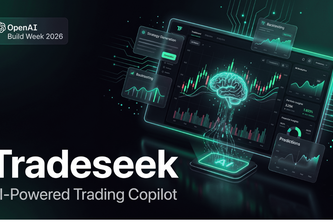
Tradeeek is an AI-powered trading copilot that allows users to describe trading strategies in natural language and receive automated support for generating, backtesting, optimizing, and deploying those strategies. It is presented as a platform designed to democratize algorithmic trading by removing technical barriers.
What changed
The project was developed during the OpenAI 2026 hackathon, with an emphasis on rapid prototyping using AI tools like Codex and OpenAI models. The author describes it as a working product that demonstrates how AI can simplify complex quantitative workflows in trading.
Single most important open question — the commercial due-diligence read
Is there evidence of real-world demand or traction from actual traders, or is this a proof-of-concept built for a hackathon?
What The Product Actually Is
The description states that Tradeeek is an AI-native platform designed to help traders build, test, and deploy trading strategies without needing advanced programming knowledge. It supports:
- Natural language strategy generation
- Backtesting on historical data
- Visualization of performance metrics (returns, drawdown, Sharpe ratio)
- AI-powered explanations of trading logic
- Strategy optimization
- Deployment through broker APIs
- An AI assistant for learning and improving strategies
It also includes an interactive dashboard for monitoring strategy performance.
Inference The product is described as a unified AI-powered experience that integrates multiple aspects of algorithmic trading into one interface, but no actual functionality or live data is evidenced in the description.
Positioning & Claim Evolution
The author positions Tradeeek as a tool that democratizes algorithmic trading by enabling users to describe their ideas in natural language and have them executed via AI. It is framed as an alternative to traditional platforms where traders must learn multiple tools, write code, or manually manage infrastructure.
Key Claims
- “What if traders could simply describe their trading idea in natural language, and AI could generate, explain, backtest, optimize, and prepare it for deployment?”
- “Tradeseek transforms complex quantitative trading workflows into simple conversations with AI.”
- “We believe the future of trading is not just automation—it is intelligent collaboration between humans and AI.”
Inference The positioning implies a shift from code-heavy to conversational-based trading, but there is no evidence that this approach has been validated in practice or adopted by users beyond the hackathon.
Target Customer & ICP
The description identifies retail traders as the primary audience. It states:
- “Algorithmic trading has become increasingly popular, yet building and deploying trading strategies remains difficult for most retail traders.”
- “We asked ourselves a simple question: What if traders could simply describe their trading idea in natural language…”
Inference The target customer is likely someone who wants to engage in algorithmic trading but lacks technical skills or time to learn complex systems. However, no specific segment or persona details are provided.
Business Model & Pricing Evidence
There is no mention of pricing, monetization strategy, or business model in the description.
Not evidenced No information on how the platform will generate revenue, whether it’s free-to-use, subscription-based, transactional, or otherwise.
Technical & Delivery Signals
The project was built using:
- Frontend: Next.js, React, TypeScript, Tailwind CSS
- Backend: Python, FastAPI, PostgreSQL (Neon), Redis
- AI Layer: Open source models, AI agents, prompt engineering, OpenAI Codex
- Infrastructure: Vercel, Oracle Cloud (later scope), broker APIs, market data APIs
Inference The architecture suggests a modern, scalable stack suitable for future production deployment. However, no evidence of actual live usage or performance metrics is provided.
Traction & Maturity Signals
The project was submitted to the OpenAI 2026 hackathon and described as a working prototype built in a short timeframe.
Not evidenced No customer base, revenue, user engagement, or adoption data exists beyond the author’s own account. The product is explicitly labeled as a hackathon submission with no indication of traction post-hackathon.
Competitive Context
The description does not reference existing competitors or market positioning relative to them.
Not evidenced No mention of competing platforms, their features, or how Tradeeek differentiates itself in the marketplace.
Open Questions & Risks
- Unproven demand: The product is described as a hackathon prototype with no evidence of real-world usage or user feedback.
- AI reliability concerns: The system relies heavily on AI for strategy generation and explanation, which may not be reliable enough for financial decisions without further validation.
- Lack of business model clarity: No indication of how the platform will monetize or sustain itself beyond its initial development phase.
- Technical complexity assumptions: While the architecture is described as scalable, no evidence shows it has been tested at scale or integrated with real brokers.
Questions the description leaves open
- What specific trading strategies have users generated using Tradeeek? How were they validated?
- Has there been any testing or feedback from actual traders beyond the hackathon?
- Are there plans to integrate with live broker APIs, and what are the technical challenges involved?
- What is the current plan for monetization and scaling the product beyond a prototype?
- How does Tradeeek ensure transparency and explainability in its AI-driven decisions?
Overall Assessment
Not evidenced There is no evidence of revenue, customers, or traction to support an investment or partnership decision.
Confidence Level: Low
This is a self-reported, unverified account of a hackathon project. The description lacks any concrete data about users, performance, or commercial viability. It presents a compelling idea but offers no proof of execution or market validation.
The author states that Tradeeek is only the beginning and aims to build an AI operating system for algorithmic trading, but this remains aspirational without supporting evidence.
User Stories BotA demo video on every pull request
Get a demo video on every new feature
GitHub App that watches your pull requests and records a narrated, captioned demo.
Save time on demo prep and make informed decisions faster with a video walkthrough of every new feature.
Source
Submitted to the OpenAI 2026 hackathon on Devpost. Project home on Devpost. Back to the full gallery on Devpost.
This competitive analysis was produced by top-founders.com (opens in a new tab)
Generated by a language model from this project's public Devpost page — its tagline, the author's own write-up and any built-with tags listed there — as captured in August 2026. Short quotations are the author's words. It is an opinion on the idea as a business, not on the people behind it, and it reflects the description as published then. If the project has moved on, request a correction below. The analysis is not independent research and contains no verified traction, revenue or customer data.
An independent guide by KFG International LLC — not affiliated with, endorsed by, or connected to Devpost or OpenAI.