

Archive position — measured, not model output
1 like on Devpost
505 of the 7,850 archived projects have more likes, and 1,758 share exactly 1 — so this project's #2,101 place in the like-ranked listing is a tie-break inside that group, not a ranking.
Projects (log scale)
Likes on Devpost. ▲ marks this project's group.
Show the figures
| Likes | Projects | Share of archive |
|---|---|---|
| 0 | 5,587 | 71.2% |
| 1 | 1,758 | 22.4% |
| 2 | 284 | 3.6% |
| 3–4 | 132 | 1.7% |
| 5–9 | 75 | 1.0% |
| 10+ | 14 | 0.2% |
 User Stories BotA demo video on every pull request
Get a demo video on every new feature
GitHub App that watches your pull requests and records a narrated, captioned demo.
Save time on demo prep and make informed decisions faster with a video walkthrough of every new feature.
Executive Summary
What the company appears to be
Torvo Construction is a self-reported, non-traditional software product built by one individual using AI tools (GPT, Claude, Codex) as the engineering layer. It aims to automate paperwork generation for construction professionals through voice-to-document workflows. The author states that it supports multiple verticals beyond construction but uses construction as its primary proof-of-concept.
What changed
The project evolved from an idea rooted in personal frustration with administrative inefficiencies into a working multi-vertical platform prototype, leveraging AI and PWA technology. It was submitted to the OpenAI 2026 hackathon.
Single most important open question — the commercial due-diligence read
Is there sufficient evidence of real-world traction or customer validation to support claims about product-market fit and scalability across multiple verticals?
What The Product Actually Is
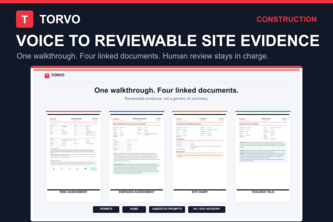
The description states that Torvo Construction is a phone-first Progressive Web App (PWA) designed for field workers to record site walkthroughs via voice. It captures speech, extracts structured facts, and generates professional documents such as risk assessments, RAMS, toolbox talks, permits, and audit trails.
It includes features like:
- Mobile recording with GPS context
- Structured data extraction from spoken input
- Document drafting based on extracted information
- Desktop review workspace with editing capabilities
- Audit trail of changes and approvals
- Detection of high-voltage hazards
The author claims the system supports multiple verticals including construction, field service, clinics, hospitality, offshore operations, police, community care, and auto diagnostics.
Evidence
- The description states it is a PWA.
- It uses voice AI for transcription and document generation.
- It includes mobile stale-state recovery and HV/EHV advisory detection.
- It supports multiple verticals beyond construction.
Inference The product appears to be a hybrid of AI-assisted field data capture and automated document drafting, intended for use in safety-critical environments where documentation is time-consuming and error-prone.
Positioning & Claim Evolution
The author positions Torvo as a solution to the problem of “skilled people doing the real work, then losing hours proving they did it.” The tagline is: “the paperwork does itself.”
Key claims:
- Torvo turns spoken site walkthroughs into reviewable evidence packs.
- It drafts documents without replacing human judgment.
- It allows humans to edit, correct, and approve generated content.
- It works across multiple verticals (construction, field service, clinics, etc.).
- It was built by a non-traditional founder using AI tools.
Evidence
- The author says Torvo started from a frustration with paperwork inefficiencies.
- The tagline is explicitly stated as “the paperwork does itself.”
- The system supports various verticals and has sample outputs for construction.
- The author claims to have used AI tools to build the entire product without traditional coding.
Inference Torvo positions itself as an automation tool that reduces manual administrative burden while maintaining human oversight, particularly in high-risk industries where compliance and auditability are critical.
Target Customer & ICP
The description states that Torvo targets skilled professionals working in environments with heavy documentation needs, such as:
- Construction sites
- Field service operations
- Clinics
- Hospitality venues
- Offshore facilities
- Police/BADGE units
- Community care settings
- SEND education institutions
- Auto diagnostic workshops
Construction is highlighted as the strongest vertical due to its extreme administrative pain and real stakes.
Evidence
- The author identifies construction as the “spearpoint” and “strongest proof.”
- It supports multiple verticals beyond construction.
- Sample outputs include documents relevant to construction (e.g., RAMS, toolbox talks, permits).
Inference The core ICP is likely skilled field workers in safety-sensitive industries who spend significant time on paperwork. The broader market includes any profession requiring structured documentation and compliance.
Business Model & Pricing Evidence
Not evidenced.
There is no mention of pricing models, monetization strategies, or revenue streams in the description.
Evidence
- No pricing information provided.
- No indication of whether the product will be sold directly to users or through enterprise channels.
- No evidence of customer acquisition costs or unit economics.
Technical & Delivery Signals
The author reports that Torvo was built using:
- AI tools (GPT, Claude, Codex)
- Progressive Web App (PWA) architecture
- Mobile-first design with offline recovery capabilities
- Voice-to-text and structured data extraction
- Document generation workflows
- Server-side processing and UI components
It includes features like:
- GPS context
- Audit trails
- Version history
- HV/EHV advisory detection
- Public sample PDFs
- Field recorder + desktop review workspace
Evidence
- The system is described as a PWA.
- It supports mobile recording with recovery mechanisms.
- It integrates voice AI and document generation.
- It includes public samples of generated documents.
Inference The technical stack suggests a modern, low-friction delivery model using cloud-based AI services and responsive web interfaces. However, no details are provided on scalability, security, or integration capabilities.
Traction & Maturity Signals
Not evidenced.
There is no evidence of:
- Revenue
- Customers
- User base
- Adoption metrics
- Product usage data
- Market validation beyond the author’s own claims
Evidence
- The author describes building the product in less than two months.
- It includes a live demo and sample outputs.
- No mention of actual users or pilot programs.
Inference The product appears to be at an early prototype stage, possibly pre-launch. There is no evidence of traction or market validation.
Competitive Context
Not evidenced.
There is no mention of competitors, existing solutions in the space, or competitive positioning.
Evidence
- No reference to similar products or platforms.
- No discussion of how Torvo differentiates from current tools in construction documentation or field reporting.
Inference The competitive landscape is unknown. However, given the focus on voice-to-document automation and safety compliance, there may be overlap with existing field service, compliance, or document management platforms.
Open Questions & Risks
- Founder background: The founder is described as a non-traditional software engineer (automotive diagnostic technician). This raises questions about technical depth, product quality control, and long-term scalability.
- AI dependency: Heavy reliance on AI tools for development implies potential fragility if those tools change or become unavailable.
- Trust and legal risk: The system must avoid issuing authoritative commands or leaking sensitive data — risks are mitigated by human confirmation steps but remain a concern.
- Lack of traction: No evidence of real-world usage, customers, or revenue indicates a high risk that the product has not yet proven its value proposition.
- Unverified claims: All statements are self-reported and unverified; there is no third-party validation.
Evidence
- The founder is described as non-coder.
- AI tools were used extensively for building.
- No mention of users, customers, or revenue.
- Risks around trust and data handling are acknowledged but not quantified.
Questions the description leaves open
- What specific verticals have you tested with real users? Can you provide examples of actual use cases?
- How do you ensure accuracy and compliance in generated documents, especially in safety-critical environments?
- Have you conducted any pilot testing or feedback loops with end-users?
- Are there any known limitations or edge cases where the system fails to generate appropriate content?
- What is your plan for scaling beyond a single developer?
- How do you intend to monetize this product, and what pricing model are you considering?
- What are the legal and audit implications of using AI-generated documents in regulated industries?
Overall Assessment
Not evidenced.
There is no evidence of:
- Revenue or financial performance
- Customer traction or adoption
- Market validation
- Strategic partnerships or investor interest
Evidence
- The project was submitted to a hackathon.
- No mention of funding, investors, or commercial relationships.
- No indication of business model maturity or scalability.
Inference At this stage, Torvo is an early-stage prototype with strong conceptual appeal and a compelling narrative. However, without evidence of traction, revenue, or customer validation, it is difficult to assess its readiness for investment or partnership. It may be suitable for early-stage experimentation or proof-of-concept funding, but not for large-scale commercial commitment.
User Stories BotA demo video on every pull request
Get a demo video on every new feature
GitHub App that watches your pull requests and records a narrated, captioned demo.
Save time on demo prep and make informed decisions faster with a video walkthrough of every new feature.
Source
Submitted to the OpenAI 2026 hackathon on Devpost. Project home on Devpost. Back to the full gallery on Devpost.
This competitive analysis was produced by top-founders.com (opens in a new tab)
Generated by a language model from this project's public Devpost page — its tagline, the author's own write-up and any built-with tags listed there — as captured in August 2026. Short quotations are the author's words. It is an opinion on the idea as a business, not on the people behind it, and it reflects the description as published then. If the project has moved on, request a correction below. The analysis is not independent research and contains no verified traction, revenue or customer data.
An independent guide by KFG International LLC — not affiliated with, endorsed by, or connected to Devpost or OpenAI.