

Archive position — measured, not model output
1 like on Devpost
505 of the 7,850 archived projects have more likes, and 1,758 share exactly 1 — so this project's #2,102 place in the like-ranked listing is a tie-break inside that group, not a ranking.
Projects (log scale)
Likes on Devpost. ▲ marks this project's group.
Show the figures
| Likes | Projects | Share of archive |
|---|---|---|
| 0 | 5,587 | 71.2% |
| 1 | 1,758 | 22.4% |
| 2 | 284 | 3.6% |
| 3–4 | 132 | 1.7% |
| 5–9 | 75 | 1.0% |
| 10+ | 14 | 0.2% |
 User Stories BotA demo video on every pull request
Get a demo video on every new feature
GitHub App that watches your pull requests and records a narrated, captioned demo.
Save time on demo prep and make informed decisions faster with a video walkthrough of every new feature.
Executive Summary
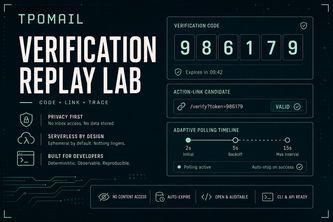
Tpomail is a self-reported private verification inbox built solo by one developer using GPT-5.6 and OpenAI Codex as an end-to-end engineering agent. The product is described as a bilingual serverless application hosted on OpenAI Sites, with deterministic extraction of verification codes and links from emails routed through Cloudflare Email Routing and stored in D1. It includes features like TOTP auto-submit, mailbox lifecycle controls, rules, pagination, time sorting, and a public Replay Lab for demonstration without exposing private data.
The author states that the system was built entirely with AI assistance during a hackathon submission, using no runtime model calls for email processing. The service intentionally avoids R2, Queue, or Durable Objects to keep costs predictable while demonstrating how AI can be used from architecture through deployment.
Key commercial signals are absent: there is no evidence of revenue, customers, pricing, or adoption. The product is described as a proof-of-concept submission with no indication of market traction or business model beyond the author's own account.
The single most important open question is whether Tpomail has any commercial viability or path to monetization, given that it appears to be an experimental tool built for a hackathon rather than a product intended for real-world use.
What The Product Actually Is
The description states that Tpomail is:
- A "private verification inbox" — a system designed to receive and process email verification messages
- Built as a bilingual serverless application using OpenAI Sites
- Hosted on Cloudflare infrastructure with Email Routing, a thin Worker, and D1 storage
- Designed for deterministic extraction of verification codes and links from emails
- Includes features such as TOTP auto-submit, mailbox controls, rules, pagination, time sorting, and resource views
- Has a public Replay Lab that demonstrates functionality without exposing private data
The author claims the system uses GPT-5.6 and Codex to implement all aspects of the product, including architecture, engineering, testing, deployment, documentation, and media production.
Not evidenced: actual functionality beyond the author's self-description; whether it works as claimed in practice; any real-world email processing or user interaction data.
Positioning & Claim Evolution
The description states that Tpomail was built "solo with GPT-5.6 + Codex" and that this approach was used to create a "bilingual serverless verification inbox on OpenAI Sites with deterministic extraction."
It positions itself as:
- A demonstration of AI-assisted software development
- A tool for handling email verification codes and links
- An example of how AI can be used from design through deployment
- A system that avoids runtime AI dependencies to maintain predictability and cost control
The author frames the project as a "Build Week extension" that turned an existing utility into a clearly scoped, testable product with visible reasoning behind its design.
Not evidenced: prior positioning or claims; evolution of those claims over time; any market validation or feedback on positioning.
Target Customer & ICP
The description does not state who the target customer is. It only describes the tool as a "private verification inbox" for handling email verification codes and links.
The author implies that the system is intended for developers or users who need to process verification emails in a controlled, deterministic way — particularly those interested in AI-assisted development workflows.
Not evidenced: specific customer segments; buyer personas; any evidence of target market research or user interviews.
Business Model & Pricing Evidence
The description does not contain any information about pricing, monetization, or business model. It describes the product as a hackathon submission built with AI tools but makes no claims about revenue generation or commercial viability.
Not evidenced: pricing structure, monetization strategy, customer acquisition costs, or any commercial metrics.
Technical & Delivery Signals
The description states that Tpomail was built using:
- GPT-5.6 for reasoning and design
- OpenAI Codex for software engineering tasks including code inspection, feature implementation, testing, deployment, and media production
- Cloudflare Email Routing for email ingestion
- A thin Cloudflare Worker for validation and streaming
- D1 for message storage (7-day retention)
- OpenAI Sites for the web application interface
- No R2, Queue, or Durable Objects in runtime to keep costs predictable
It also claims that:
- The system does not require per-message model calls during runtime
- Email processing is deterministic and lightweight
- The product was submitted to an OpenAI hackathon (Devpost)
- Codex handled terminal operations, browser control, Git workflows, media production, and Devpost integration
Not evidenced: actual performance data; scalability claims; infrastructure costs or usage patterns; any real-world testing beyond the author's account.
Traction & Maturity Signals
The description states that this is a hackathon submission for the OpenAI 2026 hackathon. It was built by one person and submitted to Devpost, with no evidence of traction, adoption, or user engagement.
Not evidenced: any revenue, customers, usage metrics, or growth indicators beyond the author's own account.
Competitive Context
The description does not mention any competitors or competitive landscape. It focuses on the unique approach taken in building the product using AI tools rather than comparing it to existing solutions.
Not evidenced: competitive analysis; market positioning relative to other email verification tools; differentiation from existing products.
Open Questions & Risks
- The entire system was built by one person using AI tools, which raises questions about scalability and long-term maintainability
- No evidence of real-world usage or customer feedback
- The product is described as a hackathon submission with no indication of commercial intent or path to monetization
- The use of GPT-5.6 and Codex in development may not translate into sustainable business practices or product quality
- There is no evidence of any revenue, customers, or traction beyond the author's own account
Questions the description leaves open
- What specific problems are you trying to solve with Tpomail?
- How do you plan to monetize this product if at all?
- Have you tested the system with real users or in production environments?
- What is your long-term vision for the product beyond the hackathon submission?
- How would you scale this solution if it were to become a commercial product?
- What are the key assumptions underlying your approach, and how do you plan to validate them?
Overall Assessment
Not evidenced: No evidence of any investment or partnership interest in Tpomail beyond its status as a hackathon submission. The description does not indicate any commercial traction, revenue, or strategic value that would justify investment or partnership consideration.
The product appears to be an experimental tool built for demonstration purposes rather than a commercially viable offering. There is no evidence of market demand, customer adoption, or sustainable business model beyond the author's own account.
User Stories BotA demo video on every pull request
Get a demo video on every new feature
GitHub App that watches your pull requests and records a narrated, captioned demo.
Save time on demo prep and make informed decisions faster with a video walkthrough of every new feature.
Source
Submitted to the OpenAI 2026 hackathon on Devpost. Project home on Devpost. Back to the full gallery on Devpost.
This competitive analysis was produced by top-founders.com (opens in a new tab)
Generated by a language model from this project's public Devpost page — its tagline, the author's own write-up and any built-with tags listed there — as captured in August 2026. Short quotations are the author's words. It is an opinion on the idea as a business, not on the people behind it, and it reflects the description as published then. If the project has moved on, request a correction below. The analysis is not independent research and contains no verified traction, revenue or customer data.
An independent guide by KFG International LLC — not affiliated with, endorsed by, or connected to Devpost or OpenAI.