

Archive position — measured, not model output
2 likes on Devpost
221 of the 7,850 archived projects have more likes, and 284 share exactly 2 — so this project's #484 place in the like-ranked listing is a tie-break inside that group, not a ranking.
Projects (log scale)
Likes on Devpost. ▲ marks this project's group.
Show the figures
| Likes | Projects | Share of archive |
|---|---|---|
| 0 | 5,587 | 71.2% |
| 1 | 1,758 | 22.4% |
| 2 | 284 | 3.6% |
| 3–4 | 132 | 1.7% |
| 5–9 | 75 | 1.0% |
| 10+ | 14 | 0.2% |
 User Stories BotA demo video on every pull request
Get a demo video on every new feature
GitHub App that watches your pull requests and records a narrated, captioned demo.
Save time on demo prep and make informed decisions faster with a video walkthrough of every new feature.
Executive Summary
What the company appears to be
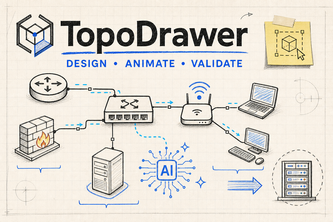
TopoDrawer is a self-reported Python desktop application designed for network engineers to visually design, organize, animate, and export network topologies into EVE-NG lab environments. It integrates AI-assisted workflows (Builder + Validator and Fast Q&A) and includes features like animated packet flows, an Organizer for network-specific data, and deterministic validation.
What changed
The author describes a shift from disconnected tools to a single workflow that spans design through deployment, with a focus on making network engineering as intuitive as Vim is for programming. The project was built for the OpenAI 2026 hackathon.
The single most important open question — the commercial due-diligence read
Is there evidence of real-world adoption or traction from network engineers beyond the author’s own development experience? The description states no revenue, customers, or usage data exist beyond the self-reported project write-up.
What The Product Actually Is
The description states that TopoDrawer is a Python desktop application built with Tkinter and a custom interactive canvas. It supports:
- Drag-and-drop of network devices (routers, switches, firewalls, etc.)
- Renaming of devices and interfaces
- Repositioning and rotating of interfaces
- Free-form drawing
- Annotations
- Organizing network-specific information via an "Organizer"
- Animated packet flow
- AI integration through a Model Context Protocol (MCP) layer
- Export to EVE-NG as a ZIP file containing topology, configurations, validation results, lab instructions, and runbooks
The application uses a structured JSON topology model that includes nodes, links, interface assignments, device states, annotations, configurations, and teaching aids.
It also includes a dependency-free MCP server enabling secure API key input for AI workflows.
Not evidenced: actual product functionality beyond the author’s account; no screenshots, demos, or user feedback available.
Positioning & Claim Evolution
The description states that TopoDrawer was built around the idea of being “A Network Engineer’s Best Friend.” It positions itself as a tool that:
- Enables seamless movement from generation to modification to deployment
- Provides an intuitive UI for visual modeling and communication
- Integrates AI-assisted workflows (Builder + Validator, Fast Q&A)
- Offers deterministic validation to ensure exported topologies are accurate
It claims to make network engineering as intuitive as Vim is for programming.
The author also mentions a long-term vision of making TopoDrawer the fastest path from paper to lab — implying a focus on workflow efficiency and reducing tool fragmentation.
Inferred: The positioning reflects an attempt to solve a common pain point in network engineering workflows, but no evidence of market validation or competitive differentiation exists.
Target Customer & ICP
The description states that TopoDrawer is built for network engineers, particularly those who:
- Work with topology design and visualization
- Use tools like EVE-NG for emulation
- Need to generate, validate, and deploy configurations quickly
- Want to avoid splitting workflows across disconnected tools
It targets users who are likely in roles such as network architects, DevOps engineers, or educators teaching networking concepts.
Not evidenced: No specific customer segments, personas, or use cases beyond the author’s own experience. No evidence of existing customers or pilot programs.
Business Model & Pricing Evidence
The description does not state any business model or pricing information.
It only mentions that TopoDrawer exports to EVE-NG, which is a free tool, and that it uses an MCP layer for AI integration — but no mention of monetization strategy, licensing, or subscription models.
Inferred: Since this is a hackathon project submitted by one person (Flawed Logic), there is no evidence of any commercial business model at this time.
Technical & Delivery Signals
The description states that TopoDrawer is built using:
- Python
- Tkinter
- A custom interactive canvas
- A structured JSON topology model
- A dependency-free MCP server for AI integration
- Integration with EVE-NG
It also mentions:
- Handling of zooming and panning via a separate world-coordinate system
- Use of Codex during development to deploy and test AI-generated labs in real emulation environments
- Deterministic validation of AI-generated configurations
Not evidenced: No information on scalability, performance metrics, or production readiness.
Traction & Maturity Signals
The description states that this is a hackathon project submitted to the OpenAI 2026 hackathon. It was built by one person (Flawed Logic).
No evidence of:
- Revenue
- Customers
- User adoption
- Product-market fit
- Market traction or usage data
Inferred: The lack of any commercial or user data strongly suggests that this is an early-stage prototype, not a mature product.
Competitive Context
The description does not mention any competitors. It does not describe how TopoDrawer compares to existing tools in the network design and simulation space (e.g., Cisco Packet Tracer, Visio, GNS3, EVE-NG, etc.).
Inferred: The author may be unaware of or not referencing direct competitors, but the presence of EVE-NG integration suggests some overlap with emulation platforms.
Open Questions & Risks
- Single-person development: The project is built by one individual (Flawed Logic), raising questions about scalability and long-term maintenance.
- No commercial traction: No evidence of revenue, customers, or adoption beyond the author’s own experience.
- AI reliability concerns: The description notes that AI-generated configurations can be misleading and require validation — a potential risk for usability.
- Limited maturity: This is a hackathon project with no indication of product-market fit or long-term roadmap.
- No pricing or monetization strategy: No business model is described, which raises questions about sustainability.
Questions the description leaves open
- What is the current status of TopoDrawer beyond the hackathon? Is it being actively developed or used?
- Have you tested TopoDrawer with actual network engineers in real-world scenarios?
- How do you plan to monetize or scale this product if it gains traction?
- What are your plans for expanding AI workflows beyond the current MVP?
- Are there any specific challenges in integrating with EVE-NG that could limit adoption?
- Do you have a long-term roadmap for cross-platform support and live-lab feedback loops?
Overall Assessment
The description states that TopoDrawer is a self-reported hackathon project built by one developer, Flawed Logic. There is no evidence of revenue, customers, or traction.
This is an early-stage idea with strong technical execution and a clear problem statement, but it lacks commercial viability indicators.
Confidence: Low
Not evidenced: No data on market demand, user feedback, or business model. The project appears to be a proof-of-concept rather than a product ready for investment or partnership.
Inferred: If the author continues development and gains traction with network engineers, this could evolve into a useful tool. However, as of now, it is not a commercial proposition.
User Stories BotA demo video on every pull request
Get a demo video on every new feature
GitHub App that watches your pull requests and records a narrated, captioned demo.
Save time on demo prep and make informed decisions faster with a video walkthrough of every new feature.
Source
Submitted to the OpenAI 2026 hackathon on Devpost. Project home on Devpost. Back to the full gallery on Devpost.
This competitive analysis was produced by top-founders.com (opens in a new tab)
Generated by a language model from this project's public Devpost page — its tagline, the author's own write-up and any built-with tags listed there — as captured in August 2026. Short quotations are the author's words. It is an opinion on the idea as a business, not on the people behind it, and it reflects the description as published then. If the project has moved on, request a correction below. The analysis is not independent research and contains no verified traction, revenue or customer data.
An independent guide by KFG International LLC — not affiliated with, endorsed by, or connected to Devpost or OpenAI.