

Archive position — measured, not model output
2 likes on Devpost
221 of the 7,850 archived projects have more likes, and 284 share exactly 2 — so this project's #485 place in the like-ranked listing is a tie-break inside that group, not a ranking.
Projects (log scale)
Likes on Devpost. ▲ marks this project's group.
Show the figures
| Likes | Projects | Share of archive |
|---|---|---|
| 0 | 5,587 | 71.2% |
| 1 | 1,758 | 22.4% |
| 2 | 284 | 3.6% |
| 3–4 | 132 | 1.7% |
| 5–9 | 75 | 1.0% |
| 10+ | 14 | 0.2% |
 User Stories BotA demo video on every pull request
Get a demo video on every new feature
GitHub App that watches your pull requests and records a narrated, captioned demo.
Save time on demo prep and make informed decisions faster with a video walkthrough of every new feature.
Executive Summary
Company: TraceCase
Tagline: Practice debugging realistic production incidents before they page you
Self-reported basis: The description is entirely self-reported and unverified, based on the author’s own write-up and project metadata. No third-party evidence or historical data is available.
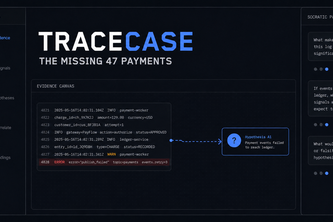
What it appears to be: TraceCase is an interactive simulator for practicing incident response in software engineering environments. It presents synthetic production incidents with logs, metrics, code, and timelines, allowing engineers to reconstruct events, form hypotheses, and submit root-cause analyses. GPT-5.6 is used as a Socratic coach and evaluator.
What changed: The project was built as part of the OpenAI 2026 hackathon. It represents an early-stage prototype with three synthetic cases, no revenue or customer data, and limited public traction.
Single most important open question: Is there evidence of demand for this product from engineering teams or training programs, or is it a proof-of-concept that has not yet reached market validation?
What The Product Actually Is
The description states that TraceCase is an interactive production-incident investigation simulator. It allows users to work through synthetic cases using:
- Realistic timelines
- Logs
- Metrics
- Code
- Evidence artifacts
Users must reconstruct what changed, pin relevant evidence, write a falsifiable hypothesis, connect facts into a causal chain, and submit a root-cause assessment.
GPT-5.6 is used as a Socratic investigation partner, asking one concise question at a time instead of revealing the answer. When an assessment is submitted, GPT-5.6 returns a structured review covering:
- Causal mechanism
- Supporting evidence
- Remediation
The system uses structured outputs to validate scores, strengths, missing elements, and next learning steps.
Inference: The product appears to be a training tool for incident response, not a production monitoring or alerting platform.
Positioning & Claim Evolution
The description states that TraceCase is designed to help engineers practice debugging in a safe environment, before they are under real operational pressure. It positions itself as a way to:
- Reconstruct timelines
- Separate facts from assumptions
- Test hypotheses
- Defend root cause
Claim: The product aims to improve incident response skills through simulation.
Inference: This is a learning and development tool, not a commercial SaaS offering or operational platform. It does not appear to be positioned for direct use in production environments.
Target Customer & ICP
The description states that TraceCase is intended for engineers who need to practice incident response. It is designed to help them:
- Reconstruct timelines
- Separate facts from assumptions
- Test hypotheses
- Defend root cause
It is described as a tool for learning, not for production use.
Inference: The ICP (Ideal Customer Profile) likely includes:
- Engineering teams or individuals in training programs
- SREs, DevOps engineers, or software engineers who want to improve their incident response skills
Not evidenced: No specific customer segments, roles, or organizational size are mentioned. No evidence of existing customers or use cases beyond the hackathon prototype.
Business Model & Pricing Evidence
The description does not state a business model or pricing structure.
It mentions:
- A one-day isolated demo account with no registration required
- All incident data is synthetic and created specifically for the TraceCase demo
Inference: The product appears to be in a pre-commercial prototype phase, likely intended as a proof-of-concept. No evidence of monetization, pricing tiers, or customer acquisition.
Technical & Delivery Signals
The description states that the product was built using:
- Next.js
- React
- Prisma
- SQLite
- OpenAI Responses API with GPT-5.6 Terra
- Codex
It includes features such as:
- End-to-end investigation flow
- Evidence-first interface (timeline, logs, metrics, code, hypotheses)
- Structured assessment grading
- GPT-5.6 coaching that does not leak canonical answers
Inference: The product is a web-based prototype, likely built quickly for a hackathon. It uses modern tools and AI integration but lacks evidence of production-grade infrastructure or scalability.
Traction & Maturity Signals
The description states:
- Three synthetic incident cases with independent saved progress
- A one-day isolated demo account with no registration required
- The product is a complete end-to-end investigation flow
- All data is synthetic and created for the demo
Not evidenced: No evidence of:
- Revenue
- Customers
- User engagement or retention
- Product usage metrics
- Market traction beyond the hackathon
Inference: This is an early-stage prototype, likely built in a hackathon context, with no demonstrated traction or commercial viability.
Competitive Context
The description does not mention any competitors. It does not state whether similar tools exist in the market for:
- Incident response training
- Simulation-based learning for engineers
- SRE or DevOps skill development
Not evidenced: No competitive landscape, existing products, or market positioning is described.
Open Questions & Risks
- No commercial traction or revenue: The product is a prototype with no evidence of monetization.
- Unproven demand: There is no evidence that engineers or organizations are actively seeking this type of tool.
- Limited scope: Only three synthetic cases are included, and the system is not scalable beyond the hackathon version.
- AI dependency: Heavy reliance on GPT-5.6 raises questions about cost, availability, and consistency in a commercial setting.
- No customer feedback or validation: The product was built for a hackathon, with no evidence of user testing or real-world feedback.
Questions the description leaves open
- What is the intended use case beyond the hackathon prototype?
- Have you tested this with actual engineers or teams in training programs?
- How do you plan to scale beyond three synthetic cases?
- Is there a path to monetization, and if so, what is it?
- What are the limitations of GPT-5.6 in terms of consistency, cost, and availability for commercial use?
- Are there any existing partnerships or early adopters in engineering teams or training programs?
Overall Assessment
Not evidenced: No data on revenue, customers, or traction is available.
Inference: This is a pre-product-market-fit prototype, likely built as a hackathon project. It has potential as a learning tool but lacks evidence of commercial viability or demand.
Confidence level: Low — the description is self-reported and unverified, with no third-party validation or traction data. The product is in an early stage and not yet ready for investment or partnership consideration.
User Stories BotA demo video on every pull request
Get a demo video on every new feature
GitHub App that watches your pull requests and records a narrated, captioned demo.
Save time on demo prep and make informed decisions faster with a video walkthrough of every new feature.
Source
Submitted to the OpenAI 2026 hackathon on Devpost. Project home on Devpost. Back to the full gallery on Devpost.
This competitive analysis was produced by top-founders.com (opens in a new tab)
Generated by a language model from this project's public Devpost page — its tagline, the author's own write-up and any built-with tags listed there — as captured in August 2026. Short quotations are the author's words. It is an opinion on the idea as a business, not on the people behind it, and it reflects the description as published then. If the project has moved on, request a correction below. The analysis is not independent research and contains no verified traction, revenue or customer data.
An independent guide by KFG International LLC — not affiliated with, endorsed by, or connected to Devpost or OpenAI.