

Archive position — measured, not model output
0 likes on Devpost
2,263 of the 7,850 archived projects have more likes, and 5,587 share exactly 0 — so this project's #7,321 place in the like-ranked listing is a tie-break inside that group, not a ranking.
Projects (log scale)
Likes on Devpost. ▲ marks this project's group.
Show the figures
| Likes | Projects | Share of archive |
|---|---|---|
| 0 | 5,587 | 71.2% |
| 1 | 1,758 | 22.4% |
| 2 | 284 | 3.6% |
| 3–4 | 132 | 1.7% |
| 5–9 | 75 | 1.0% |
| 10+ | 14 | 0.2% |
 User Stories BotA demo video on every pull request
Get a demo video on every new feature
GitHub App that watches your pull requests and records a narrated, captioned demo.
Save time on demo prep and make informed decisions faster with a video walkthrough of every new feature.
Executive Summary
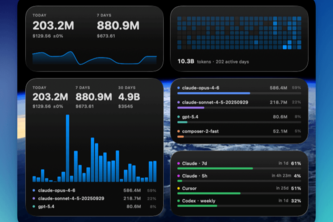
What the company appears to be: TokenTracker is a local-first tool for tracking token usage across 27 AI coding tools. The author states it works entirely on the user’s machine, with no cloud account, API keys or setup required. It parses session logs from AI tools locally and displays normalized token data in a dashboard that can be served locally or embedded in native desktop apps (macOS and Windows). An optional cloud layer enables cross-device aggregation and social features like leaderboards and badges.
What changed: The project started as a personal solution to a problem the author had with tracking usage across multiple AI coding tools. It evolved into a self-contained, local-first product with support for multiple platforms and an optional cloud sync feature.
The single most important open question: Is there any evidence of user adoption or traction beyond the author’s own use? The description states no revenue, customers or adoption data are available.
What The Product Actually Is
- The description states that TokenTracker is a local-first tool for tracking token usage across 27 AI coding tools.
- It parses session logs from these tools locally and normalizes them into consistent shapes (input tokens, cached input, cache-creation, output, reasoning tokens).
- The parsed data is served through a small local HTTP API on port 7680.
- A React + TypeScript dashboard is built once and reused across multiple surfaces: as a locally-served page, a Vercel-hosted marketing site, a macOS menu-bar app (Swift), and a Windows system-tray app (.NET + WebView2).
- The author states that an optional cloud layer supports cross-device aggregation and social features like leaderboards and badges.
- No cloud account, API keys or setup are required for local usage.
Note: The product is described as working entirely on the user’s machine, with no data leaving the device unless explicitly opted in via a cloud sync feature. The dashboard can be embedded in native apps but does not appear to require any third-party integrations beyond its own CLI and local parsing logic.
Positioning & Claim Evolution
- The author states that TokenTracker was built because existing community tools failed to match provider billing data due to double-counting issues.
- It is positioned as a solution for users who distrust the accuracy of other tools and want privacy — no prompts or file contents are sent to any server.
- The tool evolved from a personal need into a product with cross-platform support and optional cloud features.
- The author emphasizes that the design principle was "local-first" from day one, which became a constraint rather than a feature.
Inference: The positioning appears to be driven by a combination of accuracy concerns and privacy preferences. There is no evidence of a broader market positioning or branding strategy beyond this personal motivation.
Target Customer & ICP
- The description states that the tool targets users who use multiple AI coding tools (e.g., Claude Code, Codex, Cursor, Gemini CLI).
- It is aimed at developers or technical users who care about tracking token usage and cost across these tools.
- Users are likely those who already use several AI coding tools and want to understand their combined usage without relying on fragmented dashboards.
Note: No evidence of customer segmentation, personas, or specific buyer profiles beyond the author’s own use case is provided. The target audience seems to be self-defined rather than market-tested.
Business Model & Pricing Evidence
- The description states that no cloud account, API keys or setup are required for local usage.
- An optional cloud layer exists for cross-device aggregation, leaderboards, and badges.
- No pricing information, monetization strategy, or revenue model is stated in the description.
Inference: There may be a freemium or tiered model where basic tracking is free and premium features (e.g., cloud sync) are paid. However, this remains unconfirmed.
Technical & Delivery Signals
- Built with JavaScript, plpgsql, Swift, TypeScript.
- Uses a CLI (
bin/tracker.js) to install lightweight hooks into session logs on disk. - Parses logs incrementally and normalizes schemas from different providers.
- Data lands in an append-only local queue and is served via a local HTTP API on port 7680.
- Dashboard built with React + TypeScript, reused across platforms (local web, macOS app, Windows app).
- Cross-platform support includes native macOS menu-bar app and Windows system-tray app.
- Cloud sync is additive — only aggregate token counts are shared, not prompt content.
Note: The tool is described as self-contained and not requiring external dependencies beyond its own runtime. Packaging challenges were noted for both macOS and Windows apps.
Traction & Maturity Signals
- No evidence of revenue, customers, or adoption beyond the author’s personal use.
- The project was submitted to the OpenAI 2026 hackathon on Devpost.
- There is no mention of user feedback, usage metrics, or product iteration history beyond the author's own account.
Absence of evidence: No data on traction, growth, or user engagement is provided. The maturity level is inferred from the complexity of the solution but not confirmed.
Competitive Context
- The description does not name specific competitors.
- It mentions that existing community tools failed to match provider billing data due to double-counting issues.
- The author notes that no vendor-published spec exists for token count sums, making validation difficult.
Inference: TokenTracker appears to address a gap in accuracy and privacy among existing tools. However, the competitive landscape is not clearly defined or described.
Open Questions & Risks
- The tool is described as being built by a single person (team size: 1).
- No evidence of product-market fit, user feedback, or traction.
- The author notes that packaging for macOS and Windows was difficult — suggesting potential scalability issues.
- Cross-device aggregation introduces design complexity and security risks (e.g., missing row-level-security policy).
- The tool is local-first but includes an optional cloud layer — this tension may complicate long-term maintenance.
Inference: The lack of external validation, user data, or team size raises questions about scalability and commercial viability. The optional cloud feature introduces potential security and design trade-offs.
Questions the description leaves open
- What is your evidence that users care enough to pay for this tool?
- How do you plan to scale beyond a single developer’s use case?
- Have you validated the accuracy of your parsers against real provider billing data across all 27 tools?
- Is there any feedback or interest from users outside of yourself?
- What is the roadmap for monetization and product development?
- How do you plan to handle security and privacy concerns as more users adopt the cloud sync feature?
Overall Assessment
- The project is described as a personal solution built by one developer.
- No evidence of revenue, customers or traction exists beyond the author’s own use.
- It is positioned as a local-first tool with optional cloud features, but no business model or monetization strategy is evident.
- There is no indication of market validation or product-market fit.
Assessment: Not evidenced. The description does not provide sufficient evidence to assess commercial viability or investment potential. The project appears to be an experimental or personal endeavor without demonstrated traction or scalability.
User Stories BotA demo video on every pull request
Get a demo video on every new feature
GitHub App that watches your pull requests and records a narrated, captioned demo.
Save time on demo prep and make informed decisions faster with a video walkthrough of every new feature.
Source
Submitted to the OpenAI 2026 hackathon on Devpost. Project home on Devpost. Back to the full gallery on Devpost.
This competitive analysis was produced by top-founders.com (opens in a new tab)
Generated by a language model from this project's public Devpost page — its tagline, the author's own write-up and any built-with tags listed there — as captured in August 2026. Short quotations are the author's words. It is an opinion on the idea as a business, not on the people behind it, and it reflects the description as published then. If the project has moved on, request a correction below. The analysis is not independent research and contains no verified traction, revenue or customer data.
An independent guide by KFG International LLC — not affiliated with, endorsed by, or connected to Devpost or OpenAI.