

Archive position — measured, not model output
0 likes on Devpost
2,263 of the 7,850 archived projects have more likes, and 5,587 share exactly 0 — so this project's #7,283 place in the like-ranked listing is a tie-break inside that group, not a ranking.
Projects (log scale)
Likes on Devpost. ▲ marks this project's group.
Show the figures
| Likes | Projects | Share of archive |
|---|---|---|
| 0 | 5,587 | 71.2% |
| 1 | 1,758 | 22.4% |
| 2 | 284 | 3.6% |
| 3–4 | 132 | 1.7% |
| 5–9 | 75 | 1.0% |
| 10+ | 14 | 0.2% |
 User Stories BotA demo video on every pull request
Get a demo video on every new feature
GitHub App that watches your pull requests and records a narrated, captioned demo.
Save time on demo prep and make informed decisions faster with a video walkthrough of every new feature.
Executive Summary
What the company appears to be
ThreatLens is an AI-assisted incident investigation platform for security analysts, built as a single-person project using Django and Python. It allows users to upload security logs and receive structured investigations with MITRE ATT&CK mapping and executive-ready reports.
What changed
The author states that ThreatLens evolved from a simple AI chat interface into a full end-to-end platform supporting secure file uploads, structured outputs, validation, and PDF reporting — all within a single application. It was submitted to the OpenAI 2026 hackathon.
Single most important open question
Is there evidence of traction or commercial adoption beyond this self-reported project? The description does not indicate any revenue, customers, or usage beyond the author’s own development and demo mode.
What The Product Actually Is
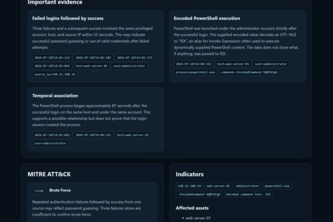
The description states that ThreatLens is an AI-assisted incident investigation platform for security analysts. It accepts various log formats (TXT, LOG, JSON, JSONL, CSV) via paste or upload. The application validates and normalizes input before sending a bounded request to GPT-5.6 through the OpenAI Responses API.
It generates structured outputs including:
- Severity and confidence assessments
- Chronological timelines
- MITRE ATT&CK mappings
- Indicators of compromise (IOCs)
- Affected assets/accounts
- Containment actions
- Long-term recommendations
- Executive PDF reports
A deterministic Guided Demo is included so users can explore the workflow without consuming API credits.
Evidence
- The author states that ThreatLens accepts multiple log formats.
- It uses GPT-5.6 via OpenAI Responses API.
- It generates structured outputs including timelines, MITRE mappings, IOCs, and executive reports.
- A guided demo is included for exploration without API usage.
Inference The platform appears to be a single-user tool built for analysts to automate parts of incident response using AI.
Positioning & Claim Evolution
The author describes ThreatLens as evolving from an “AI chat interface” into a full end-to-end investigation platform. The positioning is that it transforms raw security logs into structured, actionable insights with MITRE ATT&CK alignment and executive reporting capabilities.
Evidence
- The author says: “I’m proud that ThreatLens evolved into a complete end-to-end investigation platform instead of just an AI chat interface.”
- It supports secure file uploads, structured investigations, MITRE mapping, PDF reporting, dashboards, and demo mode.
- It is built for security analysts.
Inference The product was initially conceived as a basic AI assistant but grew into something more comprehensive, likely in response to the needs of cybersecurity practitioners.
Target Customer & ICP
The description states that ThreatLens is built for security analysts, who are the primary users. It supports workflows involving log analysis, incident investigation, and executive reporting.
Evidence
- The author writes: “ThreatLens is an AI-assisted incident investigation platform built for security analysts.”
- It includes features like timeline generation, MITRE mapping, IOC identification, and executive reports — all relevant to analyst use cases.
Inference The target customer is a cybersecurity professional or team member involved in incident response. The ICP likely centers around mid-to-senior-level analysts working with structured logs and needing rapid, evidence-based insights.
Business Model & Pricing Evidence
There is no information provided about pricing, monetization strategy, or business model in the project description.
Evidence
- No mention of subscriptions, per-user fees, or any commercial structure.
- The author mentions future plans to deploy as a SaaS platform but does not describe current or planned pricing.
Inference The product is currently a prototype or proof-of-concept with no evidence of a defined business model or pricing mechanism.
Technical & Delivery Signals
ThreatLens was built using Django 6 and Python 3.13, following a service-oriented architecture that separates:
- Event parsing
- AI analysis
- Investigation management
- PDF generation
- Dashboard functionality
It uses GPT-5.6 via the OpenAI Responses API, with Pydantic validating every AI response before saving an investigation.
The frontend uses server-rendered Django templates with responsive HTML and CSS. Codex was used during development to improve code quality, testing, and documentation.
Evidence
- Built with Django 6 and Python 3.13.
- Uses GPT-5.6 via OpenAI Responses API.
- Pydantic validates AI responses.
- Server-rendered templates with responsive design.
- Codex used for development acceleration.
- Modular services and automated testing included.
Inference The architecture suggests a focus on software engineering quality, modularity, and integration of AI into a structured workflow — suitable for enterprise-grade tools.
Traction & Maturity Signals
There is no evidence of traction, revenue, or customer adoption beyond the author’s own development and demo mode.
Evidence
- The team size is listed as 1.
- No mention of users, customers, or product usage.
- No data on engagement, retention, or performance metrics.
- The project was submitted to a hackathon (OpenAI 2026).
Inference This is a prototype or personal project with no commercial traction. It has not yet entered production use or gained market validation.
Competitive Context
The author does not reference competitors or provide context about the broader marketplace for AI-powered incident investigation platforms.
Evidence
- No mention of existing tools, platforms, or competitive offerings.
- No indication of how ThreatLens compares to other solutions in the space.
Inference Without any reference to the market landscape, it is unclear whether ThreatLens addresses a gap or competes directly with established players in cybersecurity AI or SIEM tools.
Open Questions & Risks
Several key risks and open questions are present based on the self-reported description:
- Single-person development: With only one team member, scalability and long-term maintenance may be concerns.
- No commercial traction: No evidence of revenue, customers, or adoption beyond the author’s own use.
- Unverified AI output reliability: While Pydantic validates responses, there is no indication of how errors or hallucinations are handled at scale.
- Unclear path to monetization: The author mentions future SaaS plans but provides no roadmap or business model details.
- No third-party integrations or data sources mentioned: This limits its utility in real-world environments.
Evidence
- Team size is 1.
- No revenue, customers, or usage metrics.
- No mention of SIEM or cloud log ingestion capabilities beyond future plans.
- No indication of how the platform would integrate with existing security infrastructures.
Inference The project lacks commercial viability indicators and may not be ready for enterprise deployment without significant development and validation.
Questions the description leaves open
- What is your plan to validate AI-generated outputs in real-world scenarios?
- How do you intend to scale beyond a single developer?
- Are there any early adopters or pilot users of the platform?
- What are your specific plans for monetization and go-to-market strategy?
- How will you handle data privacy, compliance, and security concerns in a SaaS environment?
- What is the expected timeline to move from prototype to production-ready product?
Overall Assessment
Not evidenced.
There is no evidence of revenue, customers, traction, or commercial viability beyond the author’s own development efforts. The project is described as a hackathon submission with no indication of market readiness or business model.
Confidence Level Low This is a self-reported, unverified account of a single-developer project submitted to a hackathon. No evidence supports any form of commercial traction or investment-readiness.
User Stories BotA demo video on every pull request
Get a demo video on every new feature
GitHub App that watches your pull requests and records a narrated, captioned demo.
Save time on demo prep and make informed decisions faster with a video walkthrough of every new feature.
Source
Submitted to the OpenAI 2026 hackathon on Devpost. Project home on Devpost. Back to the full gallery on Devpost.
This competitive analysis was produced by top-founders.com (opens in a new tab)
Generated by a language model from this project's public Devpost page — its tagline, the author's own write-up and any built-with tags listed there — as captured in August 2026. Short quotations are the author's words. It is an opinion on the idea as a business, not on the people behind it, and it reflects the description as published then. If the project has moved on, request a correction below. The analysis is not independent research and contains no verified traction, revenue or customer data.
An independent guide by KFG International LLC — not affiliated with, endorsed by, or connected to Devpost or OpenAI.