

Archive position — measured, not model output
1 like on Devpost
505 of the 7,850 archived projects have more likes, and 1,758 share exactly 1 — so this project's #2,081 place in the like-ranked listing is a tie-break inside that group, not a ranking.
Projects (log scale)
Likes on Devpost. ▲ marks this project's group.
Show the figures
| Likes | Projects | Share of archive |
|---|---|---|
| 0 | 5,587 | 71.2% |
| 1 | 1,758 | 22.4% |
| 2 | 284 | 3.6% |
| 3–4 | 132 | 1.7% |
| 5–9 | 75 | 1.0% |
| 10+ | 14 | 0.2% |
 User Stories BotA demo video on every pull request
Get a demo video on every new feature
GitHub App that watches your pull requests and records a narrated, captioned demo.
Save time on demo prep and make informed decisions faster with a video walkthrough of every new feature.
Executive Summary
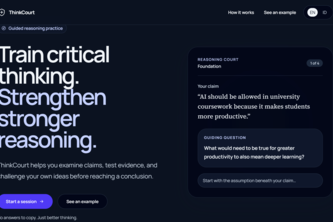
The company appears to be a solo-built AI-powered reasoning coach named ThinkCourt, designed to guide users through structured critical thinking processes instead of delivering instant answers. The project was submitted as part of the OpenAI 2026 hackathon and is described as an MVP built with Next.js, React, TypeScript, Tailwind CSS, and Vercel, with assistance from GPT-5.6 and Codex.
The author states that ThinkCourt aims to help users strengthen reasoning skills by encouraging evidence evaluation, counterargument consideration, and reflection — rather than providing direct answers. It includes four stages: Foundation, Evidence, Challenge, and Reflection, ending in a "Reasoning Snapshot."
What changed: The project evolved from an idea about AI's role beyond answering questions into a structured reasoning experience with a defined user flow.
The single most important open question: Is there evidence of any traction or user engagement beyond the author’s own development and submission to a hackathon? The description does not indicate whether ThinkCourt has been used by others, nor does it show adoption, revenue, or customer data.
What The Product Actually Is
- The description states that ThinkCourt is an AI-powered reasoning coach.
- It guides users through a structured critical thinking process, involving four stages:
- Foundation
- Evidence
- Challenge
- Reflection
- Instead of giving answers, it asks guiding questions and encourages users to evaluate evidence and consider counterarguments.
- The experience ends with a Reasoning Snapshot summarizing the user’s thinking process.
- It allows users to either explore their own claim or choose from guided cases across Education, Work, and Technology.
Note: This is self-reported. No independent verification of product functionality or usage exists beyond the author's account.
Positioning & Claim Evolution
- The author states that AI is highly adept at providing answers but that instant answers do not always foster better thinkers.
- ThinkCourt positions itself as an alternative to typical chatbots, aiming to help people strengthen reasoning skills rather than simply delivering conclusions.
- It claims to encourage users to:
- Examine assumptions
- Evaluate evidence
- Address counterarguments
- Reflect before reaching a conclusion
Inference: The positioning reflects a shift from AI-as-answer-provider to AI-as-thinking-coach. However, this is not evidenced by any external data or user feedback.
Target Customer & ICP
- The description states that users can either:
- Explore their own claim
- Choose from guided cases across Education, Work, and Technology
- No specific customer segments are named.
- No indication of target personas, use cases, or buyer profiles is provided.
Not evidenced: There is no evidence of a defined ICP or target audience beyond the general idea that users might be interested in improving reasoning skills.
Business Model & Pricing Evidence
- The description does not mention any pricing model.
- No indication of monetization strategy, revenue streams, or business model is provided.
- It is unclear whether ThinkCourt is intended to be a freemium, paid, or open-source product.
Not evidenced: There is no evidence of a business model or pricing structure.
Technical & Delivery Signals
- Built with:
- Framework: Next.js
- UI Library: React, Tailwind CSS
- Language: TypeScript
- Hosting: Vercel
- AI Tools Used: GPT-5.6 (for framework design), Codex (for implementation)
- The author notes that the project was completed within a Build Week timeframe.
- It is described as an MVP, with a clean, intuitive user experience and a complete end-to-end reasoning flow.
- The application was launched live and its open-source repository was made available.
Inference: The technical stack suggests a modern web app built for rapid prototyping. However, no evidence of scalability, performance metrics, or production deployment beyond the MVP is provided.
Traction & Maturity Signals
- The project is described as an MVP.
- It was submitted to a hackathon and launched within a short timeframe.
- The author states that it was completed ahead of deadline.
- No evidence of user engagement, adoption, or usage beyond the author’s own development is provided.
Not evidenced: There are no signs of traction, customer base, or product maturity beyond the initial build.
Competitive Context
- The description does not mention any competitors.
- It does not reference existing tools for critical thinking or reasoning coaching.
- No market analysis or competitive positioning is included.
Not evidenced: No information on competitive landscape or similar products is provided.
Open Questions & Risks
- The project is solo-built, with only one team member (Vallen Silaban).
- It was built in a short timeframe (Build Week), suggesting limited testing or iteration.
- There is no evidence of user feedback, product-market fit, or traction.
- The description implies that the tool may be experimental, not yet proven in real-world use.
- No indication of long-term sustainability or scalability beyond the MVP.
Inference: Risk of lack of validation and limited commercial viability due to absence of user data, market testing, or team capacity.
Questions the description leaves open
- What specific user feedback have you received from people who tried ThinkCourt?
- How do you plan to scale beyond a solo-built MVP?
- Have you identified any target customer segments or use cases for which the product is most valuable?
- What are your plans for monetization and long-term product development?
- Are there any existing tools in the critical thinking or reasoning coaching space that you’re aware of?
Overall Assessment
- The description states that ThinkCourt is an MVP built during a hackathon.
- It is not evidenced to have traction, revenue, or customer adoption.
- The product concept is novel but unproven in real-world use.
- The solo team and MVP status raise questions about scalability and commercial viability.
Assessment: Not evidenced as a viable investment or partnership opportunity at this stage. Further due diligence would require evidence of user engagement, market validation, and a clear path to revenue or growth.
User Stories BotA demo video on every pull request
Get a demo video on every new feature
GitHub App that watches your pull requests and records a narrated, captioned demo.
Save time on demo prep and make informed decisions faster with a video walkthrough of every new feature.
Source
Submitted to the OpenAI 2026 hackathon on Devpost. Project home on Devpost. Back to the full gallery on Devpost.
This competitive analysis was produced by top-founders.com (opens in a new tab)
Generated by a language model from this project's public Devpost page — its tagline, the author's own write-up and any built-with tags listed there — as captured in August 2026. Short quotations are the author's words. It is an opinion on the idea as a business, not on the people behind it, and it reflects the description as published then. If the project has moved on, request a correction below. The analysis is not independent research and contains no verified traction, revenue or customer data.
An independent guide by KFG International LLC — not affiliated with, endorsed by, or connected to Devpost or OpenAI.