

Archive position — measured, not model output
1 like on Devpost
505 of the 7,850 archived projects have more likes, and 1,758 share exactly 1 — so this project's #2,077 place in the like-ranked listing is a tie-break inside that group, not a ranking.
Projects (log scale)
Likes on Devpost. ▲ marks this project's group.
Show the figures
| Likes | Projects | Share of archive |
|---|---|---|
| 0 | 5,587 | 71.2% |
| 1 | 1,758 | 22.4% |
| 2 | 284 | 3.6% |
| 3–4 | 132 | 1.7% |
| 5–9 | 75 | 1.0% |
| 10+ | 14 | 0.2% |
 User Stories BotA demo video on every pull request
Get a demo video on every new feature
GitHub App that watches your pull requests and records a narrated, captioned demo.
Save time on demo prep and make informed decisions faster with a video walkthrough of every new feature.
Executive Summary
What the company appears to be
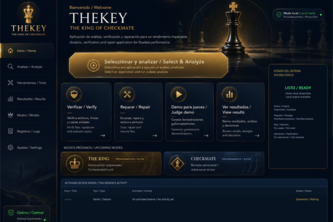
THEKEY — The King of Checkmate is a self-reported Windows-ready developer tool that governs application changes by enforcing a structured, reviewable transaction process. It operates as a portable application that inspects, verifies, and applies code changes under strict gates and policies, with no runtime dependencies beyond Windows.
What changed
The project was submitted to the OpenAI 2026 hackathon on Devpost. The description indicates it is a pre-existing project with an extension built during a “Build Week” period, using Codex and GPT-5.6 for development. It distinguishes its post-baseline work from prior efforts.
Single most important open question
Is there any evidence of real-world usage or adoption beyond the demo and submission context?
What The Product Actually Is
The description states that THEKEY is a Windows-ready developer tool designed to govern application changes. It functions as a portable application, allowing users to:
- inspect a local project read-only;
- verify an isolated copy only after explicit consent;
- run compile/test, secret-scan, and documentation gates;
- emit an assessment (VERIFIED, BLOCKED, or NO_VERIFICABLE) with JSON evidence;
- apply only a conservative, single-point repair that passes all gates in isolation.
It is described as failing closed — meaning it reviews risk but cannot write. The actual change execution is performed by an executor, not the tool itself.
Claim
THEKEY is a governed transaction system for coding agents.
- Evidenced in description.
Claim
It enforces deterministic gates and durable evidence before allowing writes.
- Evidenced in description.
Claim
The tool is portable and runs without network or toolchain installation.
- Evidenced in description.
Positioning & Claim Evolution
The author positions THEKEY as a governed transaction system for coding agents, with the tagline:
“Governed transactions for coding agents: inspect, verify, repair, and prove every change.”
This suggests an intent to bring formal governance into developer workflows, especially around code changes.
Claim
THEKEY is a tool for governing agent-driven code changes.
- Evidenced in tagline and description.
Claim
It aims to make changes inspectable, verifiable, repairable, and provable.
- Evidenced in tagline and description.
Claim
The system is built with AI assistance (Codex, GPT-5.6).
- Evidenced in description.
Inference It may be positioned as a security or compliance tool for developers.
- Based on the emphasis on gates, verification, and deterministic behavior.
Target Customer & ICP
The project is described as a developer tool, intended for users working with local projects on Windows.
Claim
THEKEY targets developers working with local codebases.
- Evidenced in description.
Inference It may appeal to teams or individuals who want to enforce strict governance over code changes.
- Based on the emphasis on verification, policy enforcement, and rollback.
Not evidenced No specific customer segment, persona, or use case beyond developer workflow is stated.
Business Model & Pricing Evidence
The description does not include any information about pricing, monetization, or business model.
Not evidenced No mention of revenue streams, pricing tiers, subscriptions, or commercial usage.
Technical & Delivery Signals
The tool is built using:
- Python, WPF/.NET Framework
- PyInstaller, Pydantic, pytest, JSON Schema, SQLite, PowerShell, Git
- Codex and GPT-5.6 (used for development only)
It is described as a portable Windows application, with no runtime dependencies beyond Windows.
Claim
THEKEY is built using Python, WPF, and various open-source tools.
- Evidenced in description.
Claim
It is a portable application requiring no network or toolchain installation.
- Evidenced in description.
Inference The use of Codex and GPT-5.6 suggests AI-assisted development but not runtime usage.
- Based on author statement that these are development tools, not runtime dependencies.
Traction & Maturity Signals
The project is described as a pre-existing effort with an extension built during a hackathon. It includes:
- A demo path (Judge demo)
- A sample repairable app
- A clean build manifest tied to a specific commit
Claim
THEKEY was submitted to the OpenAI 2026 hackathon.
- Evidenced in description.
Claim
The tool has a reproducible demo and sample application.
- Evidenced in description.
Not evidenced No evidence of revenue, customers, or adoption beyond the submission.
Competitive Context
No mention is made of competitors or market positioning. The project does not reference existing tools in this space.
Not evidenced No competitive landscape or comparison to other tools.
Open Questions & Risks
- Lack of traction or real-world usage — only a demo and hackathon submission.
- No commercial model — no pricing, monetization, or revenue data.
- Self-reported tooling stack — no verification of claims about AI use or technical architecture.
- Single founder team — limited operational capacity.
- Limited scope — focused on Windows local development only.
Inference The project may be a proof-of-concept or prototype, not yet a product for market.
- Based on the lack of real-world usage and commercialization signals.
Questions the description leaves open
- What is the actual use case that drove this tool’s development?
- Has it been tested in any real-world environments beyond the demo?
- Are there plans to expand beyond Windows or local projects?
- How does THEKEY integrate with existing CI/CD or DevOps workflows?
- Is there a plan for monetization or commercial adoption?
Overall Assessment
The project is described as a pre-existing tool with a hackathon extension, built using AI development tools (Codex, GPT-5.6) but not relying on them at runtime.
Not evidenced No revenue, customers, or traction beyond the demo and submission.
Inference It may be a prototype or early-stage idea, not yet ready for commercial investment or partnership.
- Based on lack of evidence of adoption, monetization, or market fit.
Assessment Not ready for investment or partnership without further evidence of traction, usage, or commercial viability.
User Stories BotA demo video on every pull request
Get a demo video on every new feature
GitHub App that watches your pull requests and records a narrated, captioned demo.
Save time on demo prep and make informed decisions faster with a video walkthrough of every new feature.
Source
Submitted to the OpenAI 2026 hackathon on Devpost. Project home on Devpost. Back to the full gallery on Devpost.
This competitive analysis was produced by top-founders.com (opens in a new tab)
Generated by a language model from this project's public Devpost page — its tagline, the author's own write-up and any built-with tags listed there — as captured in August 2026. Short quotations are the author's words. It is an opinion on the idea as a business, not on the people behind it, and it reflects the description as published then. If the project has moved on, request a correction below. The analysis is not independent research and contains no verified traction, revenue or customer data.
An independent guide by KFG International LLC — not affiliated with, endorsed by, or connected to Devpost or OpenAI.