

Archive position — measured, not model output
1 like on Devpost
505 of the 7,850 archived projects have more likes, and 1,758 share exactly 1 — so this project's #2,078 place in the like-ranked listing is a tie-break inside that group, not a ranking.
Projects (log scale)
Likes on Devpost. ▲ marks this project's group.
Show the figures
| Likes | Projects | Share of archive |
|---|---|---|
| 0 | 5,587 | 71.2% |
| 1 | 1,758 | 22.4% |
| 2 | 284 | 3.6% |
| 3–4 | 132 | 1.7% |
| 5–9 | 75 | 1.0% |
| 10+ | 14 | 0.2% |
 User Stories BotA demo video on every pull request
Get a demo video on every new feature
GitHub App that watches your pull requests and records a narrated, captioned demo.
Save time on demo prep and make informed decisions faster with a video walkthrough of every new feature.
Executive Summary
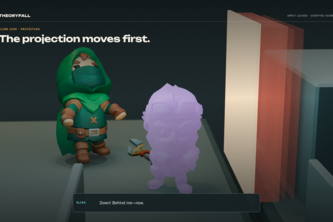
What the company appears to be: Theoryfall.com is a self-reported browser-based 3D spatial-reasoning game built around three projections of 3D structures. The author states it was developed using Codex and GPT-5.6-Sol, but no runtime AI is used in gameplay. It is described as a learning experience focused on reconstructing 3D geometry from 2D views.
What changed: The project description indicates this is a solo-built prototype submitted to the OpenAI 2026 hackathon. No prior version or evolution is evidenced; it appears to be an initial build with no prior commercial traction.
Single most important open question: Is there evidence of any measurable learning outcome, user engagement, or product-market fit beyond the author's own claims?
What The Product Actually Is
The description states that Theoryfall is a cinematic spatial-reasoning game where players reconstruct 3D structures from three projections (front, top, side). Players place and rotate cube-based pieces to match the given views. It includes a prologue with three levels: Mirror Gate, Blind Side, and Turning Crown.
- Evidenced: The product is described as a browser-native 3D game built with Three.js, React Three Fiber, TypeScript.
- Inferred: The core mechanic involves validating player constructions against projection data.
- Not evidenced: No details on gameplay mechanics beyond the stated levels or how feedback is delivered.
Positioning & Claim Evolution
The author positions Theoryfall as a learning experience that bridges the gap between 2D textbook geometry and 3D spatial reasoning. The tagline "A cinematic game where players learn spatial reasoning by reconstructing 3D structures from three projections" reflects this positioning.
- Evidenced: The product is framed as an educational tool for spatial reasoning.
- Inferred: It aims to make abstract mathematical concepts tangible through interactive play.
- Not evidenced: No evidence of prior versions, market testing, or user feedback on effectiveness.
Target Customer & ICP
The author describes the target audience as individuals who enjoy geometry and want a more immersive way to learn spatial reasoning. The game is positioned for learners who may struggle with traditional 2D representations of 3D problems.
- Evidenced: The product targets people interested in mathematics, especially geometry.
- Inferred: Likely aimed at students or hobbyists seeking hands-on learning tools.
- Not evidenced: No specific demographics, usage patterns, or customer segments are provided.
Business Model & Pricing Evidence
The description does not mention any pricing model, monetization strategy, or business model. It is described as a prototype submitted to a hackathon.
- Evidenced: No commercial structure or revenue model is stated.
- Inferred: The project may be in early development and not yet monetized.
- Not evidenced: No information on subscriptions, freemium models, or sales channels.
Technical & Delivery Signals
The author reports building the game using a tech stack including TypeScript, React Three Fiber, Three.js, Cloudflare Workers, D1, XState, and various development tools like Storybook and Vitest. AI was used in development but not during gameplay.
- Evidenced: The project is built with modern web technologies.
- Inferred: The use of AI in development suggests a rapid prototyping approach.
- Not evidenced: No details on scalability, performance metrics, or deployment architecture beyond the tech stack.
Traction & Maturity Signals
The project is described as a hackathon submission and not yet released to users. It has no evidence of revenue, customers, or adoption.
- Evidenced: Submitted to OpenAI 2026 hackathon.
- Inferred: The product is in early development stage.
- Not evidenced: No user data, engagement metrics, or market traction are reported.
Competitive Context
The description does not provide any information about competitors or the broader marketplace for educational games or spatial reasoning tools.
- Evidenced: No mention of existing products or competitive landscape.
- Inferred: Likely in a niche space involving STEM education and interactive learning.
- Not evidenced: No comparison to other platforms, tools, or methodologies.
Open Questions & Risks
Key risks include:
- Lack of measurable learning outcomes or user feedback
- Solo development may limit scalability or long-term maintenance
- Prototype nature implies unproven market fit or commercial viability
- Evidenced: The project is a solo-built hackathon submission.
- Inferred: Risk of limited product-market fit without external validation.
- Not evidenced: No evidence of risks related to funding, team expansion, or long-term strategy.
Questions the description leaves open
- What specific learning outcomes have you observed from playtesting?
- How do you plan to validate the educational value of this experience?
- Have you considered how to scale beyond a single developer?
- Is there any intention to monetize or expand the product beyond its current scope?
- What are your plans for user feedback and iteration?
Overall Assessment
Not evidenced: No financials, traction, or commercial viability data are provided.
The project is described as a solo-built prototype submitted to a hackathon. There is no evidence of revenue, customers, or product-market fit beyond the author’s own claims. The lack of measurable learning outcomes or user engagement makes it difficult to assess its potential for investment or partnership.
- Confidence: Low — based on minimal self-reported evidence.
- Conclusion: Not enough evidence to support a commercial due-diligence read beyond the initial concept.
User Stories BotA demo video on every pull request
Get a demo video on every new feature
GitHub App that watches your pull requests and records a narrated, captioned demo.
Save time on demo prep and make informed decisions faster with a video walkthrough of every new feature.
Source
Submitted to the OpenAI 2026 hackathon on Devpost. Project home on Devpost. Back to the full gallery on Devpost.
This competitive analysis was produced by top-founders.com (opens in a new tab)
Generated by a language model from this project's public Devpost page — its tagline, the author's own write-up and any built-with tags listed there — as captured in August 2026. Short quotations are the author's words. It is an opinion on the idea as a business, not on the people behind it, and it reflects the description as published then. If the project has moved on, request a correction below. The analysis is not independent research and contains no verified traction, revenue or customer data.
An independent guide by KFG International LLC — not affiliated with, endorsed by, or connected to Devpost or OpenAI.