

Archive position — measured, not model output
0 likes on Devpost
2,263 of the 7,850 archived projects have more likes, and 5,587 share exactly 0 — so this project's #2,265 place in the like-ranked listing is a tie-break inside that group, not a ranking.
Projects (log scale)
Likes on Devpost. ▲ marks this project's group.
Show the figures
| Likes | Projects | Share of archive |
|---|---|---|
| 0 | 5,587 | 71.2% |
| 1 | 1,758 | 22.4% |
| 2 | 284 | 3.6% |
| 3–4 | 132 | 1.7% |
| 5–9 | 75 | 1.0% |
| 10+ | 14 | 0.2% |
 User Stories BotA demo video on every pull request
Get a demo video on every new feature
GitHub App that watches your pull requests and records a narrated, captioned demo.
Save time on demo prep and make informed decisions faster with a video walkthrough of every new feature.
Executive Summary
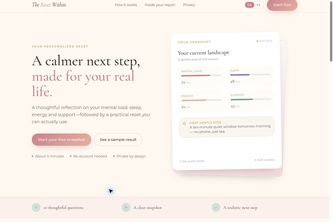
The Reset Within by Mandarina&Menta is a self-reported prototype app designed for women caregivers—particularly stay-at-home mothers who have paused their careers—to support emotional well-being through reflective prompts and personalized recommendations. The project was built entirely using AI tools (GPT-5.6, Codex) over three days by one founder, Isa V., with no evidence of revenue, users, or product-market fit beyond the author’s own description.
The app is positioned as a tool for personal growth and mindset development, not medical intervention. It seeks to offer emotional relief and self-awareness in a space where time is scarce. The single most important open question is whether this concept has traction or demand from its intended audience, which cannot be assessed from the provided evidence.
Confidence level Low — based entirely on one person’s unverified account and no external validation.
What The Product Actually Is
The description states that The Reset Within is an app built to help women caregivers "clear their minds, put into words the emotions they may be experiencing, and find a tool that supports them with practical suggestions or simply provides feedback about their current emotional state."
It is described as:
- A reflective tool asking a series of questions
- Providing personalized well-being recommendations
- Not intended for medical purposes
- Designed to support self-knowledge and emotional recovery
The app is presented as an entry point into personal growth, aiming to help women "rediscover who they are" when feeling overwhelmed.
Inference The app appears to be a digital journal or mood-check-in tool with AI-generated insights. It is not described as a marketplace, SaaS platform, or technical infrastructure product.
Positioning & Claim Evolution
The author claims the app is:
- Inspired by her own experience as a stay-at-home mom for over eight years
- Intended to support emotional well-being and mindset development
- A tool to help women "reinvent themselves professionally" while maintaining care for children
- Not a replacement for therapy or medical treatment
The positioning evolves from:
- Personal experience → to empathy-driven product
- Emotional relief → to self-discovery and professional reinvention
- AI-assisted development → to a scalable idea with potential for growth
Claim
The app is designed to help women caregivers find time, clarity, and emotional support in their daily lives.
Inference The positioning reflects a niche market need—emotional support for mothers who are also caregivers—but lacks evidence of demand or adoption.
Target Customer & ICP
The description states:
- The app is designed for women caring for young children, especially mothers who have paused their careers to become full-time caregivers at home
- The author identifies herself as a stay-at-home mom with over eight years of experience
Inference The target customer is likely a subset of stay-at-home mothers, possibly aged 25–45, seeking emotional support and self-reflection.
Not evidenced No data on demographics, user segmentation, or market size. No evidence of customer interviews or personas.
Business Model & Pricing Evidence
The description does not provide any information about:
- Revenue model
- Pricing structure
- Monetization strategy
- Subscription plans or in-app purchases
Inference The app is described as a prototype with no commercialization plan evident. It may be intended for future monetization, but there is no evidence of current or planned business model.
Technical & Delivery Signals
The project was built using:
- AI tools: GPT-5.6 (via Codex)
- Frameworks and libraries: React, TypeScript, Tailwind, Supabase, TanStack, Vite, Zod
- Development environment: GitHub, Lovable
The author states:
- The app is a first prototype
- Built entirely in three days
- The AI was used to guide the development process
- The author had wanted to try building an app for weeks before submitting it to a hackathon
Inference The technical stack suggests a modern frontend-heavy web application, but there is no evidence of scalability, performance, or production deployment.
Traction & Maturity Signals
The description states:
- This is the first prototype
- Built in three days
- Submitted to a hackathon (OpenAI 2026)
- No mention of users, downloads, or usage metrics
Not evidenced No data on user engagement, retention, or adoption. No evidence of product-market fit or customer feedback.
Competitive Context
The description does not reference:
- Competitors
- Similar products in the market
- Market size or trends
- Differentiation from existing tools
Inference The app appears to target a niche within emotional wellness and caregiver support, but no competitive landscape is described.
Open Questions & Risks
- No traction or user data: The product is a prototype with no evidence of adoption or usage.
- Unverified claims: All descriptions are self-reported and unverified.
- Single-founder development: No team, no external validation, no business structure.
- AI dependency: The app was built entirely using AI tools; this may limit scalability or long-term viability.
- Lack of monetization strategy: No indication of how the product will generate revenue.
Questions the description leaves open
- What specific emotional challenges do you observe in your target audience, and how does this app address them?
- Have you conducted any user interviews or feedback sessions with caregivers?
- How do you plan to validate demand for this product beyond the prototype phase?
- What is your long-term vision for monetization or scaling the app?
- Are there any legal or ethical considerations in designing an emotional support tool for caregivers?
Overall Assessment
Not evidenced: There is no evidence of revenue, users, traction, or business model to assess viability for investment or partnership.
The project is described as a first prototype, built by one person over three days using AI tools. It is positioned as a personal tool inspired by the founder’s experience, but there is no indication of market demand, product-market fit, or commercial potential.
Assessment The concept is unproven and lacks any evidence of traction or scalability. This is a speculative idea with no demonstrated value proposition or business model. Further due diligence would require user data, market validation, and financial projections—none of which are provided.
Confidence level Very low — based on self-reported narrative only.
User Stories BotA demo video on every pull request
Get a demo video on every new feature
GitHub App that watches your pull requests and records a narrated, captioned demo.
Save time on demo prep and make informed decisions faster with a video walkthrough of every new feature.
Source
Submitted to the OpenAI 2026 hackathon on Devpost. Project home on Devpost. Back to the full gallery on Devpost.
This competitive analysis was produced by top-founders.com (opens in a new tab)
Generated by a language model from this project's public Devpost page — its tagline, the author's own write-up and any built-with tags listed there — as captured in August 2026. Short quotations are the author's words. It is an opinion on the idea as a business, not on the people behind it, and it reflects the description as published then. If the project has moved on, request a correction below. The analysis is not independent research and contains no verified traction, revenue or customer data.
An independent guide by KFG International LLC — not affiliated with, endorsed by, or connected to Devpost or OpenAI.