

Archive position — measured, not model output
0 likes on Devpost
2,263 of the 7,850 archived projects have more likes, and 5,587 share exactly 0 — so this project's #4,228 place in the like-ranked listing is a tie-break inside that group, not a ranking.
Projects (log scale)
Likes on Devpost. ▲ marks this project's group.
Show the figures
| Likes | Projects | Share of archive |
|---|---|---|
| 0 | 5,587 | 71.2% |
| 1 | 1,758 | 22.4% |
| 2 | 284 | 3.6% |
| 3–4 | 132 | 1.7% |
| 5–9 | 75 | 1.0% |
| 10+ | 14 | 0.2% |
 User Stories BotA demo video on every pull request
Get a demo video on every new feature
GitHub App that watches your pull requests and records a narrated, captioned demo.
Save time on demo prep and make informed decisions faster with a video walkthrough of every new feature.
Executive Summary
What the company appears to be
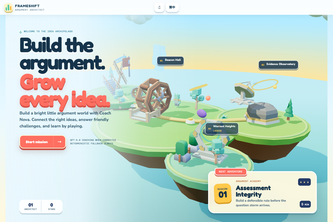
FrameShift: Argument Architect is a self-reported educational 3D argument-building tool designed for students, built as a hackathon submission. The product uses GPT-5.6 as a coaching assistant within a deterministic game engine that enforces rules and validates argument structure.
What changed
The project evolved from an initial flat debate prototype into a model-first 3D learning game using React, Three.js, and OpenAI APIs, with a focus on structured argument construction in education.
Single most important open question
Is there any evidence of user testing, adoption, or commercial traction beyond the hackathon submission?
What The Product Actually Is
The description states that FrameShift is a "playful 3D construction game" where players build arguments through three rounds. It includes:
- A deterministic rules engine that checks legality and completion
- GPT-5.6 as a coach (not referee)
- Structured Outputs from GPT-5.6 for coaching
- A bilingual experience in English and Traditional Chinese
- 3D interaction layer built with Three.js
- React, TypeScript, Vite, and Vercel for development
The product is described as a "game" that turns argument construction into an interactive 3D experience.
Confidence Low — this is self-reported functionality without independent verification or demonstration.
Positioning & Claim Evolution
The author states:
- Students are often asked to produce answers before learning how strong arguments are assembled.
- FrameShift makes the invisible thinking process visible and playful.
- It's an educational tool focused on argument construction in a 3D world.
- The mission is about AI-generated answers in formal assessment.
Inference This suggests a shift from traditional debate tools toward gamified, AI-assisted learning environments. However, no evidence of prior positioning or evolution beyond the hackathon submission exists.
Target Customer & ICP
The description states:
- Target: Students
- Use case: Learning how to construct arguments in education
- Specific mission: Whether schools should restrict fully AI-generated answers in formal assessment
Confidence Low — no evidence of customer segmentation, market research or user feedback beyond the author's own claims.
Business Model & Pricing Evidence
Not evidenced. The description does not mention any pricing model, monetization strategy, or business model.
Technical & Delivery Signals
The project uses:
- React, TypeScript, Vite, Three.js
- OpenAI Responses API with GPT-5.6
- Server-only Vercel function for structured outputs
- Deterministic engine to prevent model output from modifying game state
- Sanitized game snapshots sent to the browser
- Keyboard accessibility and non-WebGL fallback path
Inference The architecture shows an attempt at separation between AI coaching and game logic, with a focus on reproducibility and safety.
Traction & Maturity Signals
Not evidenced. There is no mention of users, customers, revenue, or adoption beyond the hackathon submission.
Competitive Context
Not evidenced. No information about competitors or market positioning is provided in the description.
Open Questions & Risks
- Unverified claims: All features and functionality are self-reported.
- No traction: No evidence of users, customers, or revenue.
- Limited scope: Built for a single hackathon challenge with one mission.
- AI dependency: Relies on GPT-5.6 for coaching; no clear fallback plan if API fails.
- Unproven market fit: No indication that the target audience has been validated.
Questions the description leaves open
- What specific educational outcomes have you observed from users of this prototype?
- How do you plan to scale beyond a single mission and language?
- Have you conducted any user testing with students or educators?
- What is your long-term vision for monetization or commercial use?
- Can you describe the process for updating or modifying argument rules without breaking determinism?
Overall Assessment
Not evidenced. No financial data, traction metrics, or commercial viability indicators are present in the description.
Confidence Very low — this is a hackathon prototype with no evidence of real-world application or business development beyond the author's own account.
User Stories BotA demo video on every pull request
Get a demo video on every new feature
GitHub App that watches your pull requests and records a narrated, captioned demo.
Save time on demo prep and make informed decisions faster with a video walkthrough of every new feature.
Source
Submitted to the OpenAI 2026 hackathon on Devpost. Project home on Devpost. Back to the full gallery on Devpost.
This competitive analysis was produced by top-founders.com (opens in a new tab)
Generated by a language model from this project's public Devpost page — its tagline, the author's own write-up and any built-with tags listed there — as captured in August 2026. Short quotations are the author's words. It is an opinion on the idea as a business, not on the people behind it, and it reflects the description as published then. If the project has moved on, request a correction below. The analysis is not independent research and contains no verified traction, revenue or customer data.
An independent guide by KFG International LLC — not affiliated with, endorsed by, or connected to Devpost or OpenAI.