

Archive position — measured, not model output
0 likes on Devpost
2,263 of the 7,850 archived projects have more likes, and 5,587 share exactly 0 — so this project's #7,232 place in the like-ranked listing is a tie-break inside that group, not a ranking.
Projects (log scale)
Likes on Devpost. ▲ marks this project's group.
Show the figures
| Likes | Projects | Share of archive |
|---|---|---|
| 0 | 5,587 | 71.2% |
| 1 | 1,758 | 22.4% |
| 2 | 284 | 3.6% |
| 3–4 | 132 | 1.7% |
| 5–9 | 75 | 1.0% |
| 10+ | 14 | 0.2% |
 User Stories BotA demo video on every pull request
Get a demo video on every new feature
GitHub App that watches your pull requests and records a narrated, captioned demo.
Save time on demo prep and make informed decisions faster with a video walkthrough of every new feature.
Executive Summary
The description states that The Last Label is a trilingual third-person heritage horror game built by a single developer using Godot 4 and AI tools like GPT-5.6. The project appears to be a personal creative endeavor submitted to a hackathon, with no evidence of commercial traction or revenue generation. The central open question is whether this represents a scalable or commercially viable product, or merely an artistic prototype.
What The Product Actually Is
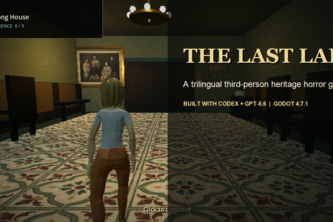
The description states that The Last Label is a third-person heritage horror game where players control Xu Anning, a tourist exploring Leong House in the fictional port of Tanjong Serai. It includes environmental storytelling, puzzles, and multilingual support (English, Simplified Chinese, Malay). The game features interactive elements such as WASD movement, over-the-shoulder camera, exploration, and evidence collection.
Positioning & Claim Evolution
The description states that The Last Label is positioned as a heritage horror experience with cultural atmosphere and narrative depth. It combines elements of mystery, environmental storytelling, and puzzle-solving within a historical context. The author claims the game presents a supernatural investigation into a 1919 erased story through changing museum labels and coded documents.
Target Customer & ICP
The description does not state any specific target customer or ideal customer profile (ICP). It describes the game as a heritage horror experience but does not identify who would purchase or use it commercially.
Business Model & Pricing Evidence
The description does not provide evidence of a business model or pricing strategy. The project is described as a downloadable Windows game, but no information is given about monetization, sales channels, or pricing.
Technical & Delivery Signals
The description states that the game was built in Godot 4 using GDScript and integrated with Codex powered by GPT-5.6. It includes features such as third-person controller, camera system, multilingual interface, puzzle mechanics, and Windows export. The author notes challenges related to collision detection, navigation reliability, and localization.
Traction & Maturity Signals
The description does not provide evidence of traction or maturity beyond the completion of a playable prototype. It mentions repeated playtests and visual refinement but lacks data on user engagement, downloads, or commercial adoption.
Competitive Context
The description does not offer any information about competitors or market positioning. No mention is made of similar games or platforms in the heritage horror or puzzle-adventure genre.
Open Questions & Risks
- The project is a solo effort with no team or external support.
- No evidence of revenue, customers, or commercial viability.
- The use of AI tools like GPT-5.6 raises questions about scalability and reproducibility.
- The project is described as a hackathon submission, suggesting it may be an experimental prototype rather than a market-ready product.
Questions the description leaves open
- What is the intended commercialization path for The Last Label?
- Are there any plans to expand beyond the current platform or audience?
- How does the author plan to sustain development or monetize the game?
- Has the author considered how AI-assisted development will scale or be maintained?
Overall Assessment
Not evidenced. The description provides no information about financials, traction, or market readiness that would support an investment or partnership decision. It is a self-reported prototype submitted to a hackathon with no indication of commercial viability or scalability.
User Stories BotA demo video on every pull request
Get a demo video on every new feature
GitHub App that watches your pull requests and records a narrated, captioned demo.
Save time on demo prep and make informed decisions faster with a video walkthrough of every new feature.
Source
Submitted to the OpenAI 2026 hackathon on Devpost. Project home on Devpost. Back to the full gallery on Devpost.
This competitive analysis was produced by top-founders.com (opens in a new tab)
Generated by a language model from this project's public Devpost page — its tagline, the author's own write-up and any built-with tags listed there — as captured in August 2026. Short quotations are the author's words. It is an opinion on the idea as a business, not on the people behind it, and it reflects the description as published then. If the project has moved on, request a correction below. The analysis is not independent research and contains no verified traction, revenue or customer data.
An independent guide by KFG International LLC — not affiliated with, endorsed by, or connected to Devpost or OpenAI.