

Archive position — measured, not model output
0 likes on Devpost
2,263 of the 7,850 archived projects have more likes, and 5,587 share exactly 0 — so this project's #7,220 place in the like-ranked listing is a tie-break inside that group, not a ranking.
Projects (log scale)
Likes on Devpost. ▲ marks this project's group.
Show the figures
| Likes | Projects | Share of archive |
|---|---|---|
| 0 | 5,587 | 71.2% |
| 1 | 1,758 | 22.4% |
| 2 | 284 | 3.6% |
| 3–4 | 132 | 1.7% |
| 5–9 | 75 | 1.0% |
| 10+ | 14 | 0.2% |
 User Stories BotA demo video on every pull request
Get a demo video on every new feature
GitHub App that watches your pull requests and records a narrated, captioned demo.
Save time on demo prep and make informed decisions faster with a video walkthrough of every new feature.
Executive Summary
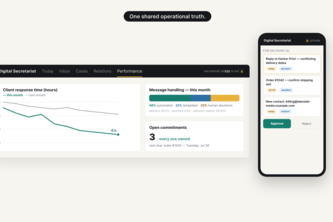
The description states that "Digital Secretariat" is a communication control plane for AI-operated companies. The author describes it as a system that logs and routes emails, clears routine work, and surfaces exceptions—aimed at preventing client loss due to dropped balls rather than bad math. It is built using AI (specifically GPT-5.6), FastAPI, PostgreSQL, and other technologies.
The company appears to be a solo project by Bogdan Czarnecki, submitted as part of the OpenAI 2026 hackathon. The description does not evidence any revenue, customers, or traction beyond its development as a reference product.
Key commercial due-diligence question: Does this system actually solve a real organizational coordination problem that companies are willing to pay for, or is it an engineering exercise?
What The Product Actually Is
The description states that Digital Secretariat is a communication control plane for AI-operated companies. It provides:
- A private workspace showing client communications, company plans, approvals, and operational truth
- One canonical mail rail for outbound messages
- Revision checks to prevent approval of changed text
- A system where a message counts as sent only when the append-only send log contains matching evidence from the canonical rail
- Integration with GPT-5.6 for interpreting intent, identifying missing context, and drafting responses
- Use of Codex as an engineering partner throughout the build
The product is described as being extracted from a working company system and turned into an independent, tested reference product.
Positioning & Claim Evolution
The description states that the project was inspired by internal problems in an AI-operated company where "a partially working legacy module could continue a long conversation with a potential client while the rest of the company had no reliable view of that exchange." This led to the insight that "the most important interface in an AI-operated company is not the model. It is the boundary between the company and its clients."
The positioning appears to be: "The Digital Secretariat never forgets—logging and routing every email, clearing routine work, surfacing only real exceptions. It scales." The claim evolution suggests a shift from a general productivity tool to a specific control plane for AI companies' communication boundaries.
Target Customer & ICP
The description states that the product is designed for "AI-operated companies" and aims to solve problems in the boundary between company and clients. It targets organizations where AI increases the number and speed of actions, requiring stronger controls over communication.
The target customer appears to be small-to-medium-sized companies using AI in their operations who need better control over client communications and organizational coordination.
Business Model & Pricing Evidence
Not evidenced. The description does not contain any information about pricing models, revenue streams, or business model details.
Technical & Delivery Signals
The description states that the system was built using:
- FastAPI and PostgreSQL
- A separate read-only cache process that retrieves message content
- Web process that never receives IMAP credentials
- Hardened systemd services
- Private exposure through Tailscale Serve
- Deterministic code validating every proposal before canonical rail release
- Use of Codex as engineering partner for inspection, testing, documentation, and AI-guided installer contract creation
The system is described as having least-privilege database roles, additive migrations, hardened service definitions, atomic deployer with rollback, preflight and verification scripts, and focused automated tests.
Traction & Maturity Signals
Not evidenced. The description does not contain any information about customers, revenue, usage metrics, or product maturity beyond its development as a reference product.
Competitive Context
Not evidenced. The description does not provide any information about competitors, market positioning, or competitive landscape.
Open Questions & Risks
- The project is described as a solo effort by one person (Bogdan Czarnecki) submitted for a hackathon
- No evidence of revenue, customers, or traction
- The system appears to be built around a specific architecture and may not be easily adaptable to different organizational needs
- The use of GPT-5.6 raises questions about how the AI is integrated into the control plane without direct sending authority
- The description mentions that "extracting a reusable product from a live, customized system meant separating genuine product capabilities from organization-specific joins" - suggesting potential difficulties in generalization
Questions the description leaves open
- What specific organizational coordination problems does this solve that companies are currently unable to address?
- How does the system handle integration with existing email systems and workflows?
- What is the actual adoption rate or usage of this system within the company it was extracted from?
- How would you adapt this system for different types of organizations or business models?
- What are the specific security invariants that make this system trustworthy, and how do they translate to real-world deployment?
Overall Assessment
Not evidenced. The description does not contain any information about funding rounds, valuations, or investment status. The project appears to be a solo hackathon submission with no evidence of commercial traction or viability beyond its development as a reference product.
User Stories BotA demo video on every pull request
Get a demo video on every new feature
GitHub App that watches your pull requests and records a narrated, captioned demo.
Save time on demo prep and make informed decisions faster with a video walkthrough of every new feature.
Source
Submitted to the OpenAI 2026 hackathon on Devpost. Project home on Devpost. Back to the full gallery on Devpost.
This competitive analysis was produced by top-founders.com (opens in a new tab)
Generated by a language model from this project's public Devpost page — its tagline, the author's own write-up and any built-with tags listed there — as captured in August 2026. Short quotations are the author's words. It is an opinion on the idea as a business, not on the people behind it, and it reflects the description as published then. If the project has moved on, request a correction below. The analysis is not independent research and contains no verified traction, revenue or customer data.
An independent guide by KFG International LLC — not affiliated with, endorsed by, or connected to Devpost or OpenAI.