

Archive position — measured, not model output
0 likes on Devpost
2,263 of the 7,850 archived projects have more likes, and 5,587 share exactly 0 — so this project's #7,206 place in the like-ranked listing is a tie-break inside that group, not a ranking.
Projects (log scale)
Likes on Devpost. ▲ marks this project's group.
Show the figures
| Likes | Projects | Share of archive |
|---|---|---|
| 0 | 5,587 | 71.2% |
| 1 | 1,758 | 22.4% |
| 2 | 284 | 3.6% |
| 3–4 | 132 | 1.7% |
| 5–9 | 75 | 1.0% |
| 10+ | 14 | 0.2% |
 User Stories BotA demo video on every pull request
Get a demo video on every new feature
GitHub App that watches your pull requests and records a narrated, captioned demo.
Save time on demo prep and make informed decisions faster with a video walkthrough of every new feature.
Executive Summary
What the company appears to be
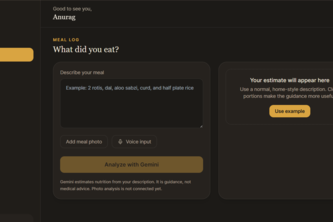
ThaliIQ is an AI-powered diet copilot designed for Indian households, built as a web application. The description states it helps users make healthier food decisions by analyzing homemade meals, family health needs, weekly budgets, groceries, and eating-out choices.
What changed
This project was submitted to the OpenAI 2026 hackathon. It is described as a prototype built in a short timeframe with no revenue or customer traction evidenced.
Single most important open question
Is there sufficient evidence of market demand or user interest beyond the authors' personal experience and hackathon context?
What The Product Actually Is
The description states that ThaliIQ is:
- A web application built with React, TypeScript, Vite, and Firebase
- Designed as a "diet copilot" for Indian households
- Capable of analyzing homemade meals (e.g., "2 rotis, dal, aloo sabzi, curd, and rice")
- Supporting family profiles with different health goals and portion needs
- Generating weekly meal plans, grocery lists, and restaurant recommendations
- Not intended to replace doctors or dieticians but to serve as an educational assistant
The product is described as a mock-first AI service layer with typed data models for various workflows (profile setup, meal logging, nutrition analysis, planning, groceries, restaurant choices, progress tracking). It includes local JSON persistence, routed screens, and a floating assistant.
Evidence strength Self-reported. No independent verification of functionality or performance.
Positioning & Claim Evolution
The description states that ThaliIQ was inspired by the author’s personal struggle with dieting and the lack of culturally relevant tools for Indian meals. It positions itself as:
- Not just another calorie tracker
- Designed around Indian household dynamics, shared meals, vegetarian protein challenges, budgets, and everyday food decisions
- An educational assistant rather than a medical tool
It claims to be practical, helping users understand what is already on their plate, how to improve it, what to buy for the week, and what to choose when eating outside.
Inference The positioning evolved from personal pain point to a broader solution for Indian dietary needs, with potential for expansion into clinics, gyms, grocery platforms, and food delivery platforms.
Target Customer & ICP
The description states that ThaliIQ targets:
- Indian households
- Users who want to make healthier food decisions without changing their eating habits entirely
- Families with different health goals (weight loss, vegetarian protein intake, diabetes awareness, PCOS support, budget-friendly eating)
- Individuals looking for nutrition education and planning assistance
It is not described as targeting dieticians or healthcare providers directly, but mentions potential use cases for them.
Evidence strength Self-reported. No evidence of actual customer segments or personas beyond the authors' own experience.
Business Model & Pricing Evidence
The description does not provide any information about:
- Revenue streams
- Pricing models
- Monetization strategy
- Customer acquisition costs
- Unit economics
It only states that ThaliIQ is an educational assistant, not a replacement for doctors or dieticians.
Evidence strength Not evidenced. No indication of how the product would generate revenue or be monetized.
Technical & Delivery Signals
The description states:
- Built with React, TypeScript, Vite, Firebase, CSS, HTML, JavaScript, Node.js, OpenAI API, Tailwind CSS
- Structured around main daily diet workflow: profile setup, meal logging, nutrition analysis, planning, groceries, restaurant choices, progress tracking
- Typed data models for family profiles, meal analysis, grocery lists, weekly plans, and restaurant recommendations
- Mock-first AI service layer for demo reliability
- Local JSON persistence, routed app screens, floating assistant, Firebase configuration foundations
Evidence strength Self-reported. No evidence of technical performance or scalability.
Traction & Maturity Signals
The description states:
- This is a hackathon submission (OpenAI 2026)
- Built in a short timeframe
- No revenue, customer, or traction data provided
- The authors are proud of its practicality and potential beyond the hackathon
There is no evidence of:
- User adoption
- Customer feedback
- Product usage metrics
- Revenue generation
- Market validation
Evidence strength Not evidenced. The project is described as a prototype with no demonstrated traction.
Competitive Context
The description does not mention any competitors or competitive landscape. It only states that the product addresses a gap in existing tools for Indian households, particularly those focused on homemade meals and cultural dietary needs.
Evidence strength Not evidenced. No information about existing solutions or competitive positioning.
Open Questions & Risks
- No traction or revenue evidence: The project is described as a hackathon submission with no demonstrated market adoption.
- Unverified claims: All features, functionality, and impact are self-reported without independent verification.
- Limited scope: The product is described as a mock-first prototype, not a production-ready system.
- Unclear monetization: No business model or pricing strategy provided.
- Cultural specificity risk: While the focus on Indian meals is a strength, it may limit scalability if not carefully managed.
Inference Without real-world usage data or financials, the viability of this product as a commercial venture remains unproven.
Questions the description leaves open
- What specific user problems are you solving beyond your own experience?
- How do you plan to validate demand for ThaliIQ outside of the hackathon context?
- What is your path to monetization and customer acquisition?
- Have you conducted any user research or testing with real Indian households?
- What are the technical challenges in transitioning from a mock-first AI service layer to a production-ready backend?
- How do you intend to build an accurate Indian nutrition database?
- Are there any partnerships or integrations planned with dieticians, clinics, or grocery platforms?
- What is your timeline for moving beyond the prototype stage?
Overall Assessment
The description states that ThaliIQ was built as a hackathon project and is not yet proven in the market. It is described as solving a real problem but lacks evidence of traction, revenue, or customer validation.
Inference While the idea has potential, there is insufficient evidence to support investment or partnership at this stage. The product needs further development, user testing, and market validation before it can be considered viable for commercial investment or strategic partnership.
The project appears to be an early-stage concept with strong positioning in a culturally specific niche, but no demonstrated path to scale or profitability.
User Stories BotA demo video on every pull request
Get a demo video on every new feature
GitHub App that watches your pull requests and records a narrated, captioned demo.
Save time on demo prep and make informed decisions faster with a video walkthrough of every new feature.
Source
Submitted to the OpenAI 2026 hackathon on Devpost. Project home on Devpost. Back to the full gallery on Devpost.
This competitive analysis was produced by top-founders.com (opens in a new tab)
Generated by a language model from this project's public Devpost page — its tagline, the author's own write-up and any built-with tags listed there — as captured in August 2026. Short quotations are the author's words. It is an opinion on the idea as a business, not on the people behind it, and it reflects the description as published then. If the project has moved on, request a correction below. The analysis is not independent research and contains no verified traction, revenue or customer data.
An independent guide by KFG International LLC — not affiliated with, endorsed by, or connected to Devpost or OpenAI.