

Archive position — measured, not model output
0 likes on Devpost
2,263 of the 7,850 archived projects have more likes, and 5,587 share exactly 0 — so this project's #7,156 place in the like-ranked listing is a tie-break inside that group, not a ranking.
Projects (log scale)
Likes on Devpost. ▲ marks this project's group.
Show the figures
| Likes | Projects | Share of archive |
|---|---|---|
| 0 | 5,587 | 71.2% |
| 1 | 1,758 | 22.4% |
| 2 | 284 | 3.6% |
| 3–4 | 132 | 1.7% |
| 5–9 | 75 | 1.0% |
| 10+ | 14 | 0.2% |
 User Stories BotA demo video on every pull request
Get a demo video on every new feature
GitHub App that watches your pull requests and records a narrated, captioned demo.
Save time on demo prep and make informed decisions faster with a video walkthrough of every new feature.
Executive Summary
What the company appears to be
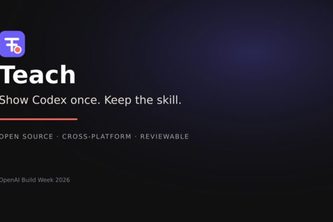
The description states that "Teach" is an open-source, cross-platform Codex plugin designed to help users demonstrate human-demonstrated workflows and convert them into structured process models. It allows a user to show a workflow once, inspect what Codex learned, and keep the result as a reusable skill.
What changed
The project was submitted to the OpenAI 2026 hackathon, indicating it is a prototype or early-stage product with no evidence of commercial traction or deployment beyond the demo environment. It is self-described as a tool for learning workflows through demonstration rather than automation.
Single most important open question
Is there any evidence that "Teach" has been used in practice by users beyond the author’s own development and testing? The description does not indicate adoption, usage, or revenue — only a self-reported technical implementation and demo.
What The Product Actually Is
The description states that Teach is:
- An open-source, cross-platform Codex plugin.
- A tool for learning human-demonstrated workflows.
- Designed to record bounded demonstrations, extract frames, and ask Codex to produce a structured process model.
- Not silently automated — the user reviews and edits the draft before publishing.
- Outputs a standard Codex skill, not a hidden macro or pixel-based automation.
It is described as a plugin that:
- Uses native recorder adapters for GNOME Wayland, macOS, and Windows 11.
- Includes an MCP Apps interface embedded in Codex.
- Has a local session store using atomic JSON and append-only JSONL.
- Uses FFmpeg validation and bounded frame extraction.
- Applies schema-constrained analysis through sandboxed Codex exec.
- Enforces deterministic capability and policy checks before publishing.
Inference The product is a developer-facing tool for workflow capture and documentation, not an end-user automation platform. It is built with a focus on transparency, privacy, and structured output.
Positioning & Claim Evolution
The description states that Teach:
- Is positioned as a differentiator from OpenAI Record & Replay.
- Emphasizes openness (Apache-2.0), cross-platform support, and structured labeling of workflows.
- Focuses on process model generation over simple replay.
- Is privacy-led, with visible recording, scoped capture, and local storage.
Inference The positioning is that Teach is a tool for developers or workflow engineers who want to document and share human-demonstrated processes in a structured, reusable way — not for general automation or end-user workflows.
Target Customer & ICP
The description does not state the target customer or ideal customer profile (ICP). It implies a developer audience due to its focus on Codex, plugin architecture, and technical implementation. However, no explicit customer segment is named.
Not evidenced No information about who uses it, what their job function is, or whether there are any known users or personas.
Business Model & Pricing Evidence
The description does not state anything about a business model or pricing. It describes the tool as open-source and built for developers to use in workflow documentation and automation capture.
Not evidenced No mention of monetization, licensing, or pricing models.
Technical & Delivery Signals
The description states:
- Built with bun, Codex, ffmpeg, GNOME Wayland, GPT-5.6, MCP Apps, Next.js, Screencapturekit, TypeScript, Windows 11.
- Includes native recorder adapters for Linux (GNOME Wayland), macOS, and Windows 11.
- Uses a local file-backed session store with atomic JSON and append-only JSONL.
- Employs FFmpeg validation and bounded frame extraction.
- Applies schema-constrained analysis through sandboxed Codex exec.
- Has deterministic capability and policy checks before publishing.
- Includes standalone platform runtimes for easy installation.
Inference The tool is technically sophisticated, cross-platform, and built with developer tools in mind. It emphasizes local execution, privacy, and structured outputs.
Traction & Maturity Signals
The description states:
- It was submitted to the OpenAI 2026 hackathon.
- Includes a demo video (https://youtu.be/1xKRY7CZj8A).
- Provides a deterministic no-credentials judge path for installation and testing.
- The repository preserves prompt history and engineering decisions in its prompt library and devlog.
Not evidenced No evidence of users, customers, revenue, or adoption beyond the author’s own development and demo. No mention of usage metrics, product releases, or market traction.
Competitive Context
The description states:
- Teach is positioned as different from OpenAI Record & Replay.
- It explores a different product boundary by focusing on structured labeling, output contracts, risks, and verification criteria.
- It is independently implemented and not affiliated with or a replacement for OpenAI Record & Replay.
Inference The competitive context is within the space of workflow automation tools and Codex plugins. However, no information is given about other players in this space or how Teach compares to them.
Open Questions & Risks
- No commercial traction or adoption: The project is described as a hackathon submission with no evidence of real-world usage.
- Developer-only focus: No indication of end-user or business-facing features, limiting its potential market reach.
- Self-reported only: All claims are unverified and based on the author’s own description.
- No pricing or monetization strategy: The tool is open-source, but no path to revenue is evident.
- Limited evidence of product maturity: No mention of production use, user feedback, or iteration beyond a demo.
Questions the description leaves open
- What is the actual use case for this tool? Who are the users?
- Has it been tested in real-world workflows beyond the demo?
- Are there any plans to monetize or commercialize the tool?
- How does Teach handle edge cases in workflow capture, especially in complex or non-standard environments?
- What is the long-term vision for Teach — is it a standalone product or part of a larger ecosystem?
Overall Assessment
Not evidenced No information is provided about revenue, customers, traction, or commercial viability.
Inference The project appears to be an early-stage prototype submitted as a hackathon entry. It has technical sophistication and a clear focus on developer workflows, but lacks evidence of adoption, monetization, or product-market fit. It is not ready for investment or partnership without further demonstration of traction or usage.
User Stories BotA demo video on every pull request
Get a demo video on every new feature
GitHub App that watches your pull requests and records a narrated, captioned demo.
Save time on demo prep and make informed decisions faster with a video walkthrough of every new feature.
Source
Submitted to the OpenAI 2026 hackathon on Devpost. Project home on Devpost. Back to the full gallery on Devpost.
This competitive analysis was produced by top-founders.com (opens in a new tab)
Generated by a language model from this project's public Devpost page — its tagline, the author's own write-up and any built-with tags listed there — as captured in August 2026. Short quotations are the author's words. It is an opinion on the idea as a business, not on the people behind it, and it reflects the description as published then. If the project has moved on, request a correction below. The analysis is not independent research and contains no verified traction, revenue or customer data.
An independent guide by KFG International LLC — not affiliated with, endorsed by, or connected to Devpost or OpenAI.