

Archive position — measured, not model output
0 likes on Devpost
2,263 of the 7,850 archived projects have more likes, and 5,587 share exactly 0 — so this project's #7,154 place in the like-ranked listing is a tie-break inside that group, not a ranking.
Projects (log scale)
Likes on Devpost. ▲ marks this project's group.
Show the figures
| Likes | Projects | Share of archive |
|---|---|---|
| 0 | 5,587 | 71.2% |
| 1 | 1,758 | 22.4% |
| 2 | 284 | 3.6% |
| 3–4 | 132 | 1.7% |
| 5–9 | 75 | 1.0% |
| 10+ | 14 | 0.2% |
 User Stories BotA demo video on every pull request
Get a demo video on every new feature
GitHub App that watches your pull requests and records a narrated, captioned demo.
Save time on demo prep and make informed decisions faster with a video walkthrough of every new feature.
Executive Summary
What the company appears to be
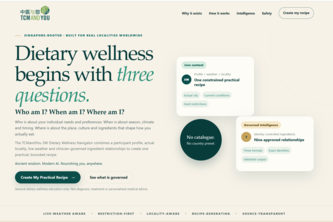
TCMandYou Global Dietary Navigator is a self-reported AI-enabled dietary wellness tool that combines user profile, real-time weather, and location with clinician-governed Traditional Chinese Medicine (TCM) knowledge to generate one practical recipe. It is described as a pilot project built during a hackathon.
What changed
The description indicates this was developed in a single week (Build Week), with no prior commercial traction or revenue evidence. The system uses constrained AI models and governed ingredient/relationship sets, aiming for responsible personalization without diagnosis or medical advice.
Single most important open question
Is there any evidence of domain expertise validation beyond the author's clinical experience, or of user adoption or feedback from real-world usage?
What The Product Actually Is
The description states that TCMandYou Global Dietary Navigator:
- Combines a participant’s self-reported profile and dietary constraints;
- Their actual locality (via GPS or manual search);
- Current local weather;
- Shopping access;
- Familiar meal styles;
- Cooking time and equipment;
- Clinician-governed TCM-informed dietary knowledge.
It then produces one practical recipe within a controlled culinary framework, using GPT-5.6 Sol only with reviewed ingredients, relationships, and formats.
The system does not allow users to pre-select ingredients but instead reasons from context before generating output.
Inference The product is an AI-driven dietary guidance tool that applies TCM principles in a constrained, personalized way based on environmental and personal data inputs.
Positioning & Claim Evolution
The author claims:
- This is not a generic meal planner or static recipe catalog.
- It focuses on “Who, When, Where” as core contextual factors.
- The system avoids national diet presets and cultural stereotypes.
- It emphasizes safety through deterministic rules and clinician-governed content.
Inference The positioning centers around responsible AI use in dietary wellness, emphasizing personalization grounded in TCM principles rather than broad or culturally biased recommendations.
Target Customer & ICP
The description states:
- Participants are individuals seeking dietary guidance.
- Users may optionally link to a “Constitution Compass” if they already know their TCM constitution.
- The system supports global localities without assigning ethnicity or illness.
- It is designed for general public use, not professional practitioners.
Inference The target customer appears to be health-conscious individuals who want personalized dietary guidance informed by TCM and environmental context. No specific ICP is defined beyond “general users.”
Business Model & Pricing Evidence
The description states:
- The application is publicly accessible without an account.
- It provides general dietary-wellness education only.
- It does not diagnose disease, recommend medication changes or replace qualified professional care.
There is no mention of pricing, monetization strategy, or business model.
Not evidenced.
Technical & Delivery Signals
The description states:
- Built with Codex and GPT-5.6 Sol.
- Uses Next.js 16, React 19, TypeScript, Tailwind CSS, Zod, OpenAI Responses API, Open-Meteo, Vitest, Vercel.
- Includes browser geolocation, live weather integration, deterministic weather classification.
- Has automated tests (78), linting, type checking, production build verification.
- Final release passed responsive testing and deployment on Vercel.
Inference The technical stack suggests a modern web application with strong validation and structured output. The use of Codex and constrained GPT models indicates an attempt to manage AI behavior within defined boundaries.
Traction & Maturity Signals
The description states:
- This is a pilot project built during Build Week.
- It was submitted to the OpenAI 2026 hackathon.
- No revenue, customer or adoption data is available beyond what the author reports.
- The current release is described as a controlled global-adaptation pilot.
Not evidenced.
Competitive Context
The description states:
- It is not a generic AI meal planner or static recipe catalogue.
- It avoids national diet presets and cultural stereotypes.
- It focuses on integrating TCM knowledge with real-time context (weather, location).
No comparison to existing products or market players is made.
Not evidenced.
Open Questions & Risks
The description states:
- The system uses a single developer (Clement Ng).
- It was built in one week.
- It does not claim to diagnose illness or replace professional care.
- It includes safety checks for allergies and vulnerable users.
- It avoids free-form ingredient selection, relying on governed relationships.
Inference
- Risk of limited scalability due to single-person development.
- Risk of over-reliance on self-reported data without external validation.
- Risk of misalignment between TCM principles and AI-generated outputs if not rigorously governed.
- Lack of evidence for domain expert validation beyond the author’s clinical experience.
Questions the description leaves open
- What is the source of the clinician-governed TCM knowledge used in the system?
- How were the seven identity-controlled culinary ingredients and nine approved ingredient relationships selected?
- Has the system been tested with actual users or validated by TCM practitioners outside of the author’s clinical experience?
- Are there plans to expand beyond the current pilot scope, and how will governance scale?
- What is the mechanism for handling user feedback on unavailable ingredients or incorrect suggestions?
Overall Assessment
The description states:
- This is a hackathon project built in one week.
- No revenue, customers, or traction data are available.
- The system is publicly accessible and does not appear to have monetization.
Inference At this stage, the project lacks commercial evidence or maturity. It may be an early-stage idea with potential for further development, but it has not demonstrated viability or scalability. Any investment or partnership would require deeper due diligence into domain validation, user testing, and product-market fit beyond its current pilot form.
User Stories BotA demo video on every pull request
Get a demo video on every new feature
GitHub App that watches your pull requests and records a narrated, captioned demo.
Save time on demo prep and make informed decisions faster with a video walkthrough of every new feature.
Source
Submitted to the OpenAI 2026 hackathon on Devpost. Project home on Devpost. Back to the full gallery on Devpost.
This competitive analysis was produced by top-founders.com (opens in a new tab)
Generated by a language model from this project's public Devpost page — its tagline, the author's own write-up and any built-with tags listed there — as captured in August 2026. Short quotations are the author's words. It is an opinion on the idea as a business, not on the people behind it, and it reflects the description as published then. If the project has moved on, request a correction below. The analysis is not independent research and contains no verified traction, revenue or customer data.
An independent guide by KFG International LLC — not affiliated with, endorsed by, or connected to Devpost or OpenAI.