

Archive position — measured, not model output
0 likes on Devpost
2,263 of the 7,850 archived projects have more likes, and 5,587 share exactly 0 — so this project's #7,153 place in the like-ranked listing is a tie-break inside that group, not a ranking.
Projects (log scale)
Likes on Devpost. ▲ marks this project's group.
Show the figures
| Likes | Projects | Share of archive |
|---|---|---|
| 0 | 5,587 | 71.2% |
| 1 | 1,758 | 22.4% |
| 2 | 284 | 3.6% |
| 3–4 | 132 | 1.7% |
| 5–9 | 75 | 1.0% |
| 10+ | 14 | 0.2% |
 User Stories BotA demo video on every pull request
Get a demo video on every new feature
GitHub App that watches your pull requests and records a narrated, captioned demo.
Save time on demo prep and make informed decisions faster with a video walkthrough of every new feature.
Executive Summary
What the company appears to be
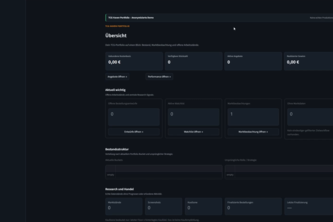
TCG Haven Portfolio is a self-reported local Python/Streamlit application designed for small TCG (trading-card game) businesses to manage inventory, purchase tracking, and market observations. It is built around a human-in-the-loop workflow that automates verified data but requires human review for uncertain or conflicting card identities.
What changed
The project evolved from an internal prototype into a publicly submitted hackathon entry. The author reports using GPT-5.6 via Codex to assist in development, debugging, and testing during the Build Week event, though no runtime integration of AI is claimed beyond that.
Single most important open question
Is there evidence of real-world usage or adoption by TCG Haven or others? The description states no revenue, customers, or traction data are available beyond the author’s own account.
What The Product Actually Is
The description states:
- TCG Haven Portfolio is a local Python and Streamlit application.
- It uses SQLite, SQLAlchemy, and Alembic migrations for data handling.
- It imports purchase data, reviews card identities, confirms costs, and finalizes orders through four stages.
- It supports OCR-based market observations, with plausibility warnings and manual confirmation steps.
- It handles shipping and transaction fee allocation across inventory lots.
- The system is designed to block unsafe inventory changes until human review is complete.
Inference:
- The product is a local desktop or browser-based tool, not cloud-hosted.
- It is not a SaaS offering; it's a self-contained application for personal use or small business internal workflows.
Positioning & Claim Evolution
The description states:
- The author runs TCG Haven, a small trading-card business in Germany.
- The tool was built to replace a fragmented spreadsheet workflow.
- It is positioned as a safer local application for managing card inventories and market tracking.
Inference:
- The product is not marketed externally, but rather developed for internal use and then shared publicly.
- It does not claim to be a general-purpose marketplace or inventory platform — it’s tailored for TCGs with complex variant structures.
Target Customer & ICP
The description states:
- The tool is intended for small TCG businesses like the author's own.
- It addresses inventory and market tracking challenges in TCGs, where card variants (set, language, finish) can be difficult to track manually.
Inference:
- The ICP is likely small-scale TCG collectors or retailers, not large distributors or online marketplaces.
- There is no evidence of segmentation beyond this niche use case.
Business Model & Pricing Evidence
The description states:
- No pricing model, revenue, or monetization strategy is described.
- The tool is a local application and not sold or offered as a service.
- It was built for internal use and then submitted to a hackathon.
Inference:
- There is no evidence of a commercial business model.
- No pricing information, subscriptions, or licensing details are provided.
Technical & Delivery Signals
The description states:
- Built with Python, Streamlit, SQLite, SQLAlchemy, and Alembic.
- Uses GPT-5.6 via Codex for development assistance (not runtime integration).
- Includes 174 automated tests, Playwright browser scenarios, and OCR safety checks.
- The demo is reproducible and anonymized, with synthetic data.
- Privacy auditing was performed.
Inference:
- The tool is developer-focused, not user-facing in a polished way.
- It uses modern Python tools for local development and testing, but no evidence of production deployment or scalability.
Traction & Maturity Signals
The description states:
- The project started as an internal prototype.
- It was substantially extended during Build Week.
- A public demo repository exists with synthetic data.
- No real-world usage, customers, or adoption is reported.
Inference:
- There is no evidence of traction, revenue, or customer base.
- The tool has not been deployed in a production environment beyond the demo.
Competitive Context
The description states:
- No mention of competitors or market positioning against other tools.
- It is designed for small TCG businesses, not general inventory systems.
Inference:
- The competitive landscape is not described.
- There is no evidence of existing tools in this niche, nor any comparison to them.
Open Questions & Risks
The description states:
- The tool is local-only, not cloud-hosted or scalable.
- It uses GPT-5.6 for development only, not runtime AI.
- No real-world usage or adoption is reported.
Inference:
- Risk of limited scalability due to local nature and lack of cloud infrastructure.
- Risk of no commercial viability without a clear path to monetization or customer base.
- The tool may be too niche or experimental for broader market appeal.
Questions the description leaves open
- Has TCG Haven (the business) actually adopted this tool in production?
- What is the actual size and scope of the TCG Haven business?
- Are there any real-world users beyond the author?
- How does the tool handle data migration or integration with existing systems?
- Is there a plan to move beyond local use, or to monetize this product?
- What are the actual limitations of the OCR and identity matching logic in practice?
Overall Assessment
The description states:
- This is a self-reported hackathon submission with no evidence of traction, revenue, or customers.
- It is a local application, not a scalable SaaS product.
- The author is the sole team member.
Inference:
- There is no commercial due-diligence basis to recommend investment or partnership at this time.
- The tool appears to be an experimental prototype with no demonstrated market fit or business model.
- The project may have potential for future development, but current evidence does not support a commercial read.
User Stories BotA demo video on every pull request
Get a demo video on every new feature
GitHub App that watches your pull requests and records a narrated, captioned demo.
Save time on demo prep and make informed decisions faster with a video walkthrough of every new feature.
Source
Submitted to the OpenAI 2026 hackathon on Devpost. Project home on Devpost. Back to the full gallery on Devpost.
This competitive analysis was produced by top-founders.com (opens in a new tab)
Generated by a language model from this project's public Devpost page — its tagline, the author's own write-up and any built-with tags listed there — as captured in August 2026. Short quotations are the author's words. It is an opinion on the idea as a business, not on the people behind it, and it reflects the description as published then. If the project has moved on, request a correction below. The analysis is not independent research and contains no verified traction, revenue or customer data.
An independent guide by KFG International LLC — not affiliated with, endorsed by, or connected to Devpost or OpenAI.