

Archive position — measured, not model output
1 like on Devpost
505 of the 7,850 archived projects have more likes, and 1,758 share exactly 1 — so this project's #2,043 place in the like-ranked listing is a tie-break inside that group, not a ranking.
Projects (log scale)
Likes on Devpost. ▲ marks this project's group.
Show the figures
| Likes | Projects | Share of archive |
|---|---|---|
| 0 | 5,587 | 71.2% |
| 1 | 1,758 | 22.4% |
| 2 | 284 | 3.6% |
| 3–4 | 132 | 1.7% |
| 5–9 | 75 | 1.0% |
| 10+ | 14 | 0.2% |
 User Stories BotA demo video on every pull request
Get a demo video on every new feature
GitHub App that watches your pull requests and records a narrated, captioned demo.
Save time on demo prep and make informed decisions faster with a video walkthrough of every new feature.
Executive Summary
What the company appears to be
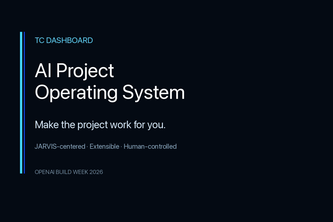
TC Dashboard — JARVIS Project Operating System is an AI-native project operating system built around a single credo: “make the project work for you—not the other way around.” It centers on a product layer called JARVIS, which connects authorized project evidence, proposes next steps, and executes supported actions only after user approval. The system is designed to govern and review project risk signals, with an emphasis on auditability, permission-scoped action, and deterministic replay paths.
What changed
The author states that the project was extended during OpenAI Build Week (July 13–21, 2026), with new features added including typed actions, untrusted-content isolation, signed single-use approvals, and a deterministic flagship proof loop. These changes were implemented using Codex and GPT-5.6.
The single most important open question
Is there any evidence of real-world usage or integration beyond the author’s own development environment? The description is self-reported and unverified; no revenue, customers, or traction data are provided.
What The Product Actually Is
The description states that TC Dashboard is an AI-native project operating system. At its core is JARVIS, a reasoning and governed-action layer that:
- Connects authorized project evidence.
- Proposes the smallest useful next step.
- Shows exact payload and intended effect.
- Executes supported actions only after user approval.
JARVIS operates within a deterministic replay path to ensure judges can inspect governance reliably. It supports actions like release readiness, risk signal handling, and follow-through on work ownership.
The system treats uploads, OCR, indexed artifacts, email, tickets, tool output, and prior model output as untrusted evidence—not instructions or authorization.
Actions that are consequential use typed schemas, exact payloads, and signed single-use approvals. Execution rechecks current permissions and state.
Evidence The description states this is a React/TypeScript frontend with an Express/MongoDB backend, using project-scoped provider configuration and a typed JARVIS action registry.
Inference The system appears to be built for quality engineering, but the author does not claim it is limited to that domain.
Positioning & Claim Evolution
The description states that TC Dashboard changes the relationship between teams and their projects by addressing scattered signals—such as risky runs, release decisions, tickets, and documents—that live in different places. The author claims the system makes the project work for you—not the other way around.
JARVIS is positioned as a governed-action layer that connects evidence, explains why it matters, proposes follow-through, and ensures human control over consequential changes.
Evidence The description states this is an AI-native operating system with a “judge-ready proof loop.”
Inference The positioning implies a shift from reactive project management to proactive, evidence-based decision-making. However, no claims are made about market adoption or competitive differentiation beyond self-description.
Target Customer & ICP
The author does not explicitly define a target customer or ideal customer profile (ICP). The description focuses on the operating model and functionality but does not name specific users, roles, or industries.
Evidence Not evidenced. The description does not state who uses this system or what their job is.
Business Model & Pricing Evidence
The description does not contain any information about pricing, monetization, or business model. It does not state whether the product will be sold, licensed, offered as a service, or used internally.
Evidence Not evidenced. No mention of revenue streams, pricing tiers, or commercial arrangements.
Technical & Delivery Signals
The system is built with:
- Frontend: React/TypeScript
- Backend: Express/MongoDB
- AI Tools Used: Codex, GPT-5.6, Playwright
- Features Implemented During Build Week:
- Typed actions and untrusted-content isolation
- Signed single-use approvals
- Replay and stale-state protection
- Audit support
- Security scans
The author claims that the system uses project-scoped provider configuration for model-backed assistance and maintains deterministic replay paths to avoid dependency on live model responses.
Evidence The description states the architecture and features implemented during Build Week, including test coverage (98 frontend / 593 backend tests) and integration verification.
Traction & Maturity Signals
There is no evidence of traction or maturity beyond the author’s own development. No customers, users, or adoption data are provided. The system appears to be a prototype or proof-of-concept built during a hackathon.
Evidence Not evidenced. No mention of real-world usage, customer feedback, or product deployment.
Competitive Context
The description does not provide any information about competitors or the competitive landscape. It does not reference existing tools in the project management, quality engineering, or AI governance space.
Evidence Not evidenced. No mention of similar products or market positioning.
Open Questions & Risks
- No real-world usage: The system is described as a personal project built by one person and has no evidence of adoption.
- Unverified claims: All descriptions are self-reported, with no independent verification.
- Limited scope: No mention of integration capabilities beyond the author’s own environment.
- Unclear commercialization path: No indication of how this would be monetized or scaled.
Inference The lack of traction and customer data raises questions about product-market fit and viability as a commercial offering.
Questions the description leaves open
- What is the intended user role for JARVIS? Is it for developers, QA engineers, project managers, or executives?
- How does TC Dashboard plan to integrate with existing CI/CD pipelines or project management tools?
- Has any external testing or feedback been gathered from users beyond the author?
- What are the plans for expanding the governed action registry and integration coverage?
- Is there a roadmap for moving beyond the current prototype stage?
Overall Assessment
Not evidenced. The description is self-reported, unverified, and lacks any data on revenue, customers, traction, or commercial viability. No evidence supports an investment or partnership opportunity at this time.
The author states that the project was built independently and is not connected to any employer or organization. There is no indication of a scalable business model or market demand.
Confidence Low. The analysis is based entirely on self-reported information with no external corroboration or evidence of product-market fit, adoption, or commercial traction.
User Stories BotA demo video on every pull request
Get a demo video on every new feature
GitHub App that watches your pull requests and records a narrated, captioned demo.
Save time on demo prep and make informed decisions faster with a video walkthrough of every new feature.
Source
Submitted to the OpenAI 2026 hackathon on Devpost. Project home on Devpost. Back to the full gallery on Devpost.
This competitive analysis was produced by top-founders.com (opens in a new tab)
Generated by a language model from this project's public Devpost page — its tagline, the author's own write-up and any built-with tags listed there — as captured in August 2026. Short quotations are the author's words. It is an opinion on the idea as a business, not on the people behind it, and it reflects the description as published then. If the project has moved on, request a correction below. The analysis is not independent research and contains no verified traction, revenue or customer data.
An independent guide by KFG International LLC — not affiliated with, endorsed by, or connected to Devpost or OpenAI.