

Archive position — measured, not model output
0 likes on Devpost
2,263 of the 7,850 archived projects have more likes, and 5,587 share exactly 0 — so this project's #5,969 place in the like-ranked listing is a tie-break inside that group, not a ranking.
Projects (log scale)
Likes on Devpost. ▲ marks this project's group.
Show the figures
| Likes | Projects | Share of archive |
|---|---|---|
| 0 | 5,587 | 71.2% |
| 1 | 1,758 | 22.4% |
| 2 | 284 | 3.6% |
| 3–4 | 132 | 1.7% |
| 5–9 | 75 | 1.0% |
| 10+ | 14 | 0.2% |
 User Stories BotA demo video on every pull request
Get a demo video on every new feature
GitHub App that watches your pull requests and records a narrated, captioned demo.
Save time on demo prep and make informed decisions faster with a video walkthrough of every new feature.
Executive Summary
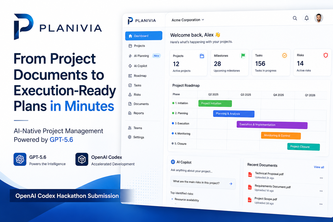
Planivia is an AI-powered, multi-tenant project management platform that the author describes as converting unstructured information into actionable work. The product is presented as a SaaS solution built with React, Node.js, and GPT-5.6, designed to streamline planning from documents and meeting notes to execution in tools like Jira.
The description states that Planivia supports uploading project briefs or meeting notes, generating structured plans and tasks, and integrating with existing workflows through AI-assisted review before task entry into the system.
Key claims include:
- The platform works with English, Spanish, or French
- It integrates with Jira
- It uses GPT-5.6 for planning and document analysis
- It supports multi-tenant isolation and role-based access control
The author reports that Planivia is a working production application covering the full journey from signup to reporting, but no revenue, customer data, or traction metrics are provided.
Most important open question
Is there evidence of real-world usage or pilot testing beyond the hackathon submission? The description does not indicate any actual customers or commercial deployment.
What The Product Actually Is
The description states that Planivia is:
- An AI-powered, multi-tenant project management platform
- Designed to turn unstructured information into actionable work
- Built with React, Node.js, Express, SQLite, and GPT-5.6
- Capable of generating phases, milestones, tasks, dependencies, risks, and roadmaps from project briefs
- Able to process meeting notes and generate structured minutes, decisions, risks, blockers, action items, and proposed tasks
- Integrated with Jira for task synchronization
- Supporting dashboards, task lists, Kanban boards, timelines, risk management, and reporting
- Available in English, Spanish, or French
The author describes it as a working production application covering the full journey from organization signup to planning, execution, meetings, risks, AI assistance, and executive reporting.
Positioning & Claim Evolution
The description states that Planivia was built to address:
- Time lost translating documents, meeting notes, emails into executable plans
- Fragmented information leading to missed tasks and late-discovered risks
- Outdated reports due to lack of integration between understanding and execution
Positioning claims include:
- Connecting project understanding with project execution
- Being an AI-powered platform that turns unstructured information into actionable work
- Supporting both project briefs and meeting notes as input sources
- Providing AI Copilot for next action recommendations
- Offering structured output through validation, review steps, and duplicate prevention
The author emphasizes that Planivia is not just an AI demonstration but a working application covering the full project lifecycle.
Target Customer & ICP
The description states that Planivia targets:
- Project teams who lose time translating documents and meeting notes into executable plans
- Organizations needing to manage execution through dashboards, task lists, Kanban boards, timelines, risk management, and reporting
- Users requiring multi-tenant isolation with roles, permissions, and organization-level subscriptions
The author mentions that the platform supports multiple organizations with tenant isolation, roles, permissions, invitations, and organization-level subscriptions.
Business Model & Pricing Evidence
Not evidenced. The description does not contain any information about pricing models, subscription tiers, or monetization strategies.
Technical & Delivery Signals
The description states that Planivia was built using:
- Frontend: React and Vite
- Backend: Node.js and Express
- Database: SQLite
- AI: GPT-5.6 for planning, document analysis, project assistance, risk analysis, meeting intelligence, and reporting
- Integration: Jira for task synchronization
The author reports that Codex was used as an engineering collaborator throughout the development process, helping with repository-wide audits, implementation, debugging, test creation, internationalization, multi-tenant authorization, prompt refinement, production hardening, and deployment verification.
Traction & Maturity Signals
The description states:
- Planivia is a working production application covering the full journey from organization signup to planning, execution, meetings, risks, AI assistance, and executive reporting
- The meeting-to-execution workflow is especially valuable: teams can record what happened in a meeting and turn it into reviewed, traceable project tasks within minutes
- The next stage is a real customer pilot
- Adoption, time saved, completion rates, accepted AI recommendations, and workflow friction will be measured during the pilot
No revenue, customer data, or traction metrics beyond the hackathon submission are provided.
Competitive Context
Not evidenced. The description does not mention any competitors or competitive positioning.
Open Questions & Risks
The description states:
- One major challenge was making AI output reliable enough to become real project data
- Another challenge was maintaining strict multi-tenant isolation while allowing one user to belong to multiple organizations with different roles
- Internationalization was particularly demanding, requiring architectural corrections to maintain language consistency
Key risks include:
- Reliability of AI-generated content for actual project execution
- Maintaining multi-tenant isolation and role-based access control
- Language consistency in AI outputs across different interface languages
- Lack of evidence for real-world usage or customer validation beyond the hackathon submission
Questions the description leaves open
- What specific problems are you solving that existing project management tools don't address?
- How do you plan to validate the reliability and accuracy of AI-generated tasks before they enter execution workflows?
- What is your timeline for the customer pilot, and what metrics will you use to measure success?
- How do you intend to scale beyond a single developer's capacity?
- What are your plans for monetization and pricing strategy?
- How do you plan to handle data privacy and security concerns in multi-tenant environments?
- What specific feedback have you received from potential users during the hackathon phase?
Overall Assessment
Not evidenced. The description does not provide any information about funding rounds, valuations, or investment status. The author states that this is a hackathon submission and that the next stage is a real customer pilot, but no commercial traction or financial data are available.
The product appears to be a working prototype built during a hackathon with claims of functionality across the full project lifecycle. However, there is no evidence of actual customers, revenue, or commercial deployment beyond the author's own description. The lack of any traction data, customer validation, or business model information makes it difficult to assess commercial viability or investment potential at this stage.
The single most important question remains: has this been tested with real users beyond the hackathon environment? Without evidence of actual usage or pilot testing, the product remains unproven in a commercial context.
User Stories BotA demo video on every pull request
Get a demo video on every new feature
GitHub App that watches your pull requests and records a narrated, captioned demo.
Save time on demo prep and make informed decisions faster with a video walkthrough of every new feature.
Source
Submitted to the OpenAI 2026 hackathon on Devpost. Project home on Devpost. Back to the full gallery on Devpost.
This competitive analysis was produced by top-founders.com (opens in a new tab)
Generated by a language model from this project's public Devpost page — its tagline, the author's own write-up and any built-with tags listed there — as captured in August 2026. Short quotations are the author's words. It is an opinion on the idea as a business, not on the people behind it, and it reflects the description as published then. If the project has moved on, request a correction below. The analysis is not independent research and contains no verified traction, revenue or customer data.
An independent guide by KFG International LLC — not affiliated with, endorsed by, or connected to Devpost or OpenAI.