

Archive position — measured, not model output
0 likes on Devpost
2,263 of the 7,850 archived projects have more likes, and 5,587 share exactly 0 — so this project's #6,288 place in the like-ranked listing is a tie-break inside that group, not a ranking.
Projects (log scale)
Likes on Devpost. ▲ marks this project's group.
Show the figures
| Likes | Projects | Share of archive |
|---|---|---|
| 0 | 5,587 | 71.2% |
| 1 | 1,758 | 22.4% |
| 2 | 284 | 3.6% |
| 3–4 | 132 | 1.7% |
| 5–9 | 75 | 1.0% |
| 10+ | 14 | 0.2% |
 User Stories BotA demo video on every pull request
Get a demo video on every new feature
GitHub App that watches your pull requests and records a narrated, captioned demo.
Save time on demo prep and make informed decisions faster with a video walkthrough of every new feature.
Executive Summary
What the company appears to be
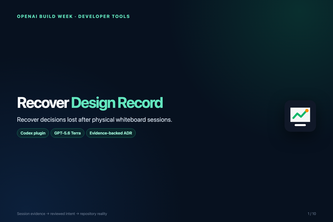
Recover Design Record is a self-reported tool that claims to help software teams capture, reconstruct, and document architectural decisions made during physical whiteboard sessions. It uses AI tools (Codex, GPT-5.6, whisper.cpp) and local media processing (FFmpeg, Git) to turn session videos and board photos into structured documentation.
What changed
The author states they built this tool in response to a common problem: architectural decisions made during physical sessions are often lost or unclear when later checked against code. The solution is described as an installable Codex plugin that processes session media, reconstructs design decisions using multimodal AI, and generates Mermaid diagrams and ADRs (Architectural Decision Records) from verified repository snapshots.
The single most important open question
Is there any evidence of real-world usage or adoption beyond the author's own development and testing? The description makes no claims about customers, revenue, or product-market fit — only that it is a working prototype built for a hackathon.
What The Product Actually Is
The description states:
- Recover Design Record is an installable Codex plugin.
- It takes session videos and board photos as input.
- It uses FFmpeg, whisper.cpp, and GPT-5.6 Terra to process media and reconstruct decisions.
- It checks reconstructed claims against a pinned Git commit in the repository.
- It outputs Mermaid diagrams and ADR files after user approval.
- The tool is designed to prevent automatic merging, requiring manual review before publication.
This is an AI-powered documentation assistant for physical architecture sessions, built as a plugin for macOS, with a focus on verifying decisions against code.
Positioning & Claim Evolution
The description states:
- The product addresses the problem of “decisions lost after whiteboard sessions”.
- It aims to turn “messy handoffs” into evidence-backed design records.
- It claims to reconstruct architecture, decisions, proposals, rejected alternatives, assumptions, and unresolved questions from session media.
- It is described as a plugin for physical architecture sessions, not digital collaboration tools or remote meetings.
The positioning is self-reported and focused on solving a specific workflow gap — the lack of traceability between in-person design discussions and code implementation.
Target Customer & ICP
The description states:
- The tool is aimed at software teams who conduct physical architecture sessions.
- It targets users who work with Git repositories, code review processes, and ADR documentation.
- It is built for macOS, suggesting a developer or engineering audience.
No explicit customer segments, personas, or use cases beyond the author’s own workflow are provided. The ICP appears to be technical teams working in code-centric environments, but no evidence of actual customers or user feedback is present.
Business Model & Pricing Evidence
The description states:
- The tool is an installable Codex plugin.
- It uses local processing (no cloud API calls).
- It includes deterministic replay and docs-only publication guard.
There is no mention of pricing, monetization, or business model. The product is described as a hackathon submission, not a commercial offering.
Technical & Delivery Signals
The description states:
- Built with Codex, GPT-5.6 Terra, FFmpeg, whisper.cpp, Node.js, Git, GitHub CLI.
- It is an installable plugin for macOS.
- It includes 70 passing automated tests.
- It supports deterministic replay, hash-checked outputs, and no API keys required.
- It uses a pinned commit to verify against repository state.
These are technical claims, but no evidence of performance, scalability, or production use is provided.
Traction & Maturity Signals
The description states:
- The project was submitted to the OpenAI 2026 hackathon.
- It includes a demo scenario with synthetic media and real repository evidence.
- It has 70 automated tests, and supports deterministic replay.
There is no evidence of customer adoption, revenue, or product-market fit beyond the author’s own testing and submission.
Competitive Context
The description states:
- The tool is built for physical architecture sessions, not remote collaboration tools.
- It uses multimodal AI (speech + visuals) to reconstruct decisions.
- It integrates with Git repositories and generates ADR documentation.
No mention of competitors, market size, or competitive positioning is provided.
Open Questions & Risks
The description states:
- The tool is a hackathon submission, not a commercial product.
- It is self-reported and unverified.
- No evidence of real-world usage, customers, or traction.
- It uses GPT-5.6 Terra, which is not a publicly known model.
Key risks include:
- Lack of independent validation or user feedback.
- Unclear scalability or production readiness.
- No commercial viability or monetization strategy described.
Questions the description leaves open
- What was the actual problem you were solving, and how did you validate it?
- Are there any users beyond yourself who are using this tool in practice?
- How does this tool integrate into existing workflows (e.g., GitOps, CI/CD)?
- What is the long-term vision for monetization or product development?
- Can you demonstrate how the tool handles edge cases or ambiguous inputs?
- Is there any plan to support platforms beyond macOS or Codex?
Overall Assessment
The description states:
- This is a self-reported hackathon project.
- It has no revenue, customers, or traction data.
- It is built as a plugin for developers, but lacks evidence of adoption or market demand.
Assessment Not evidenced. The product is described as a prototype with no commercial or user validation. It is not ready for investment or partnership consideration without further evidence of traction, customer feedback, or business model development.
User Stories BotA demo video on every pull request
Get a demo video on every new feature
GitHub App that watches your pull requests and records a narrated, captioned demo.
Save time on demo prep and make informed decisions faster with a video walkthrough of every new feature.
Source
Submitted to the OpenAI 2026 hackathon on Devpost. Project home on Devpost. Back to the full gallery on Devpost.
This competitive analysis was produced by top-founders.com (opens in a new tab)
Generated by a language model from this project's public Devpost page — its tagline, the author's own write-up and any built-with tags listed there — as captured in August 2026. Short quotations are the author's words. It is an opinion on the idea as a business, not on the people behind it, and it reflects the description as published then. If the project has moved on, request a correction below. The analysis is not independent research and contains no verified traction, revenue or customer data.
An independent guide by KFG International LLC — not affiliated with, endorsed by, or connected to Devpost or OpenAI.