

Archive position — measured, not model output
0 likes on Devpost
2,263 of the 7,850 archived projects have more likes, and 5,587 share exactly 0 — so this project's #6,289 place in the like-ranked listing is a tie-break inside that group, not a ranking.
Projects (log scale)
Likes on Devpost. ▲ marks this project's group.
Show the figures
| Likes | Projects | Share of archive |
|---|---|---|
| 0 | 5,587 | 71.2% |
| 1 | 1,758 | 22.4% |
| 2 | 284 | 3.6% |
| 3–4 | 132 | 1.7% |
| 5–9 | 75 | 1.0% |
| 10+ | 14 | 0.2% |
 User Stories BotA demo video on every pull request
Get a demo video on every new feature
GitHub App that watches your pull requests and records a narrated, captioned demo.
Save time on demo prep and make informed decisions faster with a video walkthrough of every new feature.
Executive Summary
What the company appears to be
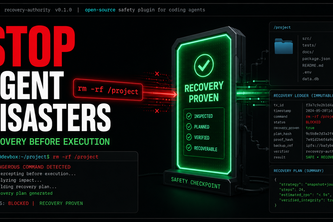
Recovery Authority is a self-reported open-source Codex plugin designed to enforce a two-key protocol for destructive actions by agents. It requires proof of recovery before granting destructive authority, using isolated drills and Ed25519-signed capabilities.
What changed
The author describes a shift from traditional security approaches (sandboxes, guards, checkpoints, approvals) toward a model where "recovery is a verb" — i.e., the system demands demonstration that an action can be undone before it's allowed.
Single most important open question
Does the described system actually function as claimed in practice, or does it remain theoretical?
Analysis basis
This report is based entirely on the self-reported project description provided by the author. No external verification, traction data, revenue figures, customer names, or independent sources are available. All statements should be treated as claims made by the author.
What The Product Actually Is
The description states that Recovery Authority is an open-source Codex plugin. It turns destructive actions into a two-key protocol, requiring:
- Proving the exact inverse works.
- Human release of authority through a separate channel.
Key technical elements include:
- Rust-based TUI (terminal user interface) for control room display
- Use of Ed25519-signed capabilities bound to operation, scope, state, proof, and expiry
- Support for POSIX filesystem deletion, local SQLite mutation, scoped PostgreSQL mutation, and git reset --hard
- Isolated drills for restoration
- MCP (Model Context Protocol) runtime written in TypeScript on Bun
- Linux sandboxing via Bubblewrap
- Human broker owns Ed25519 key; model-facing worker cannot approve itself
Inference The product appears to be a security tool built specifically for coding agents, with an emphasis on preventing accidental or malicious destruction through verification before execution.
Positioning & Claim Evolution
The author positions Recovery Authority as a security layer that shifts focus from preventing destructive actions to proving they can be undone. The key claim is:
“A backup is a noun. Recovery is a verb. I wanted destructive permission to depend on the verb.”
This evolution moves beyond conventional safeguards like sandboxes or checkpoints, which address different aspects of risk.
The author also emphasizes:
- Not promising recovery but proving it
- Keeping approval outside the chat
- Using full-database artifacts for cascading schema changes
- Composing multi-effect work as a compensated saga
- Blocking unsupported effects instead of weakening claims
Claim vs Fact
These are self-reported positioning and intent statements, not evidence of actual deployment or performance.
Target Customer & ICP
The description does not explicitly name target customers or personas. However, it implies:
- Developers using AI agents (e.g., Codex) in environments where destructive actions could cause harm
- Organizations managing sensitive data or infrastructure with high-risk automation needs
It targets users who may be building or deploying coding agents that interact with file systems, databases, and version control.
Inference Likely aimed at developers working in AI agent development, especially those concerned about safety and reversibility of operations. Not yet evidenced as having specific customer segments or ICP defined beyond general developer use cases.
Business Model & Pricing Evidence
No business model or pricing information is provided. The project is described as open-source, with no mention of monetization strategies, licensing terms, or paid tiers.
Not evidenced: No indication of revenue streams, subscriptions, or commercial offerings.
Technical & Delivery Signals
Technical details include:
- Built using Rust (TUI), TypeScript/Bun, Node.js, PostgreSQL, SQLite, Linux, Bubblewrap, MCP SDK, Zod contracts
- Uses Ed25519 signing keys, JSON-RPC, CLI tools, shell parsing, and AST analysis
- Implements sandboxing with Bubblewrap, Unix socket protocol, and constrained filesystem views
- Supports multiple destructive operations: POSIX deletion, SQLite mutation, PostgreSQL mutation, git reset
- Includes a consequence graph (non-authoritative) and proof-bound expiring capabilities
Inference Strong technical foundation for a security tool targeting AI agents. Demonstrates deep integration with system-level components and multi-platform support.
Traction & Maturity Signals
The description includes:
- 132 Bun tests, 5 Rust tests, and 3 Linux sandbox integration tests
- Demo showing installation, recovery preparation, proof display, approval, and commit
- Verification matrix covering real PostgreSQL restore drills, cascades, destructive operations against disposable state, capability tampering, stale witnesses, scope conflicts, parser evasions, and shell-built MCP routes
However:
- No mention of actual users, deployments, or adoption metrics
- No evidence of revenue, customers, or market traction beyond the author’s own testing
Not evidenced: No data on user base, customer acquisition, or product usage.
Competitive Context
The description does not reference competitors directly. However, it contrasts its approach with:
- Sandboxing (limits blast radius)
- Guards (recognize dangerous syntax)
- Checkpoints (keep copies)
- Approvals (record consent)
It positions itself as solving the gap between these approaches — specifically, ensuring that recovery can actually be proven before destruction occurs.
Inference Likely competes with other AI agent safety tools or frameworks, but no direct competitor names or market positioning are given.
Open Questions & Risks
Key risks and open questions based on the description:
- Unproven in production: The system is described as a hackathon submission; no evidence of real-world deployment.
- High friction for development: The author notes that updating the authority boundary required uninstall, edit, verification, cachebuster release, marketplace upgrade, and reinstall — suggesting potential usability issues.
- Limited scope: Only supports certain destructive actions (POSIX, SQLite, PostgreSQL, git). Unsupported effects are blocked rather than handled.
- Self-reported claims only: No third-party validation or independent audit of the system’s behavior.
Inference While technically robust, the product lacks real-world testing and adoption. Its core functionality remains unverified outside of controlled demos.
Questions the description leaves open
- How was the system tested in practice? Were there any failures during actual use?
- What are the performance implications of running recovery drills for every destructive action?
- Is there a plan to expand support beyond the current four adapters?
- Can you provide evidence that the sandboxing and isolation mechanisms work as intended under adversarial conditions?
- How does the system handle edge cases like partial or corrupted data during restoration?
- What is the expected friction level for developers integrating this into their workflows?
Overall Assessment
Not evidenced: No financials, funding rounds, headcount, or valuation data are available.
Assessment Recovery Authority presents a technically sophisticated and conceptually sound approach to AI agent safety. However, it is currently at the prototype/hackathon stage with no demonstrated traction, revenue, or customer base. It may be suitable for early-stage investment if the founder plans to build out a full product with real-world testing and adoption.
Confidence level Low — due to lack of external validation, no evidence of commercial viability, and reliance solely on self-reported claims.
User Stories BotA demo video on every pull request
Get a demo video on every new feature
GitHub App that watches your pull requests and records a narrated, captioned demo.
Save time on demo prep and make informed decisions faster with a video walkthrough of every new feature.
Source
Submitted to the OpenAI 2026 hackathon on Devpost. Project home on Devpost. Back to the full gallery on Devpost.
This competitive analysis was produced by top-founders.com (opens in a new tab)
Generated by a language model from this project's public Devpost page — its tagline, the author's own write-up and any built-with tags listed there — as captured in August 2026. Short quotations are the author's words. It is an opinion on the idea as a business, not on the people behind it, and it reflects the description as published then. If the project has moved on, request a correction below. The analysis is not independent research and contains no verified traction, revenue or customer data.
An independent guide by KFG International LLC — not affiliated with, endorsed by, or connected to Devpost or OpenAI.