

Archive position — measured, not model output
2 likes on Devpost
221 of the 7,850 archived projects have more likes, and 284 share exactly 2 — so this project's #402 place in the like-ranked listing is a tie-break inside that group, not a ranking.
Projects (log scale)
Likes on Devpost. ▲ marks this project's group.
Show the figures
| Likes | Projects | Share of archive |
|---|---|---|
| 0 | 5,587 | 71.2% |
| 1 | 1,758 | 22.4% |
| 2 | 284 | 3.6% |
| 3–4 | 132 | 1.7% |
| 5–9 | 75 | 1.0% |
| 10+ | 14 | 0.2% |
 User Stories BotA demo video on every pull request
Get a demo video on every new feature
GitHub App that watches your pull requests and records a narrated, captioned demo.
Save time on demo prep and make informed decisions faster with a video walkthrough of every new feature.
Executive Summary
Project: Nexus GPT
Self-reported basis: The entire analysis is based on the author’s own description of Nexus GPT as submitted to the OpenAI 2026 hackathon on Devpost — no external verification or historical data available.
Confidence level: Low. The description contains no evidence of revenue, customers, traction, or operational history. It is a self-reported project description with no corroboration.
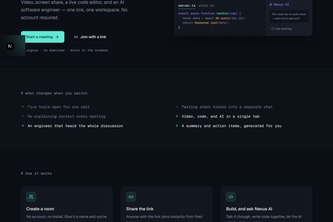
Nexus GPT is described as an AI-native collaborative workspace for developers that integrates real-time collaboration tools (video, chat, code editing) with an AI assistant (GPT-5.6) designed to act as a software engineer within meetings. The platform allows users to join meetings without accounts and supports AI-driven documentation, task extraction, and code assistance.
The most important open question is: What level of real-world utility or adoption exists for this concept, and how does it differ from existing tools like Notion, Slack, VS Code Live Share, or GitHub Codespaces?
What The Product Actually Is
The description states that Nexus GPT is:
- An AI-native collaborative workspace built for developers.
- A platform where users can create or join meetings instantly (no account required).
- A tool that supports audio/video calls, screen sharing, chat, and real-time collaborative code editing.
- An environment where an AI assistant (Nexus GPT) joins meetings to understand conversations, answer technical questions, generate code, review architecture, and capture decisions.
It uses:
- Next.js, TypeScript, Tailwind CSS, WebRTC, Monaco Editor
- GPT-5.6 for AI capabilities
Inferred: The product is a prototype or hackathon project built in a short timeframe, likely not production-ready.
Positioning & Claim Evolution
The description claims Nexus GPT:
- Is an “AI-native” workspace where developers code, meet, and build alongside an AI software engineer.
- Treats AI not as a chatbot but as an active participant in development workflows.
- Aims to reduce fragmentation of tools by combining collaboration and AI into one place.
Inferred: The positioning is aspirational — the author envisions Nexus GPT as an “AI-native operating system for modern software teams,” but this is not evidenced by any traction or product usage data.
Target Customer & ICP
The description states:
- Nexus GPT is built for developers.
- It supports software teams collaborating in real-time.
- Users can join meetings instantly via shareable links, suggesting a focus on ad-hoc collaboration and smaller teams or individuals.
Inferred: The target ICP is likely early-stage developers, small engineering teams, or remote developers who value integrated workflows. No evidence of specific personas, use cases, or customer segments beyond this general framing.
Business Model & Pricing Evidence
The description does not state:
- Any pricing model
- Revenue streams
- Monetization strategy
- Customer acquisition costs
- Subscription or usage-based models
Not evidenced: There is no indication of how the product would be monetized, if at all.
Technical & Delivery Signals
The description states:
- Built with Next.js, TypeScript, Tailwind CSS, WebRTC, Monaco Editor.
- Uses GPT-5.6 for AI capabilities.
- Implements real-time communication and collaborative editing.
- Integrates Codex to accelerate development.
Inferred: The technical stack suggests a modern web-based platform with real-time features and AI integration. However, no evidence of scalability, performance, or infrastructure maturity is provided.
Traction & Maturity Signals
The description states:
- This is a hackathon project submitted to the OpenAI 2026 hackathon.
- It was built in a short timeframe (implied by “hackathon” context).
- No mention of users, customers, or adoption metrics.
Not evidenced: There is no evidence of traction, user base, or product maturity beyond the initial prototype.
Competitive Context
The description does not reference:
- Competitors
- Market positioning relative to existing tools
- Differentiation from platforms like Slack, Notion, GitHub Codespaces, VS Code Live Share, or Zoom
Not evidenced: No competitive analysis or market context is provided. The author does not describe how Nexus GPT differs from or competes with existing solutions.
Open Questions & Risks
Inferred risks and open questions:
- Unproven concept: The idea of an AI acting as a software engineer in meetings is novel but untested.
- No revenue model: No indication of monetization strategy.
- Limited team size: Only one founder, which may limit execution capacity.
- Hackathon origin: Likely not production-ready or scalable.
- AI integration challenges: Real-time understanding and response to technical discussions is a complex problem with no evidence of success in this prototype.
Questions the description leaves open
- What specific technical challenges have you faced in enabling real-time AI understanding during meetings?
- How do you plan to differentiate Nexus GPT from existing tools like GitHub Codespaces or VS Code Live Share?
- Have you conducted any user testing or feedback collection with developers?
- What is your roadmap for monetization and scaling beyond the hackathon prototype?
- How does the AI assistant handle context switching in complex technical discussions?
Overall Assessment
The description states that Nexus GPT is a hackathon project submitted to the OpenAI 2026 hackathon, built by one person (Abdulmalik Abdulrosheed). There is no evidence of traction, revenue, customers, or product maturity.
Inferred: This is an early-stage idea with strong positioning in a promising market. However, due to the lack of any operational or commercial evidence, it is not suitable for investment or partnership consideration at this time.
Assessment: Not evidenced. No basis for commercial due diligence beyond the self-reported project description.
User Stories BotA demo video on every pull request
Get a demo video on every new feature
GitHub App that watches your pull requests and records a narrated, captioned demo.
Save time on demo prep and make informed decisions faster with a video walkthrough of every new feature.
Source
Submitted to the OpenAI 2026 hackathon on Devpost. Project home on Devpost. Back to the full gallery on Devpost.
This competitive analysis was produced by top-founders.com (opens in a new tab)
Generated by a language model from this project's public Devpost page — its tagline, the author's own write-up and any built-with tags listed there — as captured in August 2026. Short quotations are the author's words. It is an opinion on the idea as a business, not on the people behind it, and it reflects the description as published then. If the project has moved on, request a correction below. The analysis is not independent research and contains no verified traction, revenue or customer data.
An independent guide by KFG International LLC — not affiliated with, endorsed by, or connected to Devpost or OpenAI.