

Archive position — measured, not model output
0 likes on Devpost
2,263 of the 7,850 archived projects have more likes, and 5,587 share exactly 0 — so this project's #7,137 place in the like-ranked listing is a tie-break inside that group, not a ranking.
Projects (log scale)
Likes on Devpost. ▲ marks this project's group.
Show the figures
| Likes | Projects | Share of archive |
|---|---|---|
| 0 | 5,587 | 71.2% |
| 1 | 1,758 | 22.4% |
| 2 | 284 | 3.6% |
| 3–4 | 132 | 1.7% |
| 5–9 | 75 | 1.0% |
| 10+ | 14 | 0.2% |
 User Stories BotA demo video on every pull request
Get a demo video on every new feature
GitHub App that watches your pull requests and records a narrated, captioned demo.
Save time on demo prep and make informed decisions faster with a video walkthrough of every new feature.
Executive Summary
What the company appears to be
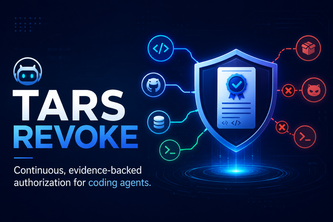
TARS REVOKE is a self-reported developer tool that implements a "live warrant" system for coding agents. It tracks assumptions, evidence and dependencies behind agent actions, and revokes only affected actions when new evidence invalidates prior justifications. The author describes it as an authorization system that checks whether an action should continue to be allowed, not just whether it was initially permitted.
What changed
The project is a self-contained implementation of a continuous-authorization model for autonomous coding agents, developed during OpenAI Build Week. It includes offline and live demonstrations, a command-line interface, and integration with tools like Codex and GPT-5.6.
Single most important open question
Is there evidence that TARS REVOKE has been used in production or integrated into real-world agent workflows beyond the demo?
What The Product Actually Is
The description states that TARS REVOKE is a developer tool built with Python and TypeScript, featuring:
- A command-line interface
- A local frontend
- Integration with Codex and GPT-5.6
- Offline and live demos
- Hash-chained event journaling
- Signed evidence and receipts
- Deterministic testing environments
It is described as a system that tracks relationships between agents, assumptions, evidence, tests, warrants, actions and effects.
Inference The product appears to be a proof-of-concept or prototype for an authorization system that operates in real-time during agent execution. It is not a commercial product but rather a demonstration of a conceptual architecture.
Positioning & Claim Evolution
The author claims TARS REVOKE addresses a gap in current agent safety tools, which typically check actions before they happen and do not revisit decisions once approved.
The core positioning is:
- Memory tools answer: “What did the agent know?”
- Guardrails answer: “Is this action allowed?”
- TARS answers: “This action was allowed, but the reason behind it is no longer true. Revoke it and recover.”
Inference The author positions TARS REVOKE as a novel approach to agent safety that evolves authorization dynamically based on changing conditions.
Target Customer & ICP
The description does not state who the target customer or ideal customer profile (ICP) is.
Not evidenced.
Business Model & Pricing Evidence
There is no mention of pricing, monetization or business model in the description.
Not evidenced.
Technical & Delivery Signals
The project was built using:
- Python, TypeScript
- FastAPI, React, Vite
- Pydantic, Typer, Rich, SQLite
- Git, GitHub
- Codex, GPT-5.6
- Flow, Actions, AI, Cryptography, Codex, MacOs
It includes:
- A deterministic offline demo
- Compensation handlers for reversible effects
- Hash-chained event journal
- Signed evidence and receipts
- Core and strict verification commands
- Crash and revocation benchmarks
- Qualification process for real Codex runs
Inference The tool is built as a developer-facing prototype with strong technical underpinnings, including cryptographic signing and dependency tracking.
Traction & Maturity Signals
The author reports:
- 311 passing offline tests
- Three successful real Codex qualification runs
- A strict R01–R20 attestation verified twice
- Selective revocation of three affected effects
- Automatic recovery of reversible effects
- A push blocked before it was dispatched
- An offline demo that judges can run without paid credits
However, no evidence of revenue, customers, or adoption beyond the author’s own testing and submission.
Not evidenced.
Competitive Context
The description does not mention any competitors or direct market context.
Not evidenced.
Open Questions & Risks
- The project is a single-developer prototype, with no evidence of team size, funding, or product-market fit.
- It was built for a hackathon and submitted to the OpenAI 2026 hackathon — not intended as a commercial product.
- No evidence of real-world usage, integration, or adoption beyond the author’s own testing.
- The system is described as not yet integrated with coding-agent runtimes, suggesting it's not production-ready.
Inference TARS REVOKE is a concept demonstration, not a product ready for enterprise use. It lacks commercial traction and evidence of market demand.
Questions the description leaves open
- What real-world agent workflows or systems have you tested TARS REVOKE with?
- Has the system been integrated into any existing development environments or CI/CD pipelines?
- How does TARS REVOKE handle edge cases in dependency tracking and revocation?
- Are there plans to support multiple agents working on the same repository?
- What is the current status of integration with agent runtimes beyond Codex?
Overall Assessment
Not evidenced.
The project is a self-reported prototype built during a hackathon, with no evidence of revenue, customers or commercial traction. It is not a product ready for investment or partnership.
Confidence Low. The description is entirely self-reported and unverified. No data on usage, adoption, or market validation exists beyond the author’s own claims.
User Stories BotA demo video on every pull request
Get a demo video on every new feature
GitHub App that watches your pull requests and records a narrated, captioned demo.
Save time on demo prep and make informed decisions faster with a video walkthrough of every new feature.
Source
Submitted to the OpenAI 2026 hackathon on Devpost. Project home on Devpost. Back to the full gallery on Devpost.
This competitive analysis was produced by top-founders.com (opens in a new tab)
Generated by a language model from this project's public Devpost page — its tagline, the author's own write-up and any built-with tags listed there — as captured in August 2026. Short quotations are the author's words. It is an opinion on the idea as a business, not on the people behind it, and it reflects the description as published then. If the project has moved on, request a correction below. The analysis is not independent research and contains no verified traction, revenue or customer data.
An independent guide by KFG International LLC — not affiliated with, endorsed by, or connected to Devpost or OpenAI.