

Archive position — measured, not model output
0 likes on Devpost
2,263 of the 7,850 archived projects have more likes, and 5,587 share exactly 0 — so this project's #7,136 place in the like-ranked listing is a tie-break inside that group, not a ranking.
Projects (log scale)
Likes on Devpost. ▲ marks this project's group.
Show the figures
| Likes | Projects | Share of archive |
|---|---|---|
| 0 | 5,587 | 71.2% |
| 1 | 1,758 | 22.4% |
| 2 | 284 | 3.6% |
| 3–4 | 132 | 1.7% |
| 5–9 | 75 | 1.0% |
| 10+ | 14 | 0.2% |
 User Stories BotA demo video on every pull request
Get a demo video on every new feature
GitHub App that watches your pull requests and records a narrated, captioned demo.
Save time on demo prep and make informed decisions faster with a video walkthrough of every new feature.
Executive Summary
What the company appears to be
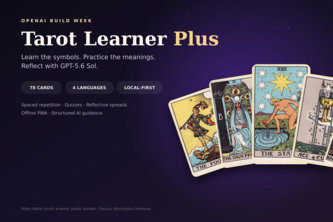
Tarot Learner Plus is a self-reported web application built as a personal project by one developer (Alan Chou), designed for tarot practitioners to study, practice, and deepen their understanding of the tarot system. It offers structured learning tools including flashcards, quizzes, reflective spreads, and an optional AI layer that provides personalized reflections grounded in card meanings.
What changed
The app was rebuilt from a plain HTML/CSS/JS prototype into a modern PWA using Next.js 16, React 19, TypeScript, Tailwind CSS, and IndexedDB. It now supports multilingual content (English, Traditional Chinese, Simplified Chinese, Japanese), offline functionality, and an AI layer powered by GPT-5.6 via a secure server-side API.
The single most important open question
Is there any evidence of user adoption or engagement beyond the author's own development and testing?
What The Product Actually Is
The description states that Tarot Learner Plus is:
- A web app for studying tarot cards.
- Built with Next.js, React, TypeScript, Tailwind CSS, IndexedDB, and a service worker.
- Designed to help users memorize the 78-card Rider–Waite–Smith deck through spaced-repetition flashcards, quizzes, and reflective spreads.
- Offers one-card and three-card spreads, monthly theme mode with daily card reveals.
- Works offline, requires no account, and stores progress locally in IndexedDB.
- Supports English, Traditional Chinese, Simplified Chinese, and Japanese.
- Includes an optional AI layer using GPT-5.6 for coaching users to reframe questions and generate reflective prompts.
Inference: The app is a self-contained learning tool that emphasizes private practice and symbolic understanding over prediction or divination.
Positioning & Claim Evolution
The author claims:
- Tarot Learner Plus fills a gap between static reference books and prediction tools.
- It aims to be a "private study companion" focused on grounding users in the symbolism of tarot for self-reflection rather than prophecy.
- The AI layer is intended to act as a learning facilitator, not an oracle — preserving user agency and encouraging actionable reflection.
Inference: The positioning evolved from a simple prototype into a more polished, accessible, and technically robust tool with optional AI integration. However, the description does not indicate any market positioning beyond personal use or developer experimentation.
Target Customer & ICP
The description states:
- The app targets "beginners and advanced readers" of tarot.
- It is designed for those who want to study, practice, and deepen their craft.
- Users are expected to engage in private, self-directed learning.
Not evidenced: No explicit identification of specific personas, segments, or use cases beyond general tarot practitioners. No evidence of customer interviews, feedback loops, or user testing.
Business Model & Pricing Evidence
The description states:
- The app works offline and requires no account.
- Progress is stored locally in IndexedDB.
- There is no mention of paid features, subscriptions, or monetization strategies.
- The AI layer is optional and runs through a server-side API route.
- No pricing information, payment methods, or business model details are provided.
Inference: The app appears to be free-to-use with no apparent commercial revenue stream. The AI layer may be used for demonstration purposes or future monetization, but this is not stated.
Technical & Delivery Signals
The description states:
- Built using Next.js 16, React 19, TypeScript, Tailwind CSS, IndexedDB.
- Uses Codex to automate large-scale refactoring and testing tasks.
- Implements a secure AI layer via server-side Responses API route with input validation, timeouts, and JSON Schema outputs re-validated with Zod.
- Supports offline-first design using service workers and IndexedDB.
- Artwork is optimized for performance (WebP format) and cached locally.
- Includes automated tests (Playwright, Vitest).
- Deployed on Vercel.
Inference: The technical stack suggests a modern, scalable approach to building a PWA with AI integration. However, the absence of production data or user metrics makes it unclear how well these systems perform in real-world usage.
Traction & Maturity Signals
The description states:
- The app was originally built as a prototype in plain HTML/CSS/JS.
- It has been rewritten using modern frameworks and tools.
- Progress migration from the old localStorage format was preserved.
- The project was submitted to the OpenAI 2026 hackathon.
- No evidence of user engagement, downloads, or retention metrics.
Not evidenced: No data on active users, usage frequency, or adoption rates. No mention of beta testing, community feedback, or product-market fit indicators.
Competitive Context
The description states:
- Most tarot apps are either static reference books or prediction tools.
- Tarot Learner Plus aims to be “in between” these two categories.
- It is described as a learning tool focused on symbolic understanding and reflection.
Not evidenced: No competitive analysis, market sizing, or comparison with existing tarot apps. No evidence of competitors or their features.
Open Questions & Risks
The description states:
- The app is built by one person (Alan Chou).
- It has no account system or database.
- AI functionality is optional and runs through a server-side API.
- There is no indication of monetization strategy or long-term sustainability.
Inference:
- Risk of limited scalability due to single-person development.
- Lack of user data or feedback could hinder product evolution.
- Optional AI layer may not drive adoption unless integrated more deeply.
- No evidence of market traction or commercial viability.
Questions the description leaves open
- What is the intended user base beyond personal use?
- Are there any plans for monetization, and if so, what form will it take?
- How do you plan to scale beyond a single developer?
- Has the AI layer been tested with real users or feedback?
- Do you have any metrics on how often users return or engage with the app?
- What are your thoughts on expanding into other symbolic systems or learning domains?
Overall Assessment
The description states:
- The project is a personal prototype that has been rebuilt and deployed.
- It includes optional AI integration but no commercial model or revenue streams.
- There is no evidence of traction, customers, or market validation.
Not evidenced: No financials, user data, or growth indicators. No indication of whether the app has gained any significant following or interest from potential partners or investors.
Inference:
This appears to be an experimental, developer-driven project with strong technical execution and a clear vision for educational tooling. However, without evidence of traction, monetization, or commercial viability, it is not suitable for investment or partnership consideration at this stage.
User Stories BotA demo video on every pull request
Get a demo video on every new feature
GitHub App that watches your pull requests and records a narrated, captioned demo.
Save time on demo prep and make informed decisions faster with a video walkthrough of every new feature.
Source
Submitted to the OpenAI 2026 hackathon on Devpost. Project home on Devpost. Back to the full gallery on Devpost.
This competitive analysis was produced by top-founders.com (opens in a new tab)
Generated by a language model from this project's public Devpost page — its tagline, the author's own write-up and any built-with tags listed there — as captured in August 2026. Short quotations are the author's words. It is an opinion on the idea as a business, not on the people behind it, and it reflects the description as published then. If the project has moved on, request a correction below. The analysis is not independent research and contains no verified traction, revenue or customer data.
An independent guide by KFG International LLC — not affiliated with, endorsed by, or connected to Devpost or OpenAI.