

Archive position — measured, not model output
1 like on Devpost
505 of the 7,850 archived projects have more likes, and 1,758 share exactly 1 — so this project's #2,027 place in the like-ranked listing is a tie-break inside that group, not a ranking.
Projects (log scale)
Likes on Devpost. ▲ marks this project's group.
Show the figures
| Likes | Projects | Share of archive |
|---|---|---|
| 0 | 5,587 | 71.2% |
| 1 | 1,758 | 22.4% |
| 2 | 284 | 3.6% |
| 3–4 | 132 | 1.7% |
| 5–9 | 75 | 1.0% |
| 10+ | 14 | 0.2% |
 User Stories BotA demo video on every pull request
Get a demo video on every new feature
GitHub App that watches your pull requests and records a narrated, captioned demo.
Save time on demo prep and make informed decisions faster with a video walkthrough of every new feature.
Executive Summary
What the company appears to be
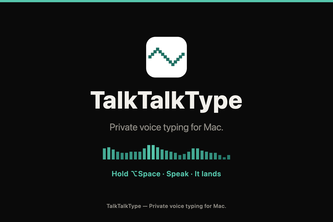
TalkTalkType is a macOS voice input application that records speech, transcribes it, applies formatting based on the destination app (e.g., Slack message, email, AI prompt), and inserts or copies the result into the currently focused Mac application. It is built as a native Swift app with a serverless backend using Cloudflare Workers and OpenAI.
What changed
The project evolved from an early design that attempted to detect AI tools, resolve files, and configure workspaces to a zero-configuration system focused on simplicity, privacy, and user control. The shift was driven by GPT-5.6’s feedback, which questioned whether users needed setup before speaking.
Single most important open question
Is there evidence of real-world usage or adoption beyond the author's own development? The description states no revenue, customers, or traction data are available; all claims are self-reported and unverified.
What The Product Actually Is
The description states that TalkTalkType is a system-wide voice input application for macOS. It records speech via a global keyboard shortcut, transcribes the audio using OpenAI, formats the result based on selected output styles (e.g., raw transcription, AI prompt, Slack message), and inserts or copies the text into the currently focused Mac application.
It does not require registration or configuration of applications or AI agents. The system supports multiple output styles tailored to different use cases but avoids modifying protected information like names, dates, URLs, or technical tokens unless necessary.
The backend is built with Cloudflare Workers, D1, and integrates with OpenAI for transcription and language models. The native macOS app is written in Swift and handles recording, HUD states, authentication, and safe insertion or clipboard delivery.
Positioning & Claim Evolution
The description states that TalkTalkType positions itself as a privacy-aware alternative to existing voice tools, emphasizing that it treats the transcript as an intermediate step rather than an end goal. It aims to bridge the gap between speaking and useful text by reducing editing and switching steps.
It evolved from an early design that attempted to understand AI tools, detect workspaces, and resolve files into a zero-configuration system. This change was informed by GPT-5.6’s critique of complexity and user need for minimal setup.
The author claims the product is built with a “purpose-aware text” approach, where formatting is applied based on destination context (e.g., Slack vs. email). It also emphasizes that it does not act on behalf of the user, preserving control over what happens after insertion.
Target Customer & ICP
The description states that TalkTalkType is designed for Mac users who work with AI tools, particularly those who frequently communicate complex tasks to AI models like Codex or ChatGPT. It targets people who want to express detailed instructions naturally without shortening them due to typing inefficiencies.
It is positioned as a tool for developers, writers, and professionals working in environments where clarity and context are important but typing time is a bottleneck.
The product is described as Japanese-first and multilingual, indicating an ICP that includes users of multiple languages, especially those dealing with technical terms across languages.
Business Model & Pricing Evidence
Not evidenced. The description does not mention any pricing model, monetization strategy, or business model. All claims about the product’s commercial viability are self-reported and unverified.
Technical & Delivery Signals
The application is built as a native macOS app in Swift and uses Cloudflare Workers for serverless processing. It integrates with OpenAI, Google OAuth, and D1 for database operations.
It supports global keyboard shortcuts, microphone recording, HUD states, accessibility permissions, and safe recovery when insertion fails.
The backend is designed to avoid storing audio or transcript content in logs or databases. It uses versioned TypeScript and Swift transport contracts and implements usage enforcement and deterministic tests.
Codex was used as a software engineering collaborator across bounded packages, while GPT-5.6 was used for architecture review, edge case reasoning, and simplification of design.
Traction & Maturity Signals
Not evidenced. There is no mention of revenue, customers, user base, or adoption metrics. The project is described as a submission to the OpenAI 2026 hackathon, with no indication of post-submission traction or usage.
Competitive Context
Not evidenced. No information is provided about competitors or market positioning beyond self-description. The author does not name competing tools or platforms.
Open Questions & Risks
- No evidence of real-world usage or adoption: The project is described as a hackathon submission with no traction data.
- Self-reported claims only: All descriptions are unverified and may reflect intent rather than actual performance.
- Unclear commercial viability: No pricing, monetization, or business model is discussed.
- Potential over-reliance on AI tools: The system depends heavily on OpenAI and GPT-5.6 for transcription and formatting — risks if those services change or become unavailable.
- Limited scope of functionality: It only works on macOS and does not appear to support cross-platform use.
Questions the description leaves open
- What is the actual usage or feedback from early adopters beyond the author?
- How do you plan to monetize this product, and what pricing model are you considering?
- Are there any plans for expanding beyond macOS or supporting other platforms?
- How does the system handle edge cases like poor audio quality or misinterpretations by transcription models?
- What is your strategy for ensuring long-term reliability if OpenAI or GPT-5.6 changes their APIs or policies?
- Can you provide evidence of how many voice inputs or minutes have been recorded since launch?
Overall Assessment
Not evidenced. No financial data, revenue figures, customer base, or traction metrics are provided. The project is described as a hackathon submission with no indication of commercial readiness or scalability.
The description indicates that the product is self-reported, unverified, and not independently validated. It lacks any evidence of real-world usage, adoption, or monetization.
Given the lack of data on traction, customers, or revenue, and the absence of a clear business model, this project cannot be evaluated for investment or partnership potential at this stage. Any commercial due-diligence read is limited to the self-reported claims in the description, which should not be taken as proof of performance or viability.
User Stories BotA demo video on every pull request
Get a demo video on every new feature
GitHub App that watches your pull requests and records a narrated, captioned demo.
Save time on demo prep and make informed decisions faster with a video walkthrough of every new feature.
Source
Submitted to the OpenAI 2026 hackathon on Devpost. Project home on Devpost. Back to the full gallery on Devpost.
This competitive analysis was produced by top-founders.com (opens in a new tab)
Generated by a language model from this project's public Devpost page — its tagline, the author's own write-up and any built-with tags listed there — as captured in August 2026. Short quotations are the author's words. It is an opinion on the idea as a business, not on the people behind it, and it reflects the description as published then. If the project has moved on, request a correction below. The analysis is not independent research and contains no verified traction, revenue or customer data.
An independent guide by KFG International LLC — not affiliated with, endorsed by, or connected to Devpost or OpenAI.