

Archive position — measured, not model output
0 likes on Devpost
2,263 of the 7,850 archived projects have more likes, and 5,587 share exactly 0 — so this project's #7,096 place in the like-ranked listing is a tie-break inside that group, not a ranking.
Projects (log scale)
Likes on Devpost. ▲ marks this project's group.
Show the figures
| Likes | Projects | Share of archive |
|---|---|---|
| 0 | 5,587 | 71.2% |
| 1 | 1,758 | 22.4% |
| 2 | 284 | 3.6% |
| 3–4 | 132 | 1.7% |
| 5–9 | 75 | 1.0% |
| 10+ | 14 | 0.2% |
 User Stories BotA demo video on every pull request
Get a demo video on every new feature
GitHub App that watches your pull requests and records a narrated, captioned demo.
Save time on demo prep and make informed decisions faster with a video walkthrough of every new feature.
Executive Summary
What the company appears to be
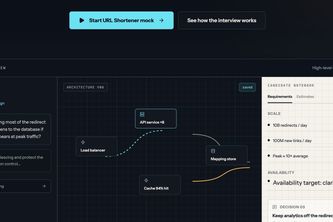
The project described by the author is a self-contained, AI-led mock system design interview platform, built as a single-person project for an OpenAI hackathon. It simulates a full system design interview around a URL-shortening service and generates a structured, evidence-linked rubric report.
What changed
This is a prototype or proof-of-concept submission to a hackathon. The author states it was built using AI tools (ChatGPT for brainstorming, Codex GPT5.6 ultra for development) and deployed with specific tech stack components (Next.js, InsForge, PostgreSQL). It includes features like deterministic simulation, adaptive follow-up questions, and evidence-linked reporting.
The single most important open question
Is this a viable product or service that could be monetized in the market? The description contains no evidence of revenue, customers, traction, or commercial viability beyond its status as a hackathon submission.
What The Product Actually Is
- The description states: “The app guides a candidate through a complete system design interview around a URL-shortening service.”
- It includes functionality such as:
- Clarifying ambiguous prompts and recording requirements.
- Capturing scale estimates and tradeoffs.
- Building a typed, vendor-neutral architecture.
- Running a deterministic workload simulation against the design.
- Introducing failure incidents and late requirement changes.
- Asking adaptive follow-up questions.
- Finalizing an evidence-linked rubric report.
- Replaying transcripts and architecture checkpoints or forking new attempts from checkpoints.
- The system is built using:
- Next.js App Router client
- Zustand for state management
- Web Worker simulator for deterministic evaluation
- InsForge for authentication, persistence, and Edge Functions
- PostgreSQL for data storage
- Not evidenced: No mention of pricing, customer base, or commercial use cases.
Positioning & Claim Evolution
- The description states: “Traditional system design practice often rewards polished diagrams without showing whether a candidate can reason under pressure.”
- It positions itself as a tool that makes reasoning observable, repeatable, and reviewable.
- The author claims the result is more than a transcript — every major claim in the report links back to interview event IDs, architecture versions, and simulation evidence.
- Inferred: This is a product aimed at improving system design interview processes, likely for tech hiring or training purposes. However, no evidence of market positioning beyond this single project exists.
Target Customer & ICP
- The description states: “The app guides a candidate through a complete system design interview.”
- It implies use in technical interviews, particularly for roles requiring system design skills.
- The author does not specify whether the tool targets:
- Hiring managers
- Candidates preparing for interviews
- Training institutions or coaches
- Companies building internal hiring tools
- Not evidenced: No explicit identification of target customer segments or ideal customer profile (ICP).
Business Model & Pricing Evidence
- The description does not state any pricing model, monetization strategy, or business model.
- It mentions a deployed demo and public source code but provides no indication of how the tool would be sold or used commercially.
- Not evidenced: No information on revenue streams, pricing tiers, or commercial licensing.
Technical & Delivery Signals
- The description states:
- Built with Next.js, InsForge, PostgreSQL, React, TypeScript.
- Uses Zustand for state management.
- Deterministic Web Worker simulator evaluates architecture without executing arbitrary code.
- InsForge handles auth, persistence, and Edge Functions.
- Durable Postgres events are authoritative; Realtime is used for acceleration but not required.
- The author notes:
- Used ChatGPT for brainstorming.
- Used Codex GPT5.6 ultra to bootstrap development.
- Repository includes setup instructions, architecture notes, security boundaries, and testing/deployment workflow.
- Inferred: This is a technical prototype built with modern web stack components and AI-assisted tooling. It shows some attention to security (e.g., no private data in browser), but lacks evidence of scalability or production-grade delivery beyond the demo.
Traction & Maturity Signals
- The description states this was submitted to the OpenAI 2026 hackathon.
- No evidence of:
- Revenue
- Customers
- User adoption
- Product-market fit
- Iteration history or versioning beyond this single submission
- Not evidenced: No data on usage, retention, or product maturity.
Competitive Context
- The description does not mention competitors.
- It is unclear whether similar tools exist in the market for mock system design interviews.
- No evidence of competitive positioning, differentiation, or market analysis.
- Not evidenced: No information about existing players or competitive landscape.
Open Questions & Risks
- The project is described as a single-person hackathon submission.
- No evidence of:
- Commercial viability
- Product-market fit
- Scalability or production readiness
- Team structure beyond one person
- Funding, traction, or revenue
- Inferred: High risk due to lack of commercial evidence and limited team size. The tool may be a proof-of-concept with no clear path to monetization.
Questions the description leaves open
- What is the intended use case for this product beyond the hackathon demo?
- Are there any plans to expand beyond URL-shortening service simulations?
- How does the tool differentiate from existing system design interview platforms or tools?
- Has there been any feedback from users or potential customers?
- What are the long-term commercial goals and monetization strategy?
- Is there a plan for scaling beyond a single-person development effort?
Overall Assessment
- The description states this is a hackathon submission with no evidence of traction, revenue, or commercial viability.
- It is not evident whether this project has moved beyond prototype stage or has any clear path to market adoption.
- Inferred: Not suitable for investment or partnership at this stage. This appears to be an early-stage idea or proof-of-concept with no demonstrated product-market fit or business model.
User Stories BotA demo video on every pull request
Get a demo video on every new feature
GitHub App that watches your pull requests and records a narrated, captioned demo.
Save time on demo prep and make informed decisions faster with a video walkthrough of every new feature.
Source
Submitted to the OpenAI 2026 hackathon on Devpost. Project home on Devpost. Back to the full gallery on Devpost.
This competitive analysis was produced by top-founders.com (opens in a new tab)
Generated by a language model from this project's public Devpost page — its tagline, the author's own write-up and any built-with tags listed there — as captured in August 2026. Short quotations are the author's words. It is an opinion on the idea as a business, not on the people behind it, and it reflects the description as published then. If the project has moved on, request a correction below. The analysis is not independent research and contains no verified traction, revenue or customer data.
An independent guide by KFG International LLC — not affiliated with, endorsed by, or connected to Devpost or OpenAI.