

Archive position — measured, not model output
0 likes on Devpost
2,263 of the 7,850 archived projects have more likes, and 5,587 share exactly 0 — so this project's #7,093 place in the like-ranked listing is a tie-break inside that group, not a ranking.
Projects (log scale)
Likes on Devpost. ▲ marks this project's group.
Show the figures
| Likes | Projects | Share of archive |
|---|---|---|
| 0 | 5,587 | 71.2% |
| 1 | 1,758 | 22.4% |
| 2 | 284 | 3.6% |
| 3–4 | 132 | 1.7% |
| 5–9 | 75 | 1.0% |
| 10+ | 14 | 0.2% |
 User Stories BotA demo video on every pull request
Get a demo video on every new feature
GitHub App that watches your pull requests and records a narrated, captioned demo.
Save time on demo prep and make informed decisions faster with a video walkthrough of every new feature.
Executive Summary
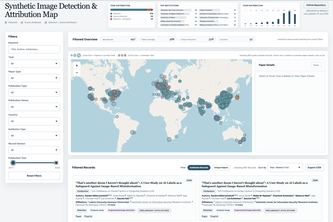
The description states that the project is a research intelligence platform — a map-based visualization of synthetic image forensics literature. The author claims it organizes scholarly papers on AI-generated image detection and attribution into an interactive world map and searchable knowledge interface. It includes metadata curation with human-in-the-loop workflows, provenance tracking, and geographic exploration capabilities.
The project is self-reported as being built by one person (Meiling Li) using tools including OpenAI's Codex, Python, JavaScript, Leaflet.js, and various open scholarly data sources like OpenAlex and OpenStreetMap. It was submitted to the OpenAI 2026 hackathon.
Key commercial due-diligence questions include: Is there a clear path from research mapping to monetization? What is the long-term vision for this platform beyond a hackathon submission? How does it differ from existing academic databases or literature review tools?
The single most important open question
Does this project have any evidence of traction, revenue, or customer adoption beyond its author’s own development and submission to a hackathon?
What The Product Actually Is
- The description states that the product is an “interactive research intelligence map” connecting papers, authors, and institutions in synthetic image detection & attribution.
- It presents a global map and searchable interface for exploring scholarly literature on AI-generated image forensics.
- Users can filter by task, method, dataset, publication year, venue, author, institution, country, etc.
- The system includes paper details, affiliations, publication links, and research classifications.
- It supports tracing metadata provenance instead of relying solely on automatic collection.
- Built with a human-in-the-loop curation workflow to reconcile scholarly metadata.
Inference Based on the description, this is not a commercial product but rather an academic or exploratory tool developed for a hackathon. There is no evidence of any revenue-generating activity or customer base beyond its creator.
Positioning & Claim Evolution
- The author positions the platform as a way to “turn fragmented literature into an interactive and auditable research intelligence platform.”
- It aims to reveal research trends, gaps, and collaboration opportunities in synthetic image forensics.
- The description emphasizes that existing databases are useful for finding individual papers but do not show how the field is structured.
- The author claims it supports both casual exploration and systematic research analysis.
Inference This project appears to be positioned as a tool for academic researchers or policy analysts working within AI-generated image forensics. It does not claim to serve end-users outside of research contexts, nor does it describe any commercial intent beyond its own development.
Target Customer & ICP
- The description does not name specific target customers.
- It implies usage by researchers studying synthetic image detection and attribution.
- The platform is described as useful for identifying active institutions, geographic patterns, emerging topics, and literature gaps.
- The author mentions that the tool supports “systematic research analysis,” suggesting an audience of academic or policy-oriented users.
Inference The ICP likely consists of researchers in AI-generated image forensics, possibly within universities, think tanks, or government agencies. No evidence of a defined customer segment beyond this general category is provided.
Business Model & Pricing Evidence
- There is no mention of pricing, subscriptions, or monetization strategies.
- The project is described as a self-developed tool for a hackathon submission.
- No indication of any revenue streams, licensing models, or paid features.
- The author states that the platform includes “auditable research-data workflow” components but does not describe how these might be monetized.
Inference There is no evidence of a business model or pricing structure. The project appears to be non-commercial in nature and likely developed for demonstration purposes only.
Technical & Delivery Signals
- Built using Python, JavaScript, HTML/CSS, Leaflet.js, Git, GitHub, OpenAI tools (Codex), REST API, JSON, CSV, GeoJSON, Nominatim, OpenAlex, OpenStreetMap.
- Uses automated scholarly metadata collection combined with human-in-the-loop curation.
- Implements canonical identifiers to maintain consistency across filtering and aggregation.
- Includes provenance-aware workflows that separate automatic suggestions from reviewed mappings.
- Supports duplicate-paper reconciliation and geographic coordinate validation.
Inference The technical stack suggests a functional prototype built for research mapping, not production-grade software. It uses open-source tools and APIs, indicating low-cost development and scalability challenges if expanded beyond current scope.
Traction & Maturity Signals
- No evidence of user adoption, customer base, or usage metrics.
- The project was submitted to a hackathon (OpenAI 2026).
- Only one team member is listed: Meiling Li.
- No mention of funding, partnerships, or growth indicators.
- The author describes the work as “not only a visualization but also an auditable research-data workflow,” implying ongoing development.
Inference There is no evidence of traction or maturity beyond the initial prototype. It remains unclear whether this project has moved past the experimental phase or if it will evolve into a more robust tool.
Competitive Context
- The description does not reference competitors.
- No mention of existing platforms for academic literature mapping or research intelligence.
- The author notes that current databases help find individual papers but do not show field structure.
- The platform is described as supporting structured filtering and geographic exploration, which may differentiate it from generic academic search engines.
Inference There is no evidence of competitive analysis or awareness of existing tools in this domain. It is unclear how this tool compares to other literature review systems or research intelligence platforms.
Open Questions & Risks
- The project is self-reported and unverified; there is no third-party validation.
- No evidence of revenue, customers, or monetization strategy.
- The platform appears to be a one-person effort with no indication of team expansion or support.
- It was submitted to a hackathon — suggesting it may not have reached a stable or scalable form.
- The author’s claim that the tool helps “understand what should be studied next” implies potential future commercialization, but no such path is evident.
Inference Risk of misalignment between stated goals and actual utility. Lack of traction or business model raises concerns about viability as a product or investment opportunity.
Questions the description leaves open
- What is the long-term vision for this platform beyond its current hackathon prototype?
- Are there any plans to monetize or commercialize this tool?
- How does this project differ from existing academic literature databases or research intelligence platforms?
- Has the author considered how to scale the human-in-the-loop curation process?
- What are the main challenges in maintaining and updating the dataset over time?
- Is there any interest from institutions, researchers, or organizations in using or funding this platform?
Overall Assessment
- The description states that the project is a self-developed tool for a hackathon submission.
- No evidence of revenue, customers, or traction beyond its author’s own development.
- There is no indication of any business model, pricing strategy, or monetization plan.
- The platform appears to be an academic or exploratory tool with limited commercial potential at this stage.
Assessment Not evidenced as a viable investment or partnership opportunity. The project lacks key signals of commercial readiness, including revenue, customer adoption, or clear monetization paths. It remains in early-stage development and requires further evidence of traction or strategic direction before any due-diligence assessment can be made.
User Stories BotA demo video on every pull request
Get a demo video on every new feature
GitHub App that watches your pull requests and records a narrated, captioned demo.
Save time on demo prep and make informed decisions faster with a video walkthrough of every new feature.
Source
Submitted to the OpenAI 2026 hackathon on Devpost. Project home on Devpost. Back to the full gallery on Devpost.
This competitive analysis was produced by top-founders.com (opens in a new tab)
Generated by a language model from this project's public Devpost page — its tagline, the author's own write-up and any built-with tags listed there — as captured in August 2026. Short quotations are the author's words. It is an opinion on the idea as a business, not on the people behind it, and it reflects the description as published then. If the project has moved on, request a correction below. The analysis is not independent research and contains no verified traction, revenue or customer data.
An independent guide by KFG International LLC — not affiliated with, endorsed by, or connected to Devpost or OpenAI.