

Archive position — measured, not model output
0 likes on Devpost
2,263 of the 7,850 archived projects have more likes, and 5,587 share exactly 0 — so this project's #7,034 place in the like-ranked listing is a tie-break inside that group, not a ranking.
Projects (log scale)
Likes on Devpost. ▲ marks this project's group.
Show the figures
| Likes | Projects | Share of archive |
|---|---|---|
| 0 | 5,587 | 71.2% |
| 1 | 1,758 | 22.4% |
| 2 | 284 | 3.6% |
| 3–4 | 132 | 1.7% |
| 5–9 | 75 | 1.0% |
| 10+ | 14 | 0.2% |
 User Stories BotA demo video on every pull request
Get a demo video on every new feature
GitHub App that watches your pull requests and records a narrated, captioned demo.
Save time on demo prep and make informed decisions faster with a video walkthrough of every new feature.
Executive Summary
What the company appears to be
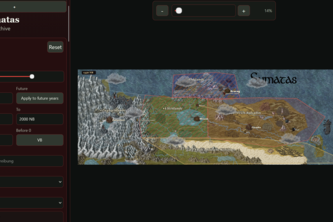
Sumatas Worldbuilding Platform is an offline worldbuilding engine designed for Dungeon Masters (DMs) and worldbuilders. The author states it combines interactive maps, timelines, knowledge graphs, linking systems, factions, characters, routes, and history into a single interconnected application. It is built with HTML5, CSS3, JavaScript, JSON, and SVG, using modular architecture to manage complexity.
What changed
The project evolved from a simple map for a DnD campaign into a modularized system that supports complex worldbuilding features like automatic citations, graph-based linking, timeline management, and performance optimization. The author reports using ChatGPT 5.6 and Codex extensively during development, including for code generation, debugging, and modularization.
The single most important open question
Is there any evidence of external adoption or usage beyond the founder's personal campaign? The description contains no data on users, customers, revenue, or market traction — only self-reported claims about functionality and future plans.
What The Product Actually Is
- The description states that Sumatas is an "offline worldbuilding engine."
- It includes an interactive map with customizable layers, filters, and support for custom pictures.
- Features a linking system with automatic citations and graph visualization of relationships.
- Includes a timeline for organizing events chronologically.
- Data is stored in structured JSON files.
- Built using HTML5, CSS3, JavaScript, JSON, SVG.
- Modular architecture implemented to improve performance and scalability.
Note: The author describes the product as being built with ChatGPT 5.6 and Codex, but there is no evidence of any third-party integration or tooling beyond this self-reporting narrative.
Positioning & Claim Evolution
- The author positions Sumatas as a tool for DMs and worldbuilders to organize complex fantasy worlds in one place.
- It is described as an alternative to using multiple tools (e.g., separate apps for maps, notes, timelines).
- The platform emphasizes interconnection between entities such as characters, factions, events, and locations.
- The author claims to have implemented features like automatic citations and graph views based on Obsidian-style linking.
Inference: The positioning appears to be focused on niche use cases within tabletop gaming communities. No indication of broader commercial intent or target beyond personal or small-group usage.
Target Customer & ICP
- The description states that Sumatas is intended for Dungeon Masters and worldbuilders.
- It is built with offline usability in mind, suggesting a preference for local deployment over cloud-based solutions.
- The author notes it was initially developed to support his own DnD campaign.
Not evidenced: No information on customer segments beyond the founder's personal use case. No evidence of user personas, market size, or competitive positioning against other tools used by DMs or worldbuilders.
Business Model & Pricing Evidence
- The description does not mention any pricing model or monetization strategy.
- There is no indication that Sumatas is sold, licensed, or offered as a service.
- The application is described as offline and built with HTML5/CSS3/JS — implying no subscription or SaaS model.
Not evidenced: No evidence of revenue streams, pricing tiers, or business model details beyond the author’s own development effort.
Technical & Delivery Signals
- Built using HTML5, CSS3, JavaScript, JSON, SVG.
- Modular architecture implemented to reduce monolithic code from ~10,000 lines to ~2,830 lines.
- Uses Codex and ChatGPT 5.6 for development, including code generation, debugging, and optimization.
- Performance improvements achieved via targeted updates, requestAnimationFrame, and DOM reduction.
- Supports JSON-based data storage and sharing.
- Includes features like animated weather systems, sprite creation, dice simulation, and map controls.
Inference: The modularization effort suggests technical maturity in managing complexity. However, the lack of independent verification or testing data limits confidence in scalability or robustness.
Traction & Maturity Signals
- The author reports building the system over two weeks using AI tools.
- The project started as a monolith and evolved into a modularized structure.
- Includes features like automatic citations, graph views, timeline management, and performance optimizations.
- No evidence of external adoption or user feedback.
- No mention of public release, downloads, or usage metrics.
Not evidenced: No data on users, customer base, or product traction beyond the founder's internal use.
Competitive Context
- The description does not reference competitors directly.
- It implies a need for integrated worldbuilding tools that combine maps, timelines, and knowledge graphs.
- Features like linking systems and graph visualization are similar to those found in Obsidian or Notion.
- The author mentions using Codex and ChatGPT 5.6, which may imply alignment with AI-assisted productivity trends.
Inference: While the product addresses a known gap in worldbuilding tools, there is no evidence of competitive analysis or differentiation from existing solutions.
Open Questions & Risks
- The entire project was built by one person (Alexander Buschner).
- No external validation, user testing, or third-party feedback.
- Reliance on AI tools like ChatGPT 5.6 and Codex raises concerns about reproducibility and quality control.
- Performance issues were encountered during monolithic development, which may indicate scalability challenges.
- The project is described as still in early stages with incomplete modularization and UI design.
Inference: The risk of limited long-term viability or scalability is high due to lack of team structure, external validation, and product maturity.
Questions the description leaves open
- What specific problems are you solving for your users that existing tools don’t?
- Have you tested Sumatas with other DMs or worldbuilders outside of your own campaign?
- How do you plan to scale beyond a single-user, offline tool?
- Are there any plans to monetize the platform or offer it as a service?
- What are the key technical limitations that remain unresolved?
- How does Sumatas compare to other tools currently used by DMs and worldbuilders?
Overall Assessment
- Not evidenced: No evidence of revenue, customers, traction, or market validation.
- The project is described as a personal tool developed over two weeks with AI assistance.
- There is no indication of commercial intent, product-market fit, or scalable business model.
- The author’s claims about functionality and future features are self-reported without corroboration.
Assessment: Based on the provided information, Sumatas does not demonstrate sufficient commercial traction or evidence of a viable market opportunity to warrant investment or partnership consideration. It remains a personal development effort with no demonstrated external adoption or monetization strategy.
User Stories BotA demo video on every pull request
Get a demo video on every new feature
GitHub App that watches your pull requests and records a narrated, captioned demo.
Save time on demo prep and make informed decisions faster with a video walkthrough of every new feature.
Source
Submitted to the OpenAI 2026 hackathon on Devpost. Project home on Devpost. Back to the full gallery on Devpost.
This competitive analysis was produced by top-founders.com (opens in a new tab)
Generated by a language model from this project's public Devpost page — its tagline, the author's own write-up and any built-with tags listed there — as captured in August 2026. Short quotations are the author's words. It is an opinion on the idea as a business, not on the people behind it, and it reflects the description as published then. If the project has moved on, request a correction below. The analysis is not independent research and contains no verified traction, revenue or customer data.
An independent guide by KFG International LLC — not affiliated with, endorsed by, or connected to Devpost or OpenAI.