

Archive position — measured, not model output
0 likes on Devpost
2,263 of the 7,850 archived projects have more likes, and 5,587 share exactly 0 — so this project's #7,014 place in the like-ranked listing is a tie-break inside that group, not a ranking.
Projects (log scale)
Likes on Devpost. ▲ marks this project's group.
Show the figures
| Likes | Projects | Share of archive |
|---|---|---|
| 0 | 5,587 | 71.2% |
| 1 | 1,758 | 22.4% |
| 2 | 284 | 3.6% |
| 3–4 | 132 | 1.7% |
| 5–9 | 75 | 1.0% |
| 10+ | 14 | 0.2% |
 User Stories BotA demo video on every pull request
Get a demo video on every new feature
GitHub App that watches your pull requests and records a narrated, captioned demo.
Save time on demo prep and make informed decisions faster with a video walkthrough of every new feature.
Executive Summary
What the company appears to be
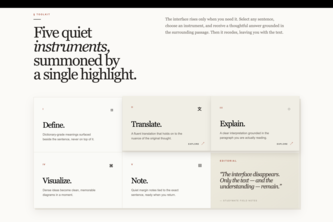
StudyMate is a self-reported PDF-first AI reading companion built for educational use. The author describes it as a tool that allows users to upload PDFs and interact with them through contextual AI-powered study tools (define, translate, visualize, note) while preserving the original document layout.
What changed
This is a hackathon submission describing an early-stage prototype. No commercial traction or revenue evidence exists beyond the project description itself.
Single most important open question
Is there any evidence of user adoption or product-market fit beyond the author’s own account?
Analysis basis
The entire report is based on the self-reported, unverified description provided by the author. No external data, funding rounds, revenue figures, customer names, or traction metrics are available.
What The Product Actually Is
The description states that StudyMate is a "private, PDF-first AI reading companion." It allows users to upload a PDF and read it in a focused environment where the original layout is preserved. When text is selected, contextual tools appear including:
- Define
- Translate
- Visualize (creates mind maps)
- Note
It also supports markup features like highlight, underline, and strikethrough.
The system uses:
- Next.js, React, TypeScript
- PDF.js for rendering
- Supabase for storage and embeddings
- pgvector for vector search
- Gemini and Headroom AI for AI processing
- Retrieval-Augmented Generation (RAG) pipeline
Inference The product is described as a document-centric AI assistant that integrates with PDFs, not a general-purpose AI tool or marketplace.
Positioning & Claim Evolution
The author positions StudyMate as an alternative to fragmented workflows involving multiple apps for reading and studying. It claims to offer a "calmer reading experience" by keeping the original PDF visible while offering tools only when needed.
It references design influences from:
- Apple’s clean document-reading experience
- Notion’s minimalist philosophy
- Modern AI research tools
The project is framed as solving a specific pain point: “understanding a difficult PDF often requires constantly switching between a reader, dictionary, translator, notes app, and diagram tool.”
Claim
The product aims to reduce cognitive load during reading by integrating study tools into the document itself.
Inference The positioning reflects an educational focus on improving comprehension through AI-assisted annotation and visualization.
Target Customer & ICP
The description does not name specific customer segments or personas. However, it implies a target audience of learners who engage with academic or technical PDFs and require support in understanding complex material.
It mentions:
- Users who study difficult documents
- Learners needing translation or definition tools
- People creating mind maps from text
Inference The ICP likely includes students, researchers, professionals reading dense documentation, or anyone using PDFs for learning purposes.
Business Model & Pricing Evidence
There is no evidence of pricing structure, monetization strategy, or business model in the description. The project is described as a hackathon submission and not yet launched commercially.
Claim
StudyMate is presented as a private tool with no public pricing information.
Inference No commercial viability or revenue model is evident beyond the author’s own account.
Technical & Delivery Signals
The technical stack includes:
- Frontend: Next.js, React, TypeScript
- PDF rendering: PDF.js
- Backend: Supabase (storage, vector DB), pgvector
- AI models: Gemini, Headroom AI
- RAG pipeline: Page-by-page text extraction, chunking, embedding, retrieval
Key features mentioned:
- Native PDF rendering with selectable text layer
- Context-aware AI responses via RAG
- Mind-map generation engine
- Private document handling
- Study markers attached to source text
Inference The product shows technical maturity for a prototype but lacks evidence of production-grade scalability or performance.
Traction & Maturity Signals
The description states that this is a "working milestone" from a hackathon submission. There is no mention of:
- Users
- Customers
- Revenue
- Product usage metrics
- Market traction
Claim
The project is in early development, not yet commercially deployed.
Inference No signs of product-market fit or user engagement beyond the author’s own use case.
Competitive Context
The description does not reference competitors directly. However, it implies a space that includes:
- PDF readers with annotation features
- AI-powered study tools (e.g., Notion AI, Obsidian)
- Educational platforms and tools for reading comprehension
- Mind-mapping software
Inference The product competes in the intersection of document reading, AI assistance, and educational technology.
Open Questions & Risks
- No commercial traction or revenue evidence: The project is described as a hackathon submission with no indication of market adoption.
- Single founder team: Only one member listed (Jagarnath), which may limit execution capacity.
- Unproven AI grounding: While RAG is mentioned, there’s no evidence of how well it performs in practice or whether the AI responses are reliable.
- Limited scope for production deployment: Challenges like upload failures, indexing delays, and UI issues suggest early-stage instability.
- No clear monetization path: No pricing, business model, or go-to-market strategy is evident.
Questions the description leaves open
- What specific user problems are you solving beyond the author’s own experience?
- Have you tested this with real users? If so, what feedback did you get?
- How do you plan to scale beyond a single-user, private environment?
- Are there any plans for monetization or commercial partnerships?
- What is your roadmap for addressing known technical issues (e.g., long indexing times, stale AI results)?
- Do you have any data on how often users engage with the AI tools versus reading alone?
Overall Assessment
Not evidenced
There is no evidence of:
- Revenue
- Customers
- Product-market fit
- Traction or growth metrics
- Commercial viability
The project is described as a hackathon prototype, not a commercial product. It lacks any indication that it has moved beyond the idea stage.
Confidence level Low — based entirely on self-reported claims and no external validation.
Final note
This analysis reflects only what was stated in the author’s own description. No third-party verification or historical data is available.
User Stories BotA demo video on every pull request
Get a demo video on every new feature
GitHub App that watches your pull requests and records a narrated, captioned demo.
Save time on demo prep and make informed decisions faster with a video walkthrough of every new feature.
Source
Submitted to the OpenAI 2026 hackathon on Devpost. Project home on Devpost. Back to the full gallery on Devpost.
This competitive analysis was produced by top-founders.com (opens in a new tab)
Generated by a language model from this project's public Devpost page — its tagline, the author's own write-up and any built-with tags listed there — as captured in August 2026. Short quotations are the author's words. It is an opinion on the idea as a business, not on the people behind it, and it reflects the description as published then. If the project has moved on, request a correction below. The analysis is not independent research and contains no verified traction, revenue or customer data.
An independent guide by KFG International LLC — not affiliated with, endorsed by, or connected to Devpost or OpenAI.