

Archive position — measured, not model output
0 likes on Devpost
2,263 of the 7,850 archived projects have more likes, and 5,587 share exactly 0 — so this project's #7,010 place in the like-ranked listing is a tie-break inside that group, not a ranking.
Projects (log scale)
Likes on Devpost. ▲ marks this project's group.
Show the figures
| Likes | Projects | Share of archive |
|---|---|---|
| 0 | 5,587 | 71.2% |
| 1 | 1,758 | 22.4% |
| 2 | 284 | 3.6% |
| 3–4 | 132 | 1.7% |
| 5–9 | 75 | 1.0% |
| 10+ | 14 | 0.2% |
 User Stories BotA demo video on every pull request
Get a demo video on every new feature
GitHub App that watches your pull requests and records a narrated, captioned demo.
Save time on demo prep and make informed decisions faster with a video walkthrough of every new feature.
Executive Summary
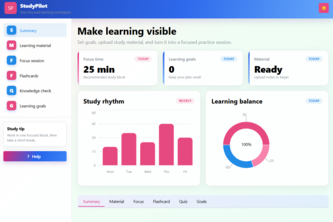
Study Pilot is a self-reported local-first study application designed to help students convert passive reading into active learning by offering tools such as summaries, flashcards, quizzes, goal-setting, and Pomodoro timers — all without requiring an internet connection or external APIs. The author states that it was built for the OpenAI 2026 hackathon using Python, Dash, and local text processing.
The single most important open question is: What level of user engagement or adoption exists beyond the initial prototype?
This analysis is based entirely on self-reported information from the project description provided by the caller. No independent verification, traction data, revenue figures, customer names, or performance metrics are available.
What The Product Actually Is
The description states that Study Pilot:
- Accepts PDF, DOCX, and TXT study materials
- Extracts and previews content locally
- Provides short summaries of uploaded material
- Allows users to ask questions about the material using local text matching
- Generates flashcards and quizzes from the content
- Enables setting learning goals
- Includes a 25-minute Pomodoro timer
- Visualizes study habits
- Supports light and dark mode
The dashboard is built with Python, Dash, and Dash Mantine Components. All processing occurs locally on the user's device.
Positioning & Claim Evolution
The author claims that Study Pilot:
- Combines multiple study tools into one workspace
- Helps students stay focused during studying
- Turns passive reading into active learning
- Works without an API or internet connection
- Is privacy-friendly
- Supports a clean, responsive dashboard experience
These claims suggest an evolution from generic productivity tools toward a specialized, local-first learning environment. The positioning emphasizes simplicity, focus, and offline functionality.
Target Customer & ICP
The description states that Study Pilot is intended for students who:
- Often switch between notes, timers, flashcards, and to-do lists
- Want to avoid depending on external APIs or internet connections
- Prefer privacy-friendly tools
- Seek a single workspace for studying
No specific demographic or institutional targeting is mentioned. The ICP appears to be individual students using local devices for personal study.
Business Model & Pricing Evidence
Not evidenced. The description does not contain any information about pricing, monetization strategy, or business model.
Technical & Delivery Signals
The author states that Study Pilot:
- Was built with Python, Dash, and Dash Mantine Components
- Processes documents locally
- Uses local text matching to answer questions based on uploaded material
- Supports multiple document formats (PDF, DOCX, TXT)
- Has a responsive dashboard UI
- Visualizes study habits
The technical stack suggests a lightweight, local-first approach with no reliance on cloud services or third-party integrations.
Traction & Maturity Signals
Not evidenced. There is no mention of users, downloads, usage metrics, or product maturity beyond the initial prototype phase.
Competitive Context
Not evidenced. No information is provided about competitors, market positioning, or competitive advantages in the marketplace.
Open Questions & Risks
- The project is described as a hackathon submission with only one team member (Esther S.), suggesting early-stage development.
- No evidence of user adoption or product-market fit beyond prototype functionality.
- The lack of revenue, customers, or traction data raises questions about commercial viability.
- The claim that the app works without internet or APIs may be technically challenging to scale or maintain consistently.
- Limited team size implies potential scalability issues in execution and growth.
Questions the description leaves open
- What is the current stage of development beyond the hackathon prototype?
- Have you conducted any user testing or gathered feedback from students?
- Are there plans for monetization or a go-to-market strategy?
- How do you plan to handle scalability and performance across different document types and sizes?
- What are your long-term goals for Study Pilot, including feature expansion or platform support?
Overall Assessment
Not evidenced. No information is available regarding valuation, funding history, or strategic fit for investment or partnership opportunities. The project remains at a very early stage, with no demonstrated traction or commercial viability beyond its initial concept and prototype.
User Stories BotA demo video on every pull request
Get a demo video on every new feature
GitHub App that watches your pull requests and records a narrated, captioned demo.
Save time on demo prep and make informed decisions faster with a video walkthrough of every new feature.
Source
Submitted to the OpenAI 2026 hackathon on Devpost. Project home on Devpost. Back to the full gallery on Devpost.
This competitive analysis was produced by top-founders.com (opens in a new tab)
Generated by a language model from this project's public Devpost page — its tagline, the author's own write-up and any built-with tags listed there — as captured in August 2026. Short quotations are the author's words. It is an opinion on the idea as a business, not on the people behind it, and it reflects the description as published then. If the project has moved on, request a correction below. The analysis is not independent research and contains no verified traction, revenue or customer data.
An independent guide by KFG International LLC — not affiliated with, endorsed by, or connected to Devpost or OpenAI.