

Archive position — measured, not model output
0 likes on Devpost
2,263 of the 7,850 archived projects have more likes, and 5,587 share exactly 0 — so this project's #6,999 place in the like-ranked listing is a tie-break inside that group, not a ranking.
Projects (log scale)
Likes on Devpost. ▲ marks this project's group.
Show the figures
| Likes | Projects | Share of archive |
|---|---|---|
| 0 | 5,587 | 71.2% |
| 1 | 1,758 | 22.4% |
| 2 | 284 | 3.6% |
| 3–4 | 132 | 1.7% |
| 5–9 | 75 | 1.0% |
| 10+ | 14 | 0.2% |
 User Stories BotA demo video on every pull request
Get a demo video on every new feature
GitHub App that watches your pull requests and records a narrated, captioned demo.
Save time on demo prep and make informed decisions faster with a video walkthrough of every new feature.
Executive Summary
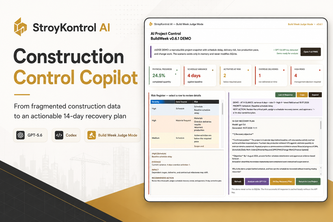
What the company appears to be: StroyKontrol AI is a self-described construction control copilot that integrates AI into project management information systems (PMIS) to analyze fragmented construction data and generate traceable risks, management recommendations, and 14-day recovery plans. It operates as a local application with optional AI integration via GPT-5.6.
What changed: The project was extended during the OpenAI Build Week hackathon, focusing on developing an AI Project Control module. This included refining risk detection logic, structuring data for AI input, implementing read-only AI access, and creating a reproducible judge mode with demo scenarios.
Single most important open question: Does StroyKontrol AI demonstrate any measurable traction or adoption beyond its developer's prototype, and can it scale from a local Windows app to a platform serving multiple construction managers?
What The Product Actually Is
The description states that StroyKontrol AI is a construction control copilot integrated into a project-management information system. It combines signals from:
- Baseline construction schedule
- Construction work plan
- Daily work orders and actual production
- Material requests and deliveries
- Change work and quantity overruns
- Financial progress
- Contract and project-control data
It uses a local rules engine to detect issues without internet connectivity, then passes structured data to GPT-5.6 for management analysis and recovery planning.
The system is described as:
- A modular C# application using Windows Forms and SQLite
- Read-only AI integration (no direct modification of project data)
- Capable of generating Markdown exports
- Operates in a local environment with optional API connectivity
Not evidenced: The actual product functionality beyond the prototype, whether it has been tested or used by others, or if there are any existing users.
Positioning & Claim Evolution
The author positions StroyKontrol AI as an AI construction control copilot that turns fragmented project data into:
- Traceable risks
- Management recommendations
- 14-day recovery plans
It claims to address three critical questions faced by construction managers:
- What evidence confirms the problem?
- What information is missing or contradictory?
- What actions should be taken today to prevent further delay?
The positioning evolved from a broader construction PMIS prototype into a dedicated AI Project Control module, developed during OpenAI Build Week.
Not evidenced: The evolution of this positioning in the market, any customer feedback, or how it compares to existing tools in the construction control space.
Target Customer & ICP
The description states that StroyKontrol AI targets construction managers who face challenges with fragmented project data and need actionable insights. It is designed for use within project-management information systems, suggesting a B2B SaaS or software-as-a-service model.
It also mentions:
- A focus on local risk detection
- Integration into existing construction PMIS
- Use of read-only AI access to maintain control
Not evidenced: Specific customer segments, size of target market, or whether there are any actual customers or pilot users.
Business Model & Pricing Evidence
The description does not provide any information about:
- Revenue streams
- Pricing models
- Customer acquisition strategies
- Monetization plans
It only describes the technical architecture and AI integration, but no business model is stated.
Not evidenced: Any commercial or financial details beyond the prototype development.
Technical & Delivery Signals
The system is built using:
- C# and Windows Forms
- SQLite database
- OpenAI API (GPT-5.6)
- Codex for code review and automation
- Modular application architecture
- Read-only access to project data
- Markdown export capability
- Cached-response fallback mechanisms
It includes features like:
- Local risk detection without internet
- Structured read-only project snapshot
- Incomplete-response detection and retry logic
- Safe, reproducible judge mode with demo scenarios
- Responsive UI for risk register and analysis
Not evidenced: Deployment infrastructure, scalability, or integration capabilities beyond local Windows app.
Traction & Maturity Signals
The description states that the project was submitted to the OpenAI 2026 hackathon, and that it was extended during Build Week. It includes:
- A reproducible judge mode with demo scenarios
- A portable Windows build for judges
- Separated Git history and documentation for Build Week work
However, there is no evidence of:
- Revenue or monetization
- Customer adoption or usage
- Product-market fit validation
- Any traction beyond the prototype phase
Not evidenced: Any real-world deployment, user feedback, or market validation.
Competitive Context
The description does not mention any direct competitors. It focuses on describing the product's functionality and architecture rather than situating it within a competitive landscape.
Not evidenced: Competitor analysis, market positioning, or differentiation from existing construction control tools.
Open Questions & Risks
- No commercial traction: The project is described as a prototype with no evidence of revenue, customers, or adoption.
- Limited scope: It is currently a local Windows application, not scalable to web or mobile platforms.
- AI dependency: While it uses GPT-5.6 for analysis, the system's core functionality relies on local logic and structured data inputs — which may limit its utility if data quality is poor.
- Single developer: The team size is listed as 1, raising concerns about scalability and long-term maintenance.
- Unverified claims: All descriptions are self-reported and unverified; no third-party validation or evidence of performance.
Not evidenced: Any risk assessments, market analysis, or competitive intelligence beyond the author's own claims.
Questions the description leaves open
- What specific construction projects or PMIS systems is this product intended to integrate with?
- Has there been any testing or feedback from actual construction managers or project teams?
- How does the system handle data inconsistencies or incomplete records in real-world settings?
- Are there plans for cloud-based deployment, and how will data security be ensured?
- What are the technical limitations of the current local-only approach, and how will they be addressed?
- Is there any plan to monetize this product beyond its prototype stage?
- How does the system distinguish between confirmed facts and assumptions when generating outputs?
Overall Assessment
The description presents StroyKontrol AI as a self-described prototype of an AI-powered construction control tool. It is built with clear technical architecture, but lacks any evidence of commercial traction or market validation.
Key considerations:
- The product shows potential for solving a real problem in construction project management.
- It demonstrates thoughtful design around data integrity and AI safety (read-only access).
- However, it remains unproven in terms of adoption, scalability, or revenue generation.
- The single developer and prototype nature raise questions about execution capability.
Assessment: Not evidenced as a viable investment or partnership opportunity at this stage. Further due diligence would require evidence of early traction, customer feedback, or product-market fit beyond the prototype phase.
User Stories BotA demo video on every pull request
Get a demo video on every new feature
GitHub App that watches your pull requests and records a narrated, captioned demo.
Save time on demo prep and make informed decisions faster with a video walkthrough of every new feature.
Source
Submitted to the OpenAI 2026 hackathon on Devpost. Project home on Devpost. Back to the full gallery on Devpost.
This competitive analysis was produced by top-founders.com (opens in a new tab)
Generated by a language model from this project's public Devpost page — its tagline, the author's own write-up and any built-with tags listed there — as captured in August 2026. Short quotations are the author's words. It is an opinion on the idea as a business, not on the people behind it, and it reflects the description as published then. If the project has moved on, request a correction below. The analysis is not independent research and contains no verified traction, revenue or customer data.
An independent guide by KFG International LLC — not affiliated with, endorsed by, or connected to Devpost or OpenAI.