

Archive position — measured, not model output
0 likes on Devpost
2,263 of the 7,850 archived projects have more likes, and 5,587 share exactly 0 — so this project's #6,969 place in the like-ranked listing is a tie-break inside that group, not a ranking.
Projects (log scale)
Likes on Devpost. ▲ marks this project's group.
Show the figures
| Likes | Projects | Share of archive |
|---|---|---|
| 0 | 5,587 | 71.2% |
| 1 | 1,758 | 22.4% |
| 2 | 284 | 3.6% |
| 3–4 | 132 | 1.7% |
| 5–9 | 75 | 1.0% |
| 10+ | 14 | 0.2% |
 User Stories BotA demo video on every pull request
Get a demo video on every new feature
GitHub App that watches your pull requests and records a narrated, captioned demo.
Save time on demo prep and make informed decisions faster with a video walkthrough of every new feature.
Executive Summary
What the company appears to be
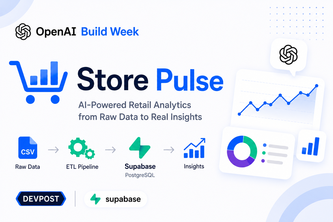
Store Pulse is a self-reported end-to-end retail analytics platform built for Walmart sales data. The description states it ingests multiple data sources, automates ETL processes, and delivers an interactive dashboard with AI-powered insights using Codex and GPT-5.6.
What changed
The project was submitted as part of the OpenAI 2026 hackathon. It is described as a complete system rather than a prototype, with features like automated ETL, schema validation, database integration, and an AI layer for natural-language queries.
Single most important open question — the commercial due-diligence read
Is there evidence of real-world traction or customer demand beyond this hackathon submission? The description does not indicate any revenue, customers, or adoption outside of the project’s own development lifecycle.
What The Product Actually Is
The description states that Store Pulse is an end-to-end retail analytics platform. It ingests three independent data sources:
- Weekly sales by store and department
- Store metadata
- External economic indicators (fuel price, CPI, unemployment, holidays)
It builds an automated ETL pipeline to extract, validate, transform, and load the data into a live PostgreSQL database hosted via Supabase.
The platform provides a 5-tab interactive dashboard built with Streamlit. It also includes a GPT-5.6-powered natural language analytics feature ("Ask Store Pulse") that generates executive summaries and answers follow-up questions.
The system uses Codex (GPT-5.6) as the primary development environment, and the AI layer never receives raw transactional data — instead, it works on precomputed business aggregates to reduce token usage and improve privacy.
A deterministic Demo Mode is implemented so that the application can run without an OpenAI API key.
Evidence
- The author states: “Store Pulse is an end-to-end retail analytics platform that transforms raw Walmart sales data into actionable business insights.”
- The author describes a multi-source ingestion pipeline, ETL process, database schema, dashboard tabs, and AI integration.
- The author says the system uses Codex (GPT-5.6), PostgreSQL, Supabase, Streamlit, and Python-based tools like pandas, numpy, SQLAlchemy.
Inference This is a self-contained analytics tool built for internal use or demonstration purposes, not a commercial product with external customers.
Positioning & Claim Evolution
The author positions Store Pulse as solving the challenge of messy retail data by combining reliable data engineering with AI-assisted decision support. The stated goal was to build a complete analytics workflow from raw data to insights.
It claims to offer:
- A clean, live analytics dashboard
- AI-powered natural language queries
- End-to-end automation from ETL to insights
- Scalable and privacy-preserving design
The project evolved from an idea to a full system that includes ETL pipelines, validation frameworks, dashboards, and AI integration.
Evidence
- The author states: “Retail organizations rarely receive perfectly structured data... we focused on solving the complete analytics workflow.”
- The author describes how they built a full pipeline including ETL, database, dashboard, and AI insights.
- The author says: “Our goal was to combine reliable data engineering with AI-assisted decision support so that every insight is grounded in validated business data.”
Inference The positioning reflects a focus on solving a real-world problem (messy retail data) through technical execution, but no evidence suggests this has been scaled or monetized beyond the hackathon.
Target Customer & ICP
Not evidenced. The description does not identify specific target customers or personas. It only mentions Walmart sales data as input and implies internal use or demonstration scenarios.
Evidence
- No mention of who uses or would use Store Pulse beyond its own developers or demo context.
- The system is described as working with Walmart data, but no indication of Walmart’s involvement or interest in the product.
Inference If this were a commercial product, it might target retail analytics teams or internal business intelligence users at large retailers — but there is no evidence of such targeting.
Business Model & Pricing Evidence
Not evidenced. There is no mention of pricing, monetization strategy, or business model in the description.
Evidence
- No statement about how Store Pulse would be sold, licensed, or offered to customers.
- No indication of revenue streams, subscriptions, or usage-based models.
Inference The project appears to be a prototype or proof-of-concept, not a commercial offering with a defined business model.
Technical & Delivery Signals
The system uses:
- Codex (GPT-5.6) as the development environment
- Python-based ETL pipeline using pandas, numpy, SQLAlchemy
- PostgreSQL database hosted via Supabase
- Streamlit for dashboard UI
- GitHub for version control and collaboration
- Natural language processing with GPT-5.6
Key technical features include:
- Automated ETL pipeline
- Schema-driven validation with row-level error reporting
- Incremental database loading with cell-level change tracking
- AI integration that works on aggregated data to reduce cost and improve privacy
- Demo Mode for offline operation without API keys
Evidence
- The author lists technologies used: Codex, GPT-5.6, Python, pandas, numpy, SQLAlchemy, PostgreSQL, Supabase, Streamlit, GitHub
- The author describes ETL pipeline components, validation logic, and AI integration details
Inference The system shows strong engineering execution for a hackathon-level project, but lacks evidence of production-grade scalability or deployment in real-world environments.
Traction & Maturity Signals
Not evidenced. There is no mention of customers, users, revenue, or adoption beyond the development team and demo mode.
Evidence
- No indication of any real-world usage or customer base
- No mention of product performance metrics, user feedback, or market traction
Inference This remains a prototype or internal tool, not a mature commercial offering.
Competitive Context
Not evidenced. The description does not reference existing competitors or similar platforms in the retail analytics space.
Evidence
- No mention of competitive products or market positioning relative to others
Inference Without context about the broader marketplace, it is unclear whether Store Pulse addresses a gap or overlaps with existing tools.
Open Questions & Risks
- Unproven commercial viability: The system is described as a hackathon project with no evidence of traction or monetization.
- AI dependency without clear fallbacks: While the AI layer uses aggregated data, it still depends on GPT-5.6 and OpenAI APIs — risks if those change or become unavailable.
- Limited scalability assumptions: The system is built for demonstration purposes; no evidence of production-grade scaling or performance optimization.
- No customer feedback loop: No indication that the tool was tested with real users or validated in a business setting.
Evidence
- The project is described as a hackathon submission, not a commercial product
- No mention of real-world testing or user validation
Inference The risk of misalignment between developer assumptions and actual market needs is high.
Questions the description leaves open
- What is the intended business model for Store Pulse? Is there any plan to monetize it?
- Has the system been tested with real users or internal stakeholders beyond the development team?
- How does the team plan to scale beyond the current demo mode and prototype architecture?
- Are there any plans to integrate additional data sources or expand functionality beyond Walmart sales data?
- What are the risks associated with relying on GPT-5.6 and OpenAI APIs for core functionality?
Overall Assessment
Not evidenced. There is no indication of funding, investor interest, or partnership discussions.
Evidence
- No mention of funding rounds, investors, or strategic partners
- No indication of commercial traction or market validation
Inference This project appears to be a technical demonstration rather than an investment-ready venture. It lacks the evidence required to assess its potential for growth or partnership opportunities.
User Stories BotA demo video on every pull request
Get a demo video on every new feature
GitHub App that watches your pull requests and records a narrated, captioned demo.
Save time on demo prep and make informed decisions faster with a video walkthrough of every new feature.
Source
Submitted to the OpenAI 2026 hackathon on Devpost. Project home on Devpost. Back to the full gallery on Devpost.
This competitive analysis was produced by top-founders.com (opens in a new tab)
Generated by a language model from this project's public Devpost page — its tagline, the author's own write-up and any built-with tags listed there — as captured in August 2026. Short quotations are the author's words. It is an opinion on the idea as a business, not on the people behind it, and it reflects the description as published then. If the project has moved on, request a correction below. The analysis is not independent research and contains no verified traction, revenue or customer data.
An independent guide by KFG International LLC — not affiliated with, endorsed by, or connected to Devpost or OpenAI.